270 Days at Sea, No Port, No Soap
The USS Abraham Lincoln's marathon deployment exposed how the Navy's logistics and mental-health systems crack under sustained combat pressure.
By The Defense Desk
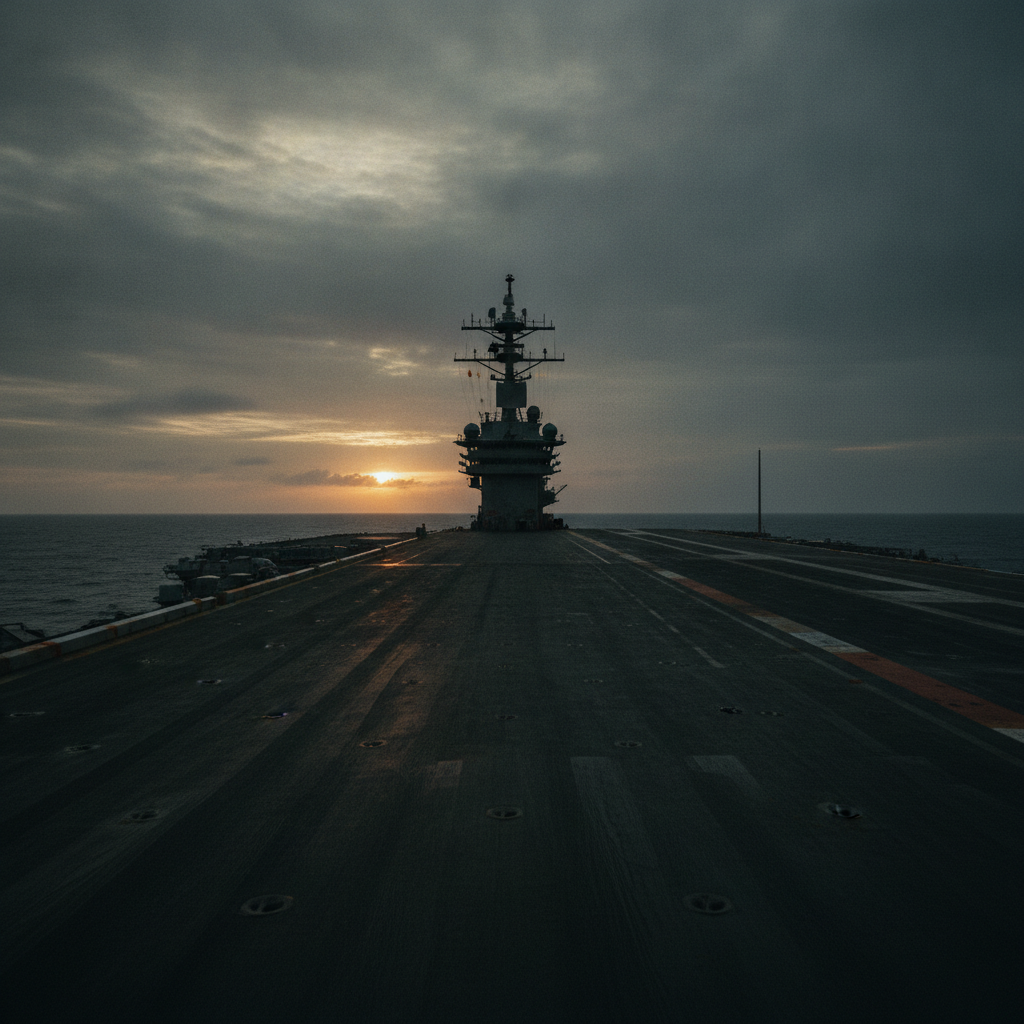
No shore leave, no restocking of basic supplies, no reliable communication home. [1][2]
It didn't. The carrier's roughly 5,000 sailors and Marines remained at sea, supporting U.S. military operations in the Middle East against Iran, with no publicly announced return date — a silence that ground families down as much as the deployment itself. [2]
Annabelle Loma, who lives in San Diego, learned what that silence costs. Her husband attempted to jump overboard during the deployment. Communication since then has been sparse. He is now on medical hold. "He's scared," Loma said. "He thinks he'll get a dishonorable discharge, and just because he was burnt out, his 13-year career is ruined, just like that. That's not fair, that's not right. That's not what he should be worrying about right now." [2]
Loma received a call from the ship's ombudsman after the incident. She has not heard from anyone in the Navy in the weeks since. Meanwhile, she is caring for the couple's three children. "I'm trying to keep a happy face for our three kids," she said. "They're little, they miss their daddy, they just want to know mommy and daddy are okay. So I can't just worry and break down, even though I want to — every single day." [2]
Loma's story is not singular. Three other sailors heard the commotion and came running to help. "He said he hadn't felt adrenaline like that in his life, and he was just so thankful he was able to get to [the sailor] in time, to stop them from going overboard," said Maria Rodriguez, the intervening sailor's wife. [2]
Stars and Stripes separately reported an incident in which watchstanders stopped a crew member from jumping overboard, and that the crew was informed through a shipwide announcement. The Navy did not provide a precise number of sailors who have attempted to go overboard or engaged in self-harm aboard Lincoln during the deployment. [2]
What emerges from the Lincoln deployment is a portrait of institutional strain that no single policy failure can fully explain. It is what happens when a system designed for defined rotations meets an open-ended conflict — when the logistics of war and the psychology of waiting collide on a vessel with no exit.
The material shortages compounded the psychological toll. Navy officials confirmed that resupply had to be prioritized during the deployment, with hygiene products taking a backseat to food. Chief of Naval Operations Adm. Daryl Caudle addressed the food question directly but reframed its substance: "This is typically not about whether or not there's protein and whether or not there's the right amount of starches, the right amount of green vegetables, that are coming," he said. "This is really about the things that sailors expect that are above and beyond that. These are, you know, the kind of ship store items that we do to try to make this right. These are, you know, Monster drinks and hygiene products and Starbucks coffee." [1]
Families described a different picture on the ground. "I don't want to worry that the circumstances of this deployment will get the best of my son, and he doesn't make it back home," Guevara said. "That's an unbearable burden on my heart." [2]
Structural logistics failures made resupply difficult from the start. Caudle acknowledged the consequences without detailing how the Navy was overcoming them. "It's a fair critique that there were some puts and takes at the beginning of Epic Fury until we got [resupply] dialed in," he said, using the Pentagon's name for the Iran conflict. [1]
More than 200 family members attended a meeting in San Diego with acting Secretary of the Navy Hung Cao. During a separate virtual meeting, Vice Adm. Joseph Cahill, commander of Naval Surface Forces, acknowledged the strain directly. [2]
Institutional acknowledgment and institutional action are rarely the same thing. The gap between them is where families live — in the unanswered calls, the missed milestones, the updates that don't come.
Shelby Sanders, whose mother is serving aboard Lincoln, is preparing to begin her senior year of high school without knowing whether her mother will make it home for any of it. "I don't know how to enjoy starting my senior year when my mom isn't here, you know?" Sanders said. "Will she be back before homecoming? My birthday? Christmas? I have no idea, and that's all that I think about." [2]
The Navy is now preparing the USS Theodore Roosevelt carrier strike group to relieve Lincoln. Caudle said he was working ahead of that deployment to stockpile ship store items, maximize parts support for the air wing, and brief sailors and their families in advance on what to expect. He also said he was working with Vice Adm. Curt Renshaw, commander of the Fifth Fleet, to identify port call locations less vulnerable to Iranian attack — naming Kenya, Diego Garcia, and India as possibilities. Each comes with what Caudle called a "transit tax" in time off-station and resources. [1]
On the question of return timelines — perhaps the single sharpest source of family anxiety — Caudle was measured but direct. "The families, [when] they don't see any endpoint in mind, so they can plan their own lives, I think that creates a lot of stress for sailors," he said. "If I can get the actual extension and when we're coming home a little bit more defined, I think that relieves a lot of tension that I think that sailors experience." Officials have still not provided a timeline for Lincoln's return, citing operational security. [1][2]
Wars do not wait for logistics to catch up. Neither do families. The question the Navy faces now is whether the lessons of one carrier's ordeal can reshape how the institution prepares — and communicates — before the next one begins.
Guevara put the calculus plainly. "Us being out there keeps wars out of our country, but it sucks having your family away. It makes the homecoming that much sweeter, but the uncertainty of when that day will come starts to eat away at you." For the families of the Lincoln, that day still has no date. [2]