500 Patriots, $2.1 Billion, Zero US Dollars
A State Department arms sale approval reveals how allies are funding Ukraine's air defense — and why paper approvals don't stop Russian missiles.
By The Defense Desk
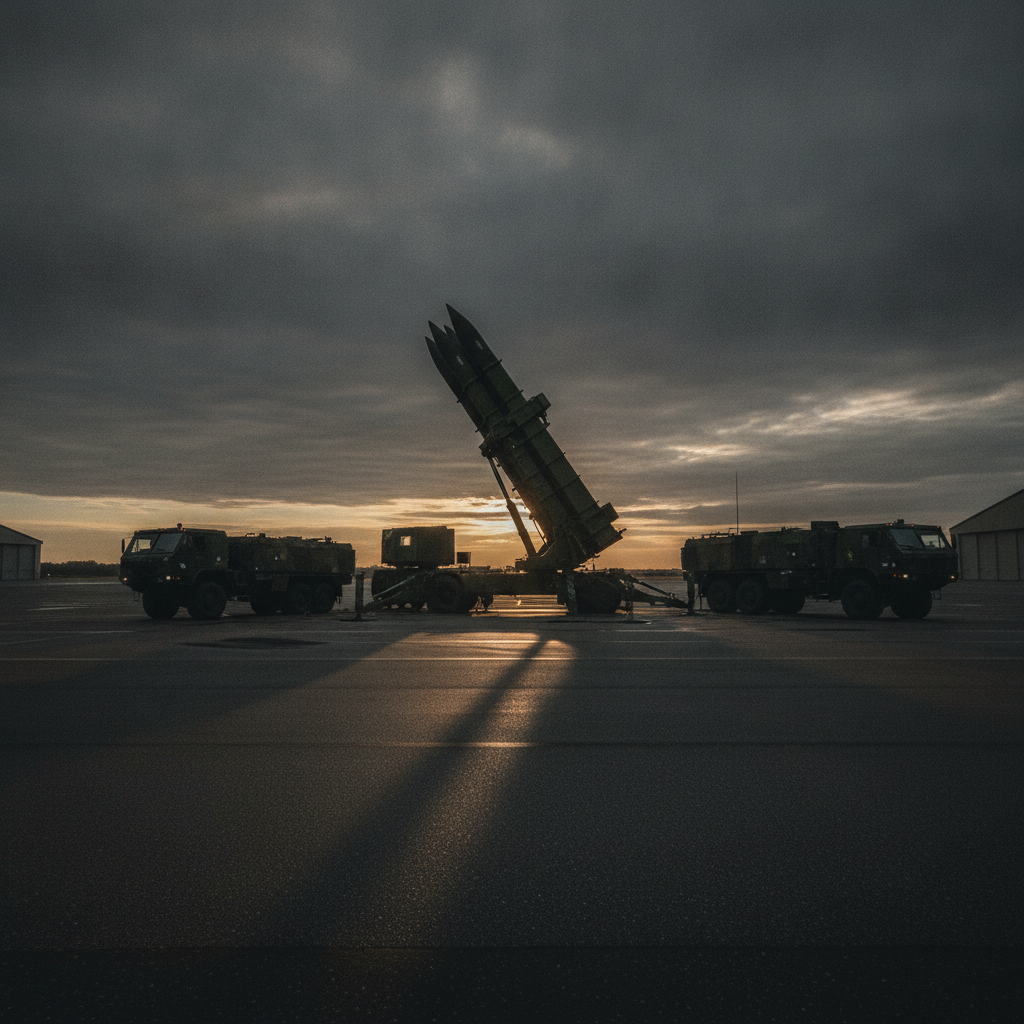
On October 30, the State Department approved the potential sale of 500 PAC-3 Missile Segment Enhancement missiles to Ukraine, priced at $2.1 billion — every dollar of it to be paid by partners and allies, not the United States. [1] The announcement was, on its face, a significant vote of confidence in Kyiv's air defense. In practice, it arrived after CNN reported that Kyiv had run out of interceptors, leaving the country more vulnerable to deadly Russian missile and drone attacks. [1]
The financing structure threads a political needle with some precision. [1] JUMPSTART was established in 2022 specifically so third-party countries could pool contributions and allow Ukraine to purchase American military equipment. [1] The State Department's congressional notification is unambiguous: "No U.S. funds are involved in this sale." [1]
The bureaucratic machinery behind JUMPSTART is more intricate than the headline number suggests. [2] Ukraine then submits Letters of Request under the terms of sale designated "Cash with Acceptance," using program code "JU" rather than the standard country code "UP." [2] It is a workaround that keeps US appropriations out of the transaction while still routing hardware through the Foreign Military Sales system.
The architecture of this deal reflects something broader: a defense ecosystem in which political will and financial mechanics have quietly decoupled. Allies pay, America supplies, and the paperwork routes around domestic political constraints without altering the fundamental risk calculus on the ground.
But the State Department's approval is an early step, not a delivery. Foreign Military Sales notifications are generally early steps in what can be years-long processes, and quantities and prices can change as contract negotiations continue. [1] Lawmakers retain the power to delay or block deals, though bipartisan support for Ukraine makes that less likely in this case. [1] None of which resolves what Kyiv needs right now.
The gap between announcement and delivery has been a raw nerve in US-Ukraine relations for weeks. [1] A few days earlier, CNN reported that Kyiv had run out of interceptors, leaving the country more vulnerable to deadly Russian missile and drone attacks. [1]
[1] Air defense, he made clear, remained unsettled. He had previously told ABC News that Ukraine would need 350 interceptors per month to properly defend its territory. [1]
"The issue of air defense remains. There is progress on missiles for Patriot systems, but things are moving very slowly. More slowly than Russian missiles fly," Zelenskyy said. "You cannot say, 'Yes, we will give the missiles to you,' and then not deliver them for a month or two. It simply does not work that way." [1] The State Department did not immediately respond to a request for comment on how the October 30 announcement affects Kyiv's near-term interceptor shortage. [1]
There is a particular tension in defense diplomacy between what a notification signals and what it delivers. Approvals move through layers of bureaucracy; missiles move through airspace at speeds that bureaucracy cannot match. The credibility of an alliance is partly measured by which of those two speeds governs the response.
The State Department's own language frames the sale in terms of strategic interest: the potential deal "will support the foreign policy and national security objectives of the United States by improving the security of a partner country that is a force for political and economic stability in Europe." [1] That formulation is standard FMS boilerplate, but its inclusion signals that the administration is comfortable defending the transaction on US-interest grounds — a relevant consideration given Trump's fraught relationship with Zelenskyy.
The JUMPSTART mechanism also carries its own constraints. Third-party nations must contact DSCA for information on establishing funds via wire transfer before Ukraine can even submit a formal Letter of Request. [2] That sequencing means the speed of any eventual delivery is bounded not only by US production capacity but by the pace at which allied finance ministries move money. The potential sale involves 500 missiles at an estimated $2.1 billion, and manufacturing timelines are not elastic.
What the JUMPSTART structure has quietly achieved is a reordering of who bears political and financial risk in Western arms transfers. The mechanism distributes cost across multiple democracies while keeping the US as the supplier of record — a model that is likely to outlast any single administration's foreign policy posture.
Whether 500 missiles, delivered on whatever timeline emerges from contract negotiations, is enough to close the gap Zelenskyy has described remains an open question. He has told ABC News that Ukraine would need 350 interceptors per month to properly defend its territory, and FMS deals of this scale typically see deliveries phased over multiple years. [1]
The October 30 notification is real, the money is committed, and the political signal to Moscow is legible. [1] What it is not is a missile in a launcher. The machinery of allied defense finance has demonstrated it can approve a $2.1 billion deal without a cent of US appropriations. [1] The harder test — moving hardware faster than the threat it is meant to intercept — remains unresolved. [1]