65 Years of Johnson: Houston's Human Spaceflight Engine
From a borrowed desk in southeast Houston to the nerve center of Artemis, JSC turns 65 and keeps reinventing what it means to send people into space.
By The space-quantum Desk
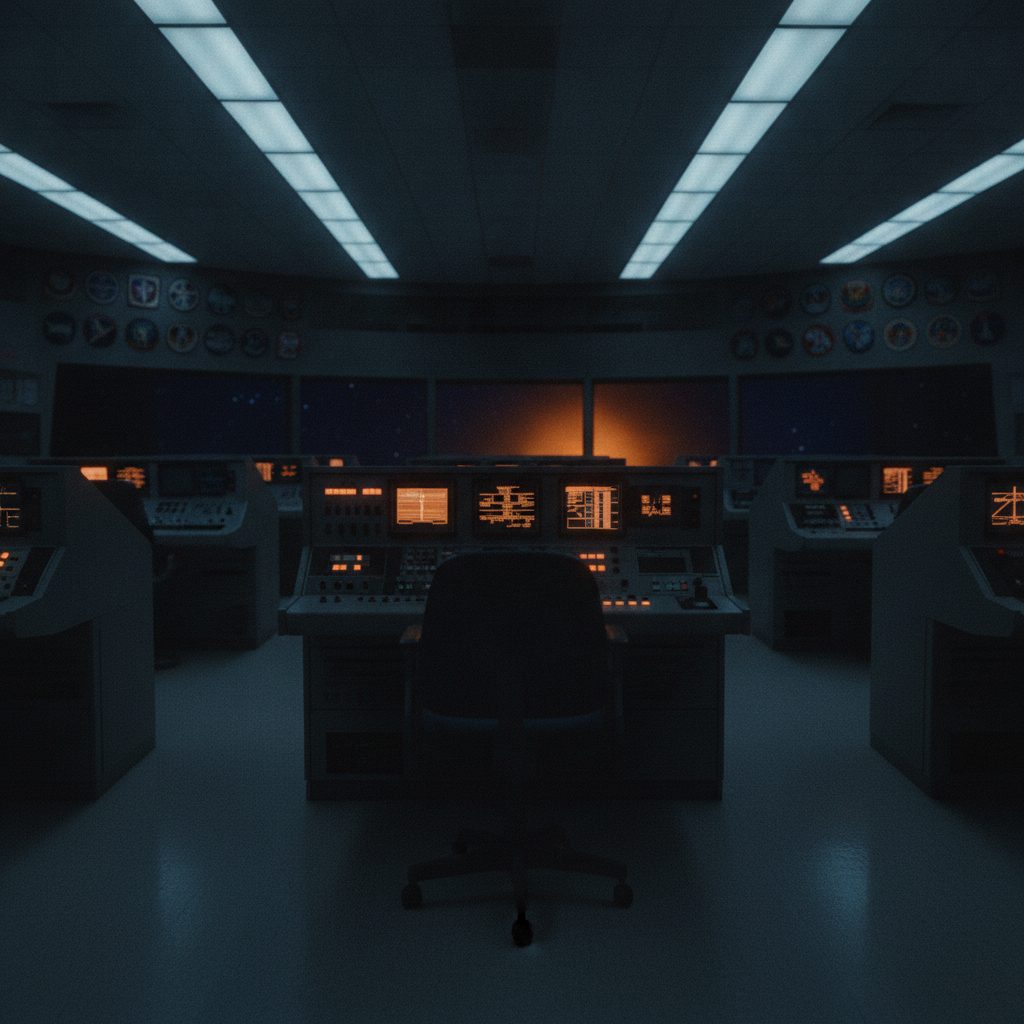
On Nov. 1, 1961, NASA's newly christened Manned Spacecraft Center existed mostly on paper — its staff scattered across 13 leased buildings in southeast Houston while construction crews were still breaking ground on the permanent Clear Lake campus [1]. Sixty-five years later, that provisional outpost has become the institutional spine of American human spaceflight, the address where astronauts train, where flight controllers watch over the International Space Station around the clock, and where engineers are now plotting the tools that will carry crews back to the Moon and, eventually, beyond.
The chain of causation is clean and well-documented. On May 25, 1961, President John F. Kennedy stood before a joint session of Congress and committed the nation to landing a man on the Moon and returning him safely to Earth before the end of the decade [1]. The declaration landed on NASA's Space Task Group like a deadline memo. The group was already running Project Mercury — focused on putting astronauts into Earth orbit — but a lunar landing demanded infrastructure on a different scale entirely, and the existing facilities at NASA's Langley Research Center in Hampton, Virginia, could not absorb it [1].
After evaluating sites across the country, NASA announced on Sept. 19, 1961, that the new center would be built near Houston, Texas [1]. The design phase took six months; construction of the first buildings took 18 months, with employees moving onto the new campus in late 1963 [1].
What makes a place like this durable is not any single mission but the quiet, compounding logic of institutional memory — the knowledge that accumulates in a facility's walls when the same teams solve new problems with tools refined over decades. Infrastructure outlasts individual programs. The architecture of training, control, and research that took shape in those first years became a platform on which each successive generation built.
Nowhere is that layering more visible than in the center's approach to spacewalk preparation. The use of neutral buoyancy for spacewalk training began with the Gemini XII mission in 1966 [1]. In 1967, an above-ground circular pool called the Water Immersion Facility was installed for astronaut training, supporting Apollo and pre-Shuttle preparations [1]. When the space shuttle arrived with its larger payload bay, training shifted to the Weightless Environment Training Facility in 1980 [1]. By 1997, the Neutral Buoyancy Laboratory in the Sonny Carter Training Center had opened, handling both shuttle and space station training as well as testing future space suits and lunar surface activities — the same facility that Artemis crew members use today [1].
Building 9 tells a similar story. Construction began in December 1965 and finished in March 1967, initially housing the Technical Services Facility [1]. In April 1969, workers converted part of the floor to include a mock lunar surface scene, complete with a Lunar Module mockup, which the Apollo 11 crew used for training [1]. An extension on the northwest side of the building begun in 1986 and completed in 1988 absorbed Space Station Freedom mockups and eventually International Space Station hardware; the building was renamed the Space Vehicle Mockup Facility [1]. Today it holds training mockups of the Orion spacecraft, commercial crew vehicles, and the Active Response Gravity Offload System — known as ARGOS — a device that simulates partial-gravity environments [1].
Mission Control has its own timeline of quiet reinvention. Construction of Building 30 began in June 1963 and finished in November 1964, initially housing two mission operations control rooms for Gemini and Apollo [1]. By January 1965, the center was monitoring the uncrewed Gemini 2 mission and the crewed Gemini 3 mission in a flight-following mode [1]. In June 1965, Houston assumed full control of Gemini IV and has controlled every subsequent NASA human spaceflight mission since [1]. A major computer upgrade in the mid-1970s prepared the center for the shuttle era; on April 4, 2011, the building was renamed the Christopher C. Kraft, Jr. Mission Control Center in honor of the man who created the concepts still in use today in human spaceflight control [1].
There is something worth pausing on in that continuity — not as sentiment, but as engineering fact. The concepts that govern how a flight control room operates, how authority is distributed, how anomalies are escalated, were invented here and have not been discarded. They have been updated, stress-tested, and handed forward. That kind of intellectual infrastructure is harder to build than a pool or a simulator bay.
The Lunar Receiving Laboratory offers one of the center's stranger chapters — and a measure of how seriously 1960s mission planners took uncertainties that seem remote today. To prevent back contamination from any possible lunar microorganisms, NASA designed Building 37 with biological containment in mind; construction began in August 1966, with the first employees moving into their offices in June 1967 [1]. The astronauts from Apollo 11, 12, and 14 completed their three-week postflight quarantine there, while scientists in the various laboratories studied the lunar samples all the Apollo missions returned [1]. Following Building 37's demolition, the Lunar Receiving Park was dedicated in 2026, preserving the site's history in a different register [1].
At 65, Johnson's organizational footprint reflects where NASA's priorities now sit. The center serves as the hub for the Low Earth Orbit Program — covering International Space Station operations and commercial partnerships and destinations in low Earth orbit [1]. For deeper destinations, Johnson houses the Moon Base Program and the Orion Program [1]. NASA's Human Health and Performance Directorate and Human Research Program, also based at Johnson, are working to protect crew health as missions extend farther from Earth — a research portfolio whose importance grows as transit times lengthen and the physiological cost of deep space becomes the binding constraint [1].
The center's resilience over six decades is, in part, a story about what it means to build for programs you cannot yet name. The buildings went up fast, but the culture they housed proved more durable than any single mission objective. Each successive program — Mercury, Gemini, Apollo, Skylab, the shuttle, the station, now Artemis — found a facility that could be converted, extended, renamed, and pressed into new service without being rebuilt from scratch.
The Mission Simulation and Training Facility in Building 5 is the clearest exhibit. It was completed in April 1965 and began supporting missions with Gemini IV in June of that year [1]. Apollo simulators — command module and lunar module — started arriving in December 1965 [1]. In the early 1970s, the building housed full-scale, high-fidelity Skylab trainers that all nine Skylab astronauts used [1]. Major renovations in the late 1970s added fixed-base and motion-base shuttle simulators; the Space Station Training Facility addition, completed in 1991, supported first Space Station Freedom and now International Space Station crew training, and also contains Orion and Starliner simulators [1]. The building is still training astronauts today.
In 1973, the center was officially renamed NASA's Lyndon B. Johnson Space Center in recognition of President Johnson's ardent support of America's space program from its foundation [1]. The rename arrived a year after Apollo 17 — the last crewed lunar mission of the 20th century — and at the start of a decade-long gap between human landings that is only now closing. The name stuck. So did the center's role: Johnson today is NASA's Center of Excellence for Human Spaceflight, home to America's astronaut corps, Mission Control, and the teams behind what the agency describes as some of humanity's greatest achievements in space [1].
Sixty-five is not a landmark that demands triumphalism. What Johnson Space Center's history actually shows is more useful: that durable institutions are the ones that design their buildings for programs not yet conceived, train their people in skills that transfer across decades, and treat each mission's end not as a conclusion but as a conversion opportunity. The water in the neutral buoyancy pool changes. The questions it is asked to answer keep returning.