A Charter Boat Caught a Drone. The Air Force Lost One.
A Florida fishing trip turned up what looks like a LUCAS kamikaze drone—the $35,000 Shahed clone the U.S. military just used in combat.
By The Defense Desk
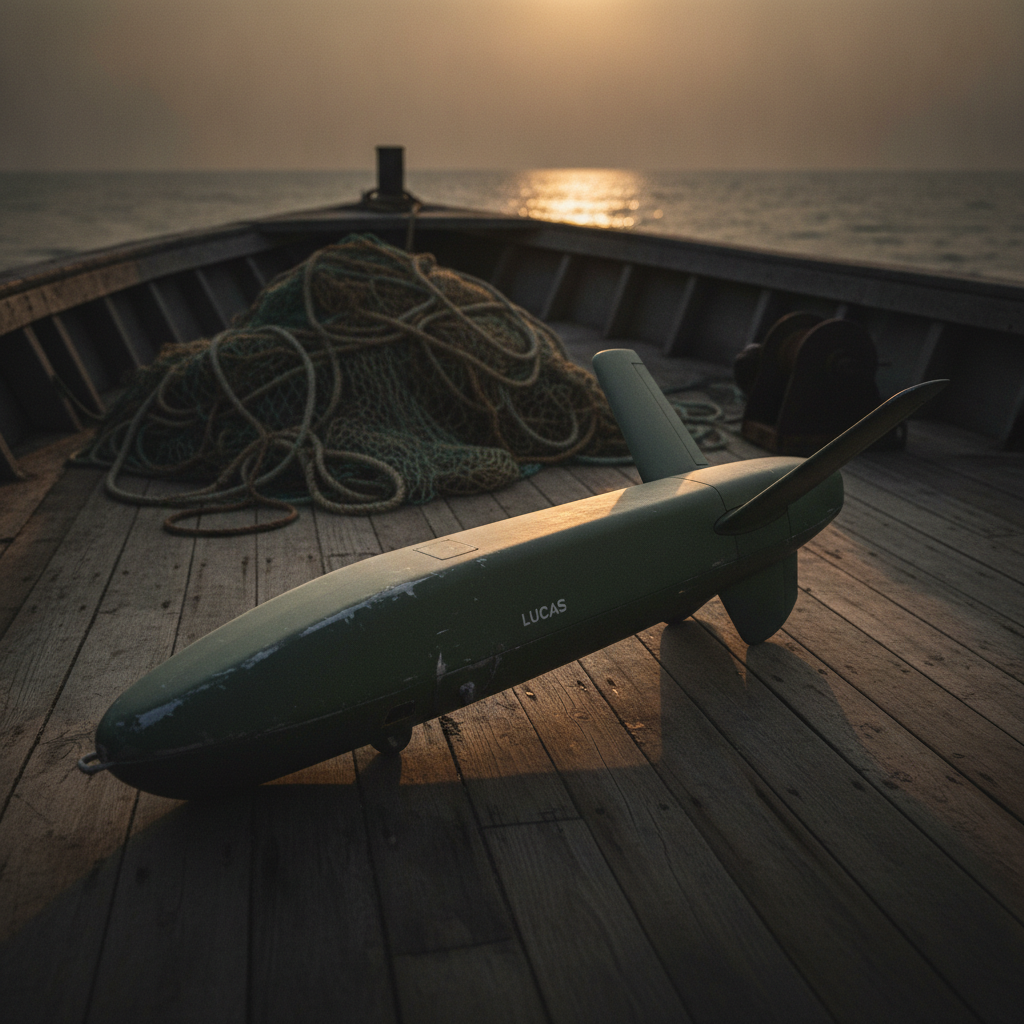
He steered over, found a mahi-mahi sheltering underneath, and his passengers helped him haul both aboard. The fish added to his already stocked cooler full of fish from that morning charter. The delta-wing drone went to the authorities. [1]
28. [1]
An Eglin AFB spokesperson confirmed a loss but offered little else. "I can confirm that we were doing a test and the test article went down," the spokesperson told TWZ, declining to specify the drone type, the date, or the location. The Pentagon could not immediately provide additional details. [1]
Eglin oversees the massive Eglin Gulf Test Range, which provides approximately 120,000 square miles of overwater airspace covering the eastern third of the Gulf of Mexico. These systems need sanitized airspace for development activities, and the vast ranges over the gulf are some of the best in the country for it. A contracted crew from Florida Offshore retrieves around 100 drones from those waters each year. [1]
Images of the recovered drone showed it missing its engine, propeller, and nose cone — components that are commonly lost on water impact. Arsenault notified local agencies and the drone was eventually collected, though Charlie Green, the aviation photographer who informed TWZ of the recovery, did not know which agency took custody. [1]
The episode is almost too neat an illustration of where the drone war stands right now. A weapon built to imitate an adversary's cheapest, most proliferated threat — then turned into that very weapon — ends up bobbing in domestic waters, caught not by a recovery vessel but by a fishing charter.
LUCAS costs approximately $35,000 per platform and is designed to be launched via catapults, rocket-assisted takeoff, or mobile ground and vehicle systems. It can operate autonomously and beyond line of sight. S. Special Operations Command Central. [1]
The broader context is hard to overstate. One-way attack drones have proven to be a defining threat in Ukraine and in multiple engagements with Iran, including Operation Epic Fury. Counter-UAS development at Eglin has included arming USAF fighters with FALCO APKWS laser-guided rockets — a program that began in 2019, which TWZ was first to report on, and was finally rushed into service years later as the standoff with Iran went hot. LUCAS development is now focused on cooperative swarming between multiple LUCAS drones, a capability that was central to the program's vision from the start. [1]
The logic of mass production demands mass attrition. Weapons designed to be risked in large numbers will occasionally wash up somewhere inconvenient — or fortuitously, depending on your appetite for a story.
This is not the first time military hardware has surfaced unexpectedly on Florida's coastline. In 2021, beachcombers in Palm Beach County found a U.S. Air Force BQM-167A high-performance target drone that had washed ashore. The pattern is consistent enough that the Air Force maintains a handful of 120-foot boats — the only vessels in its service — to help recover drones after they are shot down during live-fire exercises or otherwise need to be retrieved from these waters. [1]
LUCAS is produced to be lost. Some portion of any scalable, low-cost strike system will fail, crash, or drift — that is the arithmetic of cheap, autonomous firepower at scale. Arsenault's passengers helped haul this one aboard. Most end up at the bottom of the Gulf.