A Laser Weapon Is Now Guarding Mar-a-Lago
AeroVironment's LOCUST counter-drone system joins Avengers and radar kits in a layered air-defense perimeter around Trump's Palm Beach estate.
By The Defense Desk
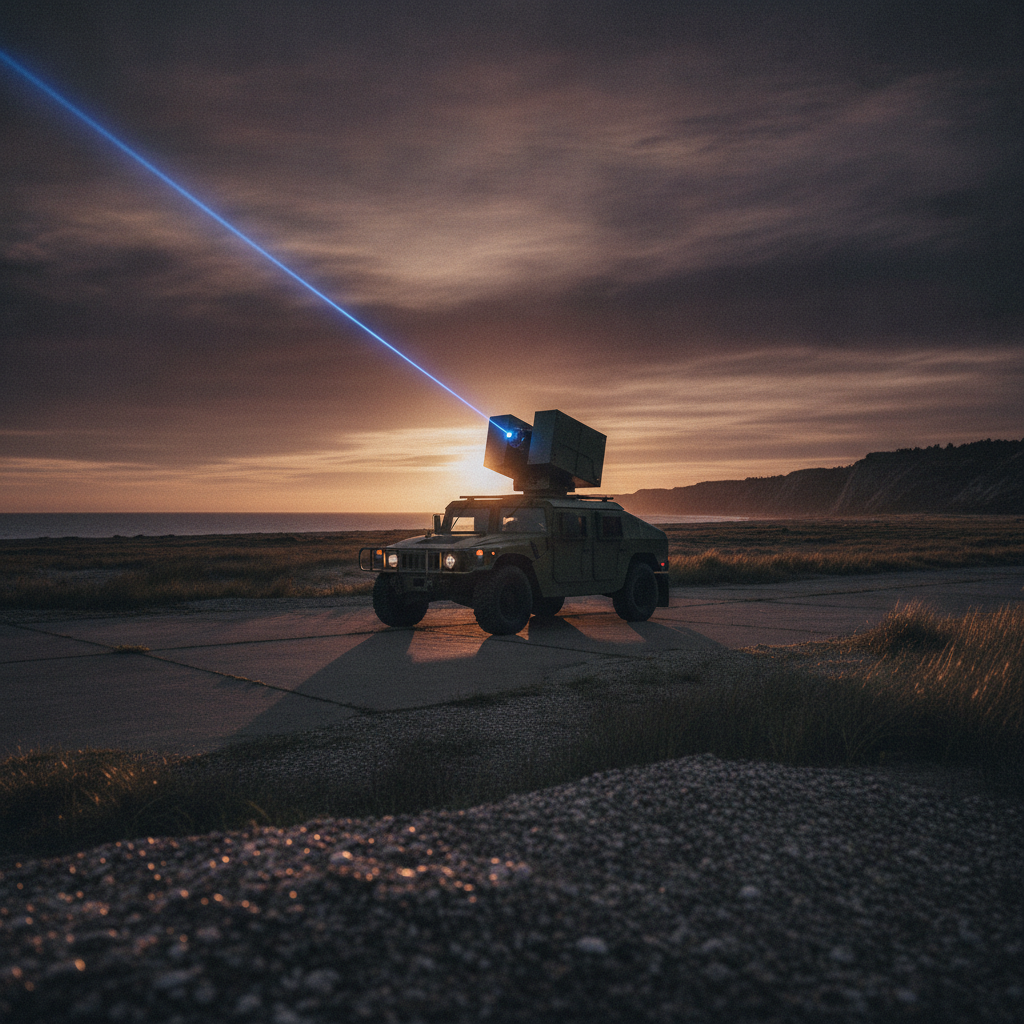
At least one AeroVironment LOCUST laser counter-drone system is now part of the air-defense array surrounding President Donald Trump's Mar-a-Lago estate in Palm Beach, Florida. [1] Photographs taken by Getty photographer Andrew Harnik on October 31 show the system mounted on a 4×4 Joint Light Tactical Vehicle parked on the estate's grounds — a deployment confirmed first by the outlet Laser Wars. [1]
The LOCUST is one layer in an increasingly dense defensive stack. A pair of Humvee-based AN/TWQ-1 Avenger short-range air defense systems sit on a floating platform in Lake Worth Lagoon at the edge of the property, deployed there just over two weeks ago. [1] Additional Avengers have been positioned around Donald J. Trump International Airport, roughly three miles to the west. [1] The U.S. military has also installed Counter-Unmanned Aircraft System Fly-Away Kits — including Ku-band radar, electronic support measures, jammers, and 360-degree infrared search and track systems — in the vicinity. [1]
NORAD and U.S. Northern Command confirmed the deployment in a statement: "At the request of the U.S. Secret Service (USSS) and under NORAD [the U.S.-Canadian North American Aerospace Defense Command] and USNORTHCOM [U.S. Northern Command] authorities, NORAD and USNORTHCOM recently deployed ground-based air defense [GBAD] assets and Counter-Unmanned Aircraft System capabilities in and around Mar-a-Lago, Florida. These assets add a complementary layer of technology to enhance protection. Due to operational security, we are unable to provide additional details. For further detail, we refer you to the USSS." [1]
The context for that threat language is concrete. [2] Crooks, 20, was killed by a Secret Service sharpshooter; a motive was never uncovered. [2] Former fire chief Corey Comperatore also died in the shooting. [2]
LOCUST itself has been climbing the military's priority list for several years. The U.S. Army began receiving JLTV-mounted versions last year through the Army Multi-Purpose High Energy Laser program, along with examples mounted on the smaller 4×4 Infantry Squad Vehicle (ISV), following earlier palletized versions delivered under a rapid prototyping effort called the Palletized-High Energy Laser in the early 2020s. [1] The Marine Corps and Navy have also explored versions for ground-based and shipboard use. [1]
The system's appeal is economic as much as tactical. As TWZ has written previously, laser directed-energy weapons offer "the promise of functionally unlimited magazine depth, as long as there is sufficient power and cooling capacity" and also present "a drastically lower cost-per-intercept proposition compared to traditional anti-air interceptors" — a meaningful advantage when the threat is cheap, expendable drones. [1] The Pentagon signed a new agreement with the FAA on laser use within U.S. airspace after one AMP-HEL system was part of the chain of events that led to the shutdown of airspace around El Paso, Texas, in February. [1]
The gap between what laser weapons promise and what they reliably deliver in the field is the defining tension of the directed-energy era. Fielding a system in a controlled, high-priority perimeter is one thing; sustaining it across varied terrain, weather, and operational tempo is another challenge entirely.
Army officials have been candid about that gap. Kirk Williams, Chief Engineer at the Army's Directed Energy Project Office, told attendees at the Association of the U.S. Army's annual convention last month: "Lasers are real. We can do it. We can go out. We can shoot things. But what we got to do now is make these systems reliable enough so that the soldiers have the faith in them when they need them, and that's really the main point that we're trying to go after right now." [1] He continued: "We're getting to the point where the systems are reliable enough, but we still have to make them maintainable and repairable because this is an Army system. Things are going to break. So if it's not reliable, or if it's not maintainable, if it's not repairable, that's a problem." [1]
LOCUST can only engage one target at a time, and lower-power variants must dwell on a target longer to cause damage — compressing the number of intercepts possible in a given window. [1] Atmospheric propagation, weather, smoke, and dust all degrade beam power at distance, keeping effective ranges to handfuls of miles. [1] Layering LOCUST alongside Avengers and the Fly-Away Kit's radar and jamming suite addresses the single-engagement limitation by distributing the kill chain across multiple systems. [1]
Mar-a-Lago is the most publicly visible deployment of LOCUST on U.S. soil — and an inadvertent stress test of how well the technology integrates into a dense, real-world defensive perimeter. The pictures are already out. The performance data will take longer to surface. [1]