America's Missile Shield Is Running Low
The Iran war burned through two-thirds of U.S. interceptor stocks. Rebuilding them will take years — if it happens at all.
By The Defense Desk
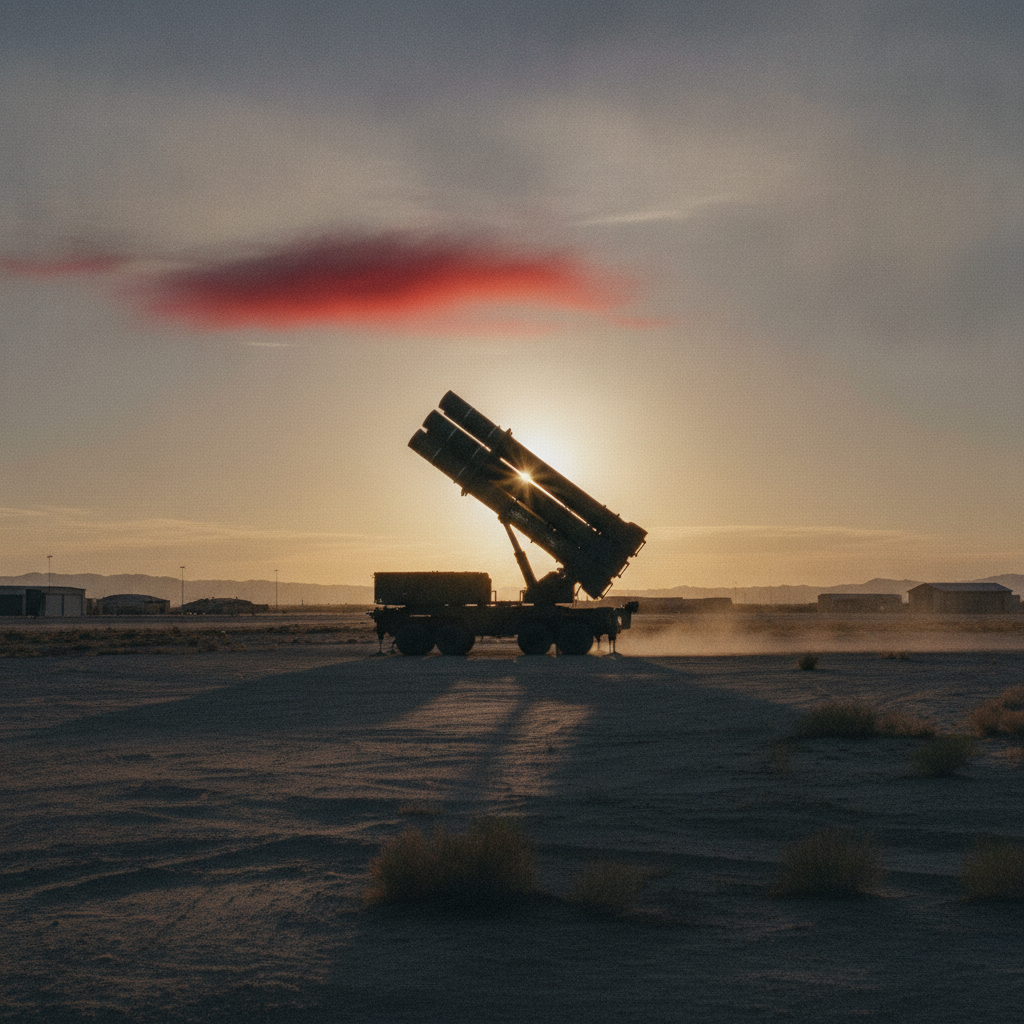
Before the Iran war began in June 2025, the U.S. military held roughly 2,330 Patriot interceptors in its inventory. By the end of July, that number had fallen to somewhere between 759 and 827 — a collapse of nearly two-thirds, according to a Center for Strategic and International Studies analysis. [1] THAAD stocks tell a similar story: down from 452 to between 234 and 278. [1] These are not abstract shortfalls. They are the physical measure of what Operation Epic Fury cost the United States in weapons it cannot quickly replace.
The Congressional Budget Office put the broader picture in sharper relief in a September analysis. The conflict has consumed between one-half and two-thirds of the U.S. inventory of certain missile-defense interceptors since June 2025, leaving the military with fewer weapons available for a future conflict. [2] Rebuilding those stocks, CBO found, could take at least five years — even if production rates increase. [2]
The overall price tag for combat operations against Iran reached about $38 billion through Aug. 1, according to the CBO analysis. [2] Replacing expended munitions alone would cost an estimated $21.7 billion, with interceptors — Patriot, THAAD, Standard Missile-3, and Standard Missile-6 — accounting for $13.1 billion of that figure. [2] Land-attack cruise missiles added another $7.3 billion. [2] The unit economics explain why the hole is so hard to fill: CBO estimates roughly $4 million per Patriot or SM-6, $12 million per THAAD interceptor, and $28 million for a sophisticated SM-3. [2]
The initial phase of Operation Epic Fury involved about 250 tactical aircraft, including roughly 90 from two carrier strike groups, as well as an amphibious ready group. [2] Those forces were supported by bombers, airlifters, refueling tankers, other Navy vessels and Army air-defense, aviation and artillery units. [2] The campaign burned through interceptors fastest in its opening weeks, as U.S. forces defended against Iranian ballistic missile and drone attacks. [2] Among the losses: a THAAD radar destroyed by Iran. [2]
The depletion of these systems exposes a structural tension that has existed in U.S. defense procurement for decades. Complex weapons take years to design and certify; wars consume them in weeks. The gap between industrial production timelines and battlefield expenditure rates was always a theoretical vulnerability. It is now a documented one.
Deputy Defense Secretary Steve Feinberg moved to address the gap in August, giving industry leaders until Aug. 26 to submit plans for "significantly faster, more aggressive delivery schedules and/or increased production for critical capabilities," according to his Aug. 5 memo. [1] The memo identified 16 critical programs under consideration for accelerated production or increased procurement, with the responses intended to inform the department's fiscal 2028 budget request. [1]
Twenty-six days after that deadline, the Defense Department had not publicly disclosed how many companies responded or what production timelines they offered. [1] The Pentagon did not respond to questions about how many companies responded to Feinberg's request or whether the department had accepted or funded any of the proposals. [1] General Dynamics declined to discuss its communications with the department. "We are not able to comment on our communications with the Department of War," a General Dynamics spokesman said. [1]
Lockheed Martin, a major supplier of U.S. missile-defense systems, did not provide a specific production timeline in response to questions from Military Times. [1] The company said it is investing $8 billion to $9 billion to expand munitions production, including new buildings, facility expansions and thousands of jobs at more than 20 U.S. sites, and that planned expansions will increase its munitions production and warehousing space by nearly 50%. [1] Lockheed did not say whether those investments were submitted as part of Feinberg's Aug. 5 request. [1]
The production timelines that do exist in the public record are sobering. CSIS estimated about 42 months to produce a PAC-3 MSE interceptor and 53 months for a THAAD interceptor. [1] Even the most aggressive framework agreements signed before and after Feinberg's deadline cannot compress physics or supply chains overnight. On July 27, the Pentagon announced seven-year framework agreements to boost propulsion component production for PAC-3 MSE and THAAD. [1] L3Harris said its PAC-3 agreement would nearly triple production of certain propulsion products, while its THAAD agreement was intended to quadruple production of key propulsion components. [1]
Additional framework agreements followed in quick succession. On Aug. 3, the Pentagon, in cooperation with Northrop Grumman and Lockheed Martin, announced two agreements to expand production capacity for critical PAC-3 and THAAD interceptor components, intended to support goals of tripling PAC-3 production capacity and quadrupling THAAD production capacity. [1] On Aug. 14, DoD announced two separate framework agreements with Boeing and RTX to increase production of components for SM-3 Block IB and SM-3 Block IIA interceptors. [1] On Aug. 17, the Pentagon announced a $22.9 billion Navy contract with RTX to accelerate production of Tomahawk missiles. [1]
What the flurry of announcements did not clarify was whether any of it resulted from Feinberg's 21-day industry exercise. The public announcements did not identify those agreements as resulting from companies' responses to Feinberg's Aug. 5 request. [1] What remains unclear is whether the 21-day exercise changed what the Pentagon plans to buy, how quickly it expects industry to deliver it or what additional funding and infrastructure the department will seek in its fiscal 2028 budget request. [1]
Funding is its own constraint. The Pentagon separately identified production goals of tripling PAC-3 MSE production capacity and quadrupling THAAD production capacity, with funding subject to annual appropriations from Congress. [1] The administration had requested $87.6 billion in supplemental funding in June, including $67.1 billion for the DoD, with $42.3 billion identified as directly related to the conflict — about 10% higher than CBO's own estimate. [2] CBO calculates each additional month of fighting at roughly $2 billion to $3 billion if the intensity remains relatively low, with costs potentially higher if operations intensify. [2]
The harder problem lurking beneath all of these numbers is strategic. Rebuilding one arsenal while managing an ongoing conflict — and doing so against the backdrop of a second potential adversary — requires a kind of industrial simultaneity that the U.S. defense base has not been asked to sustain in a generation. The contracts and framework agreements now cascading out of the Pentagon are a response to a crisis that was, in some sense, always foreseeable.
CBO's analysts were pointed about where the real long-term risk sits. The depleted interceptor stocks could pose a particular problem in a conflict with China, CBO said, because Beijing maintains large numbers of ballistic and cruise missiles. [2] The same interceptors burned through in the skies over Iran are the ones that would need to perform in any Pacific contingency. CBO noted it relied on government databases and public reports because the Pentagon did not respond to its requests for information — adding a layer of uncertainty to estimates already carrying significant margin of error. [2]
One small signal of what accelerated production can look like in practice came from Lockheed, which announced it had received its first PAC-3 MSE housing components from GM Defense just 22 days after the companies signed a production contract. [1] The components, which can traditionally take months or years to produce, were manufactured using GM's casting and machining capabilities. [1] It is a proof of concept — meaningful, but nowhere near sufficient to close a gap measured in thousands of missiles.
The U.S. defense industrial base is moving — that much is clear from the cascade of contracts and agreements signed since the summer. What is not clear is whether it is moving fast enough, or whether the opacity around Feinberg's industry exercise reflects confidence in the answers or discomfort with them. [1][2] Production timelines of 42 to 53 months are not a policy failure. They are an engineering reality. The question the Pentagon has not yet answered publicly is what happens to deterrence in the years it takes to fill the shelves.