America's Shield Has a Factory Problem
Golden Dome promises a layered missile defense spanning orbit to ocean floor. Building it depends on an industrial base that decades of cuts have left hollow.
By The space-quantum Desk
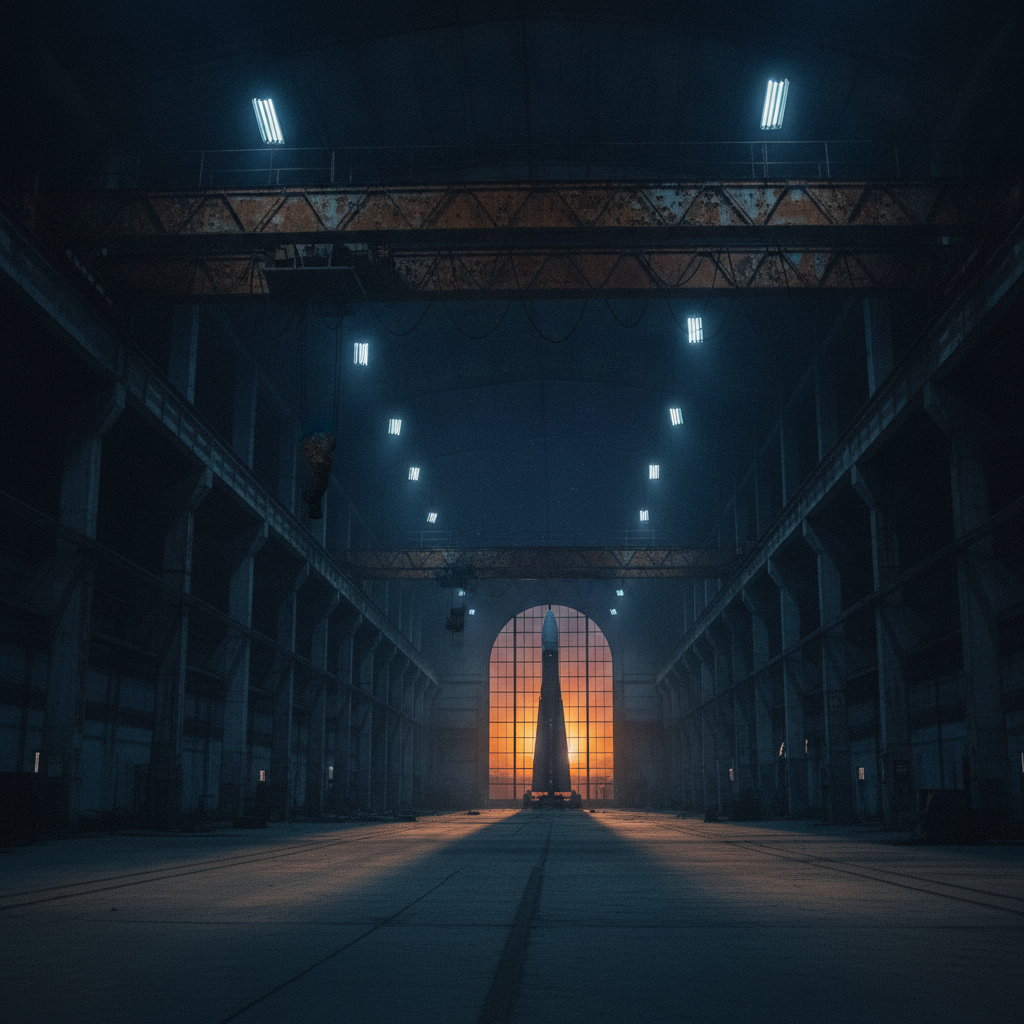
The geography that once made the continental United States a logistical nightmare for any adversary — two oceans, enormous interior distances — no longer does the work it once did [1].
Into that reality, President Donald Trump issued an executive order in 2025 calling for a comprehensive missile defense system modeled on Israel's Iron Dome [1]. Current US homeland missile defenses were first deployed more than twenty years ago, using technology developed in the 1990s and early 2000s, and were not designed to address the advancing North Korean threat or the Chinese and Russian threats [2]. Golden Dome is the attempt to close that gap — fast.
The ambition is vast and the logic is sound. But ambition and logic alone do not bend metal, cast propellant, or etch circuit boards. A program this large lives or dies not in policy documents but on factory floors — and the floors are not ready.
Golden Dome is not a single weapon. It is a system of systems: constellations of satellite-based tracking and discrimination platforms to detect missile launches in real time; kinetic interceptors based in space, at sea, and on land; directed-energy systems such as high-powered lasers for boost-phase intercepts; and artificial intelligence integration for faster sensor-to-shooter linkages [1]. That architecture demands reliable, high-volume production of components that the US defense industrial base has not manufactured at scale in years [1].
"Most of what we have to figure out is not technology. He pointed to specific shortfalls in solid rocket motors, electronics components, and propulsion chemicals — the unglamorous substrates of any serious missile program [1]. The United States still knows how to design these things. It no longer has the capacity to make them in the quantities a program like Golden Dome would demand [1].
The gap is a product of choices made across decades. Defense manufacturing capabilities have eroded through decades of consolidation and offshoring [1]. What remained was optimized for cost efficiency in a period of relative strategic calm. That calm is over. China has developed, tested, and deployed hypersonic missiles and launched a fractional orbital bombardment vehicle [2]. The threat inventory has expanded faster than the manufacturing base that would need to counter it.
There is something disorienting about a defense gap measured not in warheads or satellites but in production lines and workforce pipelines. The geopolitical stakes are familiar from decades of strategic writing. The industrial dimension is harder to dramatize, and therefore easier to defer.
The space segment of Golden Dome is where the industrial pressure is most acute — and where the potential is also most visible. Dramatic reductions in space launch costs and advances in manufacturing, sensor technology, communications networks, computing, and artificial intelligence have made a comprehensive missile defense architecture far more feasible than it was previously [2]. The Space Development Agency is already developing a Space Tracking Layer as part of its Proliferated Space Warfighting Architecture, generating precision tracking sufficient for interceptor fire control [2].
MDA and the Space Development Agency launched the first Hypersonic and Ballistic Tracking Space Sensor satellites in 2024, built using STSS lessons learned [2]. The proof of concept exists. The remaining question is whether the US can produce sensors, interceptors, and communications nodes in the numbers a full Golden Dome constellation would require — and do it on a compressed schedule.
The shift from a small number of large satellites to a large number of small satellites changes the production math entirely [1]. "The game now is proliferation and getting the right mix of assets in space to go do the mission," Magaña said [1]. That means increasing production volumes and investing in the industrial base so it can grow with the mission and offer more affordable space solutions [1]. Long-term contracts, multi-year funding, and predictable procurement cycles are the policy tools that give suppliers the confidence to invest in new facilities, workforce pipelines, and production automation [1]. Without them, manufacturers will not commit capital to capacity that may evaporate when a congressional budget cycle turns.
Government procurement reform is necessary but not sufficient. Different companies contribute distinct competencies; capital markets are engaged alongside public funding; a capability gets built on a timeline no single contractor could manage alone [1].
The strategic logic behind Golden Dome, as articulated by Robert Peters, a senior research fellow at the Heritage Foundation, is that the most effective deterrence strategies involve threats to both reduce the effectiveness of an adversary's potential attack and respond to the attack by inflicting unacceptable costs on the adversary [2]. A missile defense system that adversaries cannot be confident of defeating changes their planning calculus before a single interceptor launches. That deterrence value depends entirely on the system being real — fielded, functional, and in sufficient numbers. A shield that exists only in executive orders deters nothing.
Gen. Mike Guetlein, director of Golden Dome for America, framed the urgency plainly at an April event: "We are moving with purpose and urgency to forge a shield that is layered, integrated and automated" [1]. The architecture he described — autonomous AI-powered satellites capable of precise maneuverability, low-signature detection, and secure on-orbit data processing — is technically achievable [1]. The bottleneck is not the engineering blueprint. It is the supply chain behind the blueprint: the foundries, motor plants, chemical facilities, and electronics manufacturers that have to actually produce the hardware at scale [1].
Every generation of defense infrastructure arrives late to the threat it was designed to meet. The question is never whether to build — it is whether the institutions doing the building can move at the speed the moment demands. The answer usually depends less on strategy than on the mundane capacity to manufacture things.
"And it's the only way we can get something like Golden Dome done, because there's no one company that can do all the things that Golden Dome requires," Magaña said [1]. The satellite constellations, the interceptors, the directed-energy platforms, the AI-driven command links — none of it materializes without a rebuilt industrial base producing components at a pace and price the program can sustain. The shield is technically within reach. Whether the factory floor gets there in time is the only question that matters.