An AI Charted a Route to the Stars. Now a $15M Nonprofit Wants to Fly It.
The Fermi Explorer Mission plans to launch an interstellar probe by 2029—using a trajectory no human engineer had considered.
By The Energy-Climate Desk
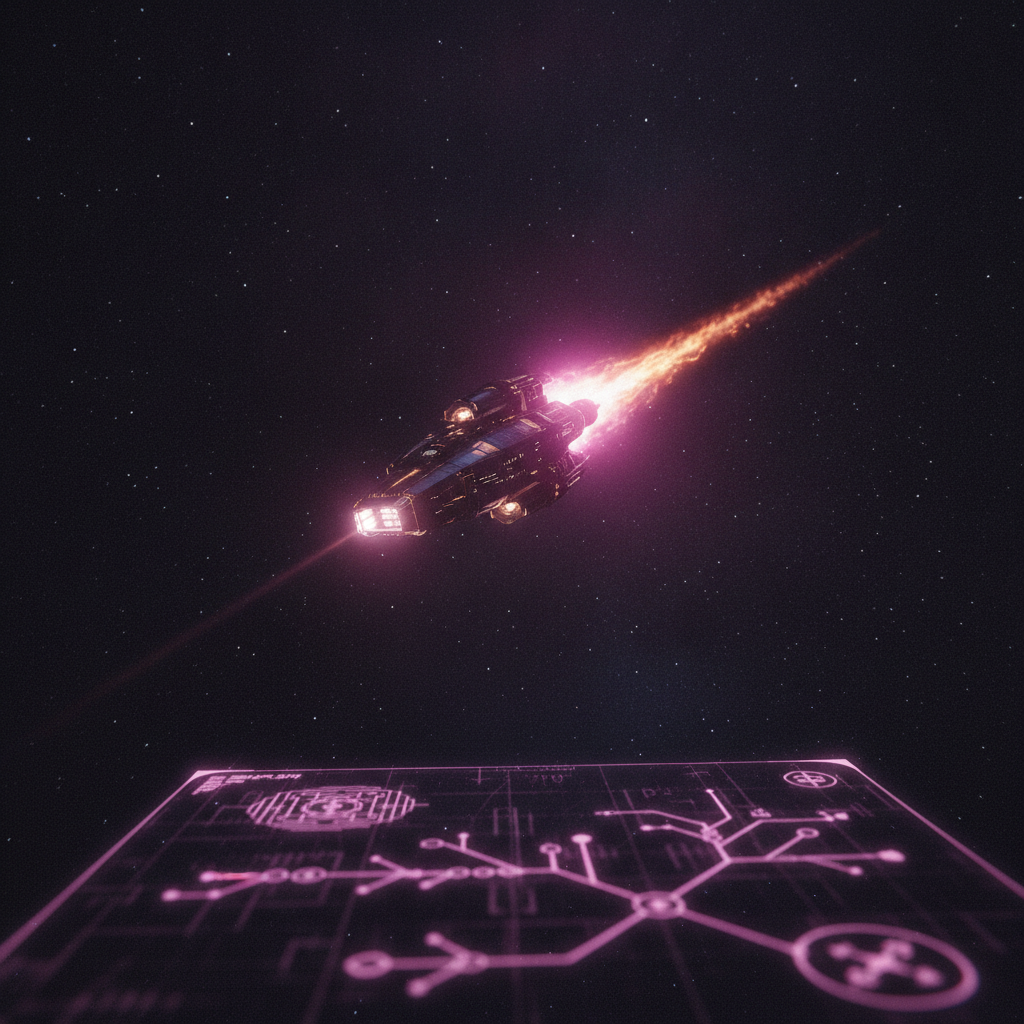
Alpha Centauri is about 25 trillion miles away. The Voyager 1 probe has been flying since 1977 and has covered less than 1% of that distance [1]. Yet a nonprofit called the Fermi Explorer Mission intends to launch a spacecraft toward that same star system by the end of 2029—on a budget of just $15 million, using a flight path that an AI system, not a human engineer, devised [1].
The system conducted the research mostly on its own for three days, running on a billion tokens [1].
The route it proposed is counterintuitive: instead of racing outward from the sun, the spacecraft would first slow down, swinging its orbit closer to the sun than Mercury [1]. On each close pass, the solar panels receive four times the normal light, and a burst of thrust delivered at high speed buys more energy than the same thrust applied anywhere else [1]. Because the engine fires only near the sun, the solar panels stay small and the spacecraft stays light—the exact tradeoff the Fermi team couldn't crack manually [1].
Even so, Philip Johnston, the cofounder and president of the Fermi Explorer Mission, is clear-eyed about the timeline: the probe could take up to 80,000 years to reach Alpha Centauri [1]. "We are not constraining ourselves to doing it in a human lifetime," Johnston says. "Let's just figure out the way to get to another star" [1]. The spacecraft will carry at least one kilogram of cargo, including a copy of the Golden Record—the gold-plated disc of Earth's sounds and images that NASA attached to its two Voyager probes in 1977 [1].
The episode illustrated a stark reality about billionaire-funded science: when the guy with the billions is ready to move on, the whole project is off [2].
The Fermi mission is structured to avoid that failure mode. It is funded by individual private donors rather than a single billionaire, and Johnston says the team is "dead set on something actually launching" [1]. The trajectory it found has not yet been peer-reviewed [1].
What makes this mission peculiar is that its ambition exceeds any plausible return within a human lifespan—and the team knows it. The value is not arrival. It is departure.
Johnston is candid that the probe will almost certainly not be first to arrive: if an engine built a thousand years from now is even 20% faster than today's, a spacecraft launched then would still beat Fermi's probe to Alpha Centauri by more than 10,000 years [1]. The deeper purpose is to reframe the Fermi Paradox itself. Once humanity launches a probe toward another star, one standard explanation—that reaching other stars is simply too difficult—no longer applies [1].
That leaves darker possibilities. Maybe life like ours is almost unimaginably rare. Or maybe intelligent civilizations tend to die before they can spread [1]. "One of those reasons could be that once you hit superintelligence, that for some reason is self-destructive," Johnston says. A mission designed to outlast civilization is also, in this reading, a bet that civilization survives.
The probe may never arrive at Alpha Centauri within any timeline that matters to anyone alive today. But the act of launching it—of becoming the kind of species that tries—is, according to Johnston, the point. An AI found the route. Whether humans can hold the course for 80,000 years is a different kind of problem entirely.