Ariane 6 Sets a Record — and Europe Eyes More
Upgraded boosters push Amazon Leo's heaviest-ever payload to orbit. Now ESA must decide how fast it can really fly.
By The space-quantum Desk
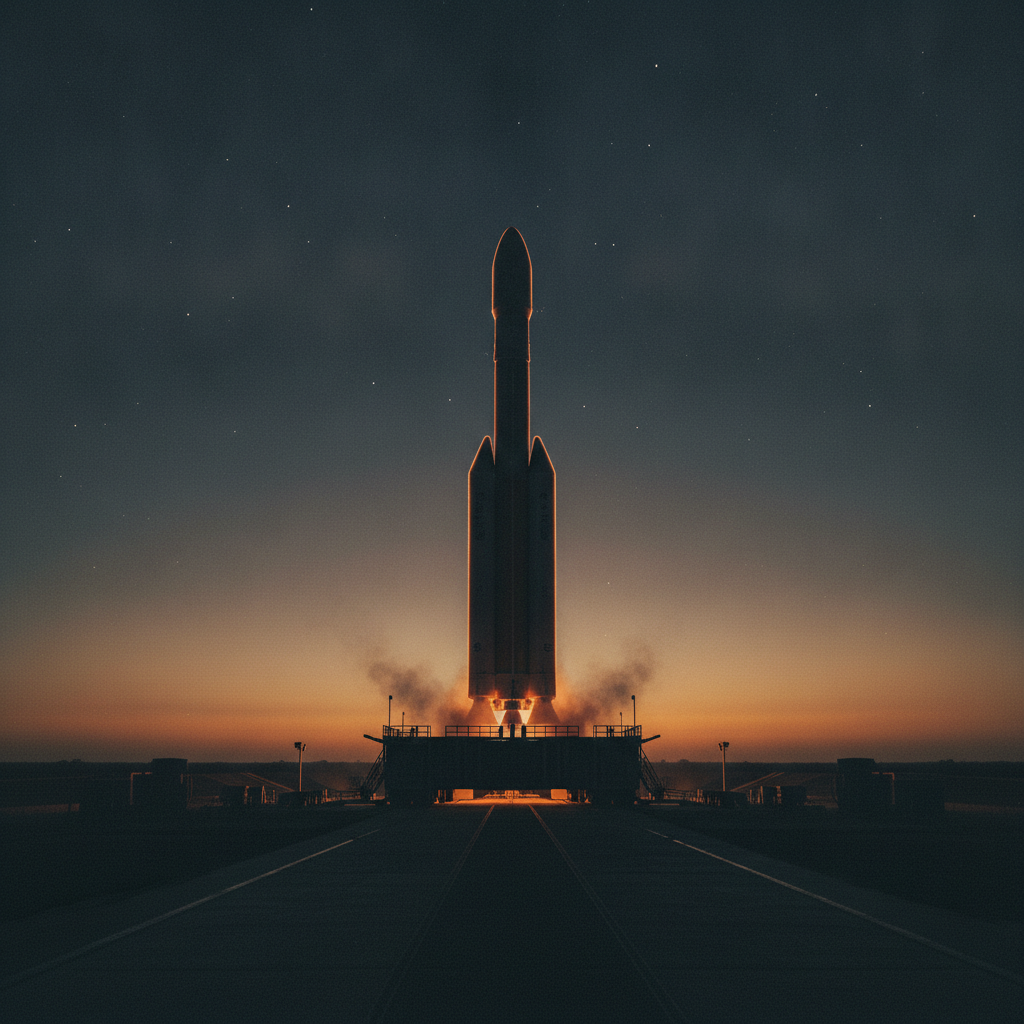
At 8:21 a.m. [1] The liftoff was delayed by about a half-hour after an unspecified issue was detected about a minute before the planned liftoff. [1] The delay barely registered. What mattered was the payload sitting beneath the fairing, and whether the machine below it could handle it.
The answer was yes, and by a margin. The mission, designated VA269 by Arianespace and LE-03 by Amazon, was the first Ariane 6 flight to fly with the P160C solid rocket boosters — a hardware upgrade that increases payload capacity to low Earth orbit by more than two metric tons compared with the P120C boosters used on previous Ariane 6 launches. [1] The prior launches in February and April each carried 32 satellites. This one lifted 36. [1] The upper stage began deploying them 1 hour and 26 minutes after liftoff and finished the job 25 minutes later. [1]
"With 100 satellites now placed in orbit by Arianespace for Amazon Leo and the launch of four more satellites than the first two missions, we are setting records with an increasingly powerful and versatile launcher," said David Cavaillolès, chief executive of Arianespace, in a statement after the launch. [1] "This further demonstrates our ability to address new markets, and especially constellation deployment." [1]
Records, of course, are only interesting because of what surrounds them. A heavier payload on a single flight is a data point. What it signals — about the state of European launch infrastructure, about the fragility of Amazon's broader manifest, and about the choices Europe must now make before the end of the decade — is the actual story.
Amazon's 3,636-satellite Leo constellation was supposed to be built on a diversified launch stack. Blue Origin's New Glenn and United Launch Alliance's Vulcan Centaur also hold large launch contracts for the constellation. [1] That diversification has since developed cracks. Delays and anomalies with both New Glenn and Vulcan Centaur have forced Amazon to lean harder on Arianespace, and there is now only one Atlas 5 launch remaining for the constellation, scheduled for July 3. [1] Of the 367 Amazon Leo satellites launched to date — across Ariane 6, Atlas V, and Falcon 9 — Ariane 6 has become the de facto workhorse for the near term. [1]
[1] But he was less guarded about his confidence in the European alternative. "They're very reliable on their manifest dates. They're very reliable and safe on their insertions in orbit," he said. "So, we definitely would continue to look forward to the next 16 launches with them on our existing contract, and we see them being a player long term beyond that." [1]
Reliability is a currency that compounds quietly. A launch provider that hits its dates and drops satellites in the right orbits does not generate headlines. It generates contracts. And contracts, repeated often enough, shape infrastructure decisions that take years to mature.
The Federal Communications Commission issued Amazon a waiver on June 5, releasing the company from a license milestone that had required it to deploy half its constellation by July 30. [1] Amazon still faces a July 2029 deadline for the full constellation, and as part of the waiver, it temporarily lost priority to some spectrum. [1] The reprieve reduces the immediate clock pressure, but it does not eliminate the math problem: 3,636 satellites, a constrained manifest, and an Ariane 6 for which Cavaillolès said in January the company expected seven or eight launches this year for both government and commercial customers. [1]
That cadence ceiling is precisely what ESA is now wrestling with. Arianespace expects to reach a peak launch rate of nine to 10 missions a year in 2027, and the company had been reticent to try to expand beyond that, citing the need to make significant infrastructure investments, like increased production of boosters and additional launch processing facilities, to support a higher launch rate. "If we think that, around 2029 or 2030, we need a higher cadence, then it is next year or the year after next that we should make the decision," he said. [1]
On June 17, the same day as the VA269 launch, ESA Director General Josef Aschbacher spoke at a briefing after a meeting of the ESA Council in Paris on what those decisions might actually look like. [1] "They have different price tags and different implementation schedules," Aschbacher said, without specifying costs or timelines. [1]
The European Commission is also weighing its own support for European launchers, but any new funding mechanism would likely not arrive until the commission's next financial cycle begins in 2028. [1] Beyond Ariane 6, ESA is looking at increasing the cadence of Vega C launches and tracking the four startups that secured funding in the European Launcher Challenge: Isar Aerospace, MaiaSpace, PLD Space, and Rocket Factory Augsburg. [1] The picture that emerges is of a European launch sector in deliberate expansion — not sprinting, but extending its stride.
On the performance side, neither Amazon nor Arianespace ruled out fitting even more Leo satellites onto future Ariane 6 flights. [1] Cavaillolès pointed to a lighter version of the Ariane 6 upper stage as one avenue. "Basically any means that could enable us to lighten the launcher and to free more performance, we'll study it," he said. [1] ULA, for example, was able to increase the payload on Atlas V launches from 27 to 29 satellites through engineering work and use of a higher-performance version of the RL10C engine in the rocket's Centaur upper stage. [1] The implication is that 36 is not a ceiling. It is a floor to build from.
There is something clarifying about watching a rocket do something it has never done before. The engineering question gets answered, and the harder questions — about strategy, investment, and institutional will — move to the front of the queue. Europe has the vehicle. The argument now is about what to build around it.
Cavaillolès put the logic plainly: "The more we launch, the better we know the launcher. We already are looking at further improvement, so we'll do our best to keep increasing the performance of the launcher and thus the number of satellites we can carry for each launch." [1] That is an iterative promise, not a one-time feat. Ariane 6 flew 36 satellites on June 17. The question ESA and the European Commission must now answer — with budgets, timelines, and political commitments — is how many it will be flying, and how often, when the decade turns.