Atlantic Thunder Sinks a Frigate, Signals a New Era
A decommissioned Oliver Hazard Perry-class warship became the target. A crewless submarine fired the first shot. The message was deliberate.
By The Defense Desk
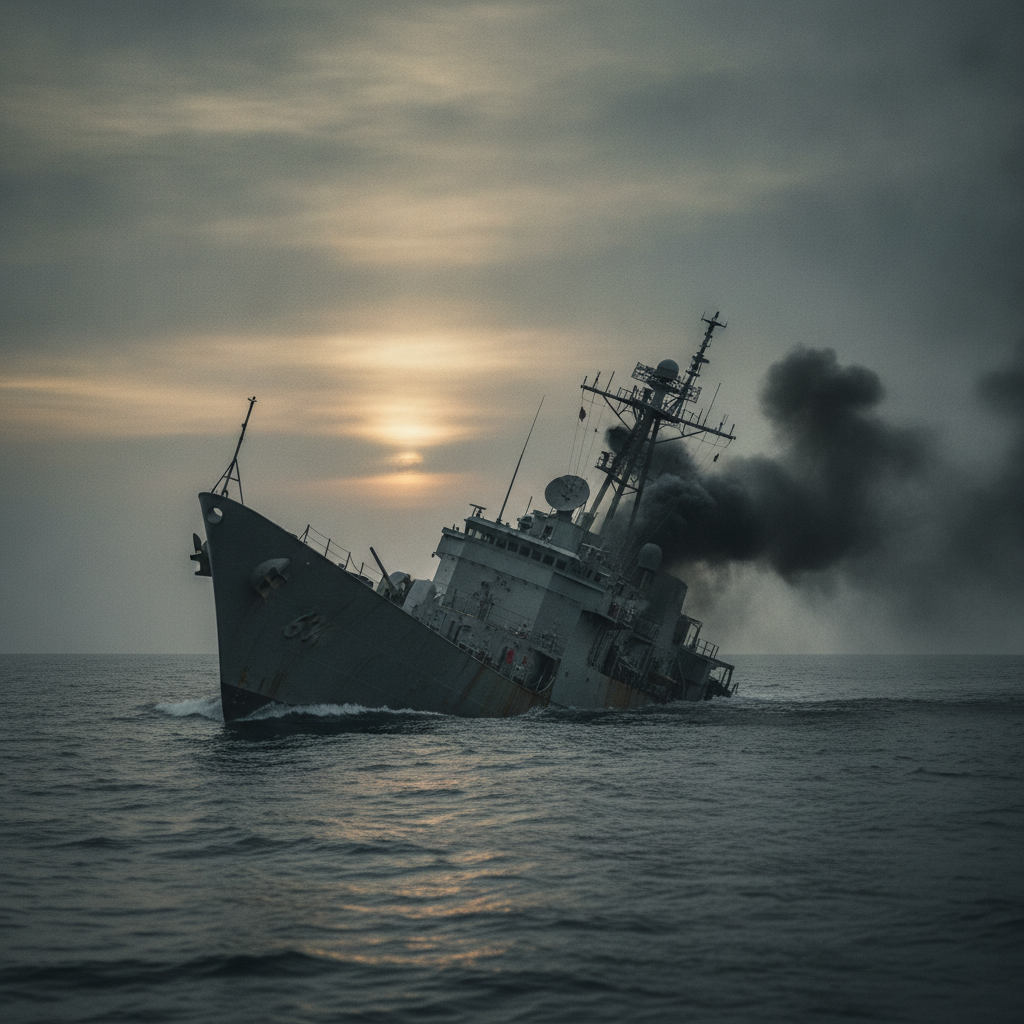
On Sept. 25, the USS Klakring — an Oliver Hazard Perry-class frigate laid up in Philadelphia, Pennsylvania, since its decommissioning on March 22, 2013 — slipped beneath the North Atlantic during Exercise Atlantic Thunder 2026, a joint U.S.-U.K. live-fire exercise led by the U.S. 6th Fleet. [1]
The kill shot came from the USS Massachusetts, a nuclear-powered Block IV Virginia-class fast-attack submarine, which struck the Klakring with a Mk 48 Advanced Capability Torpedo. [1]
The sinking came just days after a separate milestone: on Sept. 13, the Royal Navy fired a U.S. Navy Mk 48 Heavyweight Torpedo from a British Excalibur uncrewed underwater vehicle at the British Underwater Test & Evaluation Centre in Scotland. [2] According to the U.K.'[2]
That test fell under AUKUS Pillar 2, a multilateral agreement between the U.S., U.K., and Australia to enable uncrewed undersea vehicle payload systems that can be used across each country's UUVs. [2]
Together, the two events sketch a doctrine in motion: allied navies moving away from single-hull dependence toward distributed, autonomous lethality — where the platform firing the weapon need not carry a crew, or even a flag.
For adversaries watching the North Atlantic, the arithmetic is straightforward. [1] When a crewless British submarine can arm itself with American torpedoes, and a U.S. fast-attack boat can finish what it started, interoperability stops being a briefing-room concept.
This sinking exercise not only validated the power behind U.S.-UK offensive weapons but delivers a clear message to adversaries that the U.S. Navy and Royal Navy remain a ready allied force.Capt. Kelechi Ndukwe