Baltic Navies Are Mining the Sea Floor
Denmark and Lithuania have signed on to Finland's Blocker mine program, joining a five-nation NATO pact worth hundreds of millions of euros.
By The Defense Desk
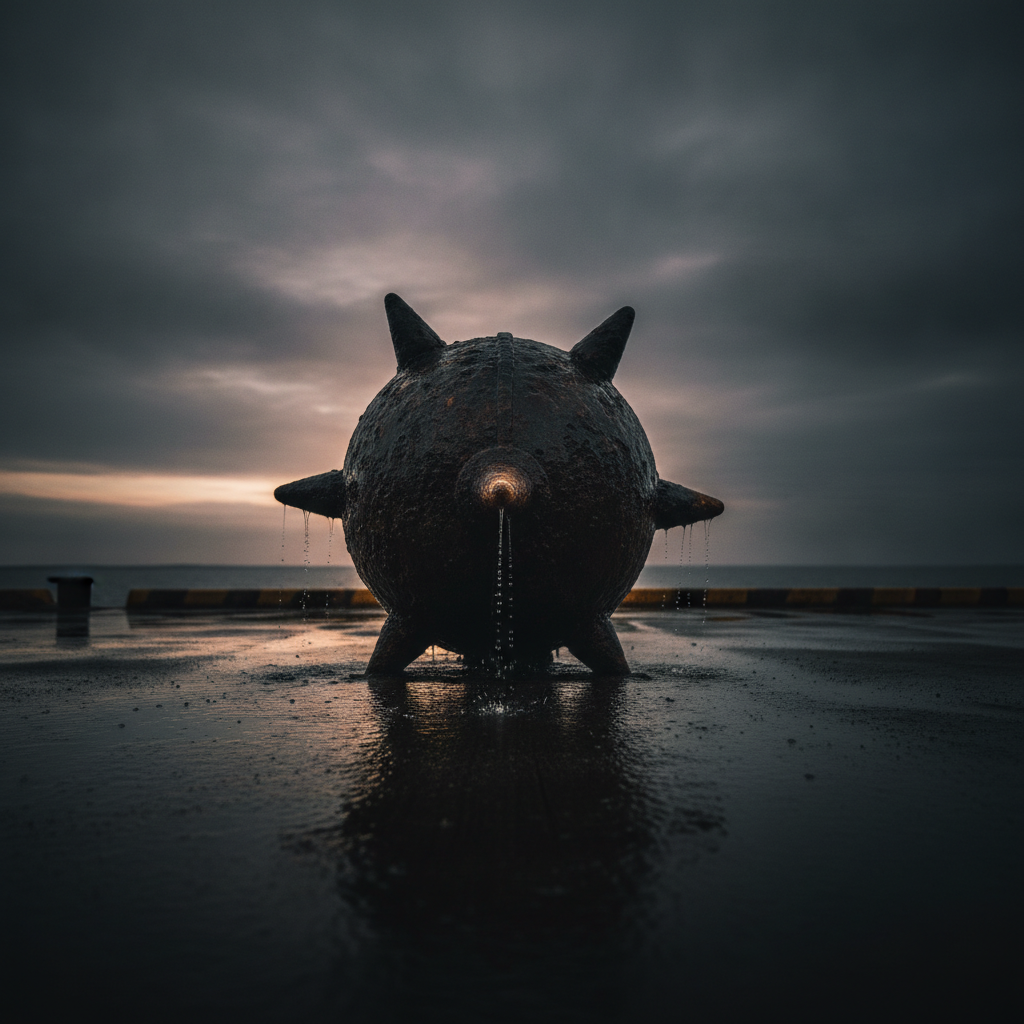
Denmark and Lithuania have each signed contracts to acquire Finland's Blocker naval mine, joining a pentalateral procurement scheme that now spans five NATO allies and is worth 'hundreds of millions of Euros,' according to the Finnish government. [1]
The Blocker is built by Finnish manufacturer Forcit Defence and already in service with Finland and Estonia, which bought the system in 2021. [1] It detects ships using a range of sensors and carries the explosive power equivalent to a ton of TNT. [1]
[1][2] Finland leads the consortium; the Finnish military signed a contract with Forcit Defence in June on behalf of the five countries participating in the NMC's procurement scheme. [1]
Beyond the initial buy, the NMC is designed to 'strengthen cooperation on logistics, training, exercises and the lifespan of the systems,' the Danish ministry of defense said. [1] Germany and Norway are also named in the pentalateral agreement but have not yet publicly announced their own contracts. [1]
Ten countries signed the pact's original declaration of intent: Belgium, Latvia, Lithuania, Norway, Poland, Sweden, Denmark, Germany, Finland and Estonia — all NATO members. [1] Germany may still announce a procurement decision this year, German industry publication Hartpunkt reported, citing 'well-informed circles.' [1]
Naval mines are enjoying a sharp return to strategic relevance. The weapons had faded from headlines for decades, associated more with Cold War contingency planning than active deterrence — but the calculus has shifted in both the Baltic and beyond.
Naval mines have been front and center in the news this year, with Iran's use of the technology to block the Strait of Hormuz and hold a large part of global energy supplies hostage in response to the U.S.-Israeli campaign against it. [1] In the Baltic, the pressure is different but equally pointed.
With Finland and Sweden's accession to NATO, the Baltic Sea is now entirely surrounded by the alliance, except for Russia's Kaliningrad and Leningrad Oblast coasts. [1] Russia, whose ships must pass through the narrow Danish straits and onward through the Kattegat and Skagerrak to reach the open ocean, faces a significant strategic constraint. [1]
Moscow has been blunt about its reading of that geography. [1]
Joint procurement at this scale is itself part of the signal. Five nations buying a single system under a shared framework means interoperable stocks, shared training pipelines, and a collective mining capability that no single Baltic navy could sustain alone. The mine becomes an alliance instrument, not just a national one.
Finland's role as lead nation is not incidental. 'Selecting Finland as the lead nation of the naval mines cooperation project is a reflection of the Finnish Navy's long-standing capability in naval mining,' the country's military wrote in a statement. [1] Forcit Defence, based in Finland, is now positioned as the primary supplier for NATO's Baltic mine stockpile.
Whether Germany and Norway formalize their contracts before year-end will indicate how quickly the alliance wants to close the loop on a weapons program that is, quietly, becoming one of NATO's most consequential Baltic investments.
If this situation cannot be resolved peacefully, the Navy will break through and eliminate the blockade.Nikolai Patrushev