Bee Logic Is Making Robot Swarms Smarter
A honeybee-inspired decision rule helps robot swarms reach consensus under bad data—and may reshape how warehouse fleets handle disruption.
By The Robotics Desk
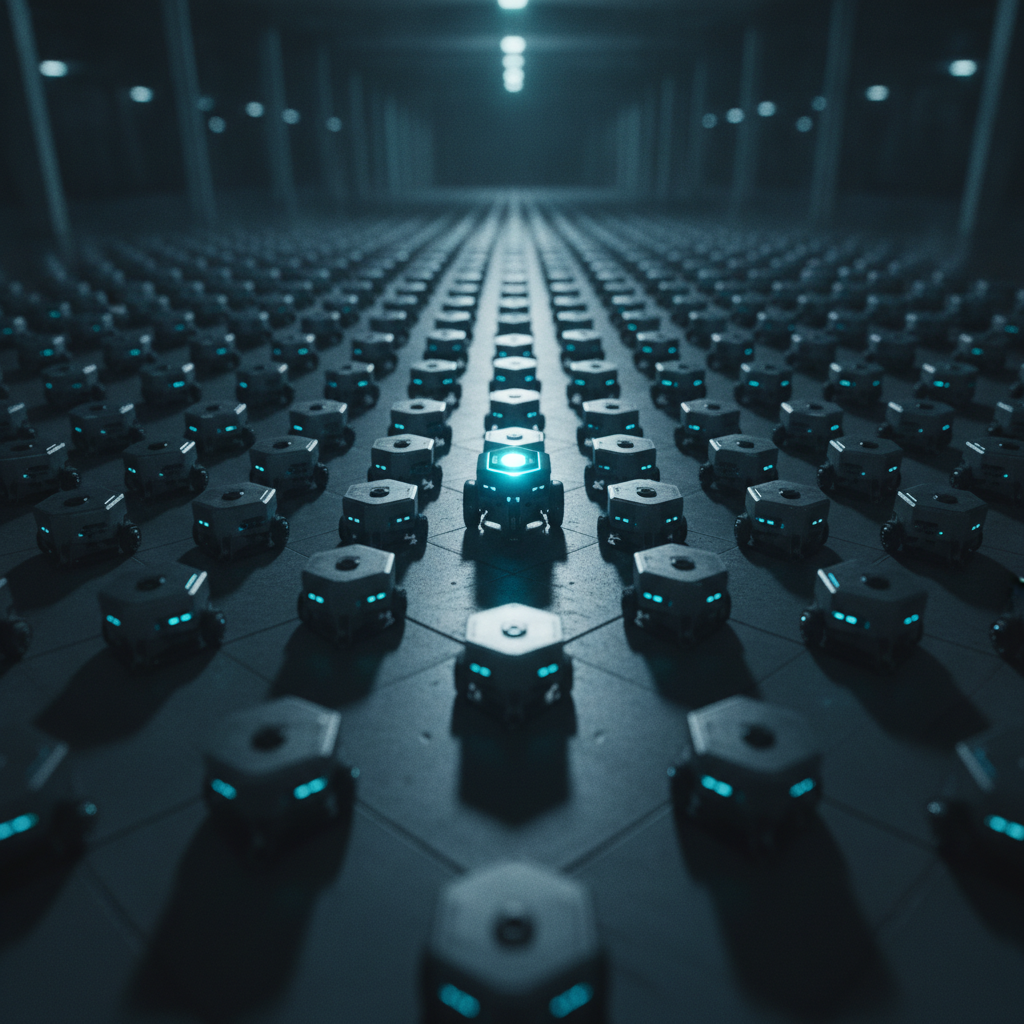
When a robot swarm disagrees, the wrong fix can make things worse. A new study published in Nature Communications by a team led by computer scientist Andreagiovanni Reina at the University of Konstanz shows that a honeybee-inspired rule called cross-inhibition helps swarms reach clear, fast consensus—even when some of the information circulating in the group cannot be trusted. [2]
The researchers tested two competing approaches to collective decision-making. Under the simpler rule, called direct-switch, a robot immediately abandons its current opinion and adopts whatever information it just received. The method is cheap on memory and computing power, but conflicting or inaccurate messages can leave the swarm repeatedly switching opinions without forming a clear majority. [2]
Cross-inhibition works differently. Rather than copying a conflicting message outright, the robot pauses and temporarily becomes uncommitted before accepting new evidence. The rule was drawn from honeybee colonies searching for a new nest: bees supporting one location can send stop signals that inhibit bees advertising competing sites. This simple behaviour prevents the colony from remaining divided between alternatives, allowing it to reach consensus on a single destination. The study found that cross-inhibition generally enabled the swarm to reach clearer and faster decisions—and the advantage persisted when the robots had to choose among more than two alternatives or as the swarm became larger. [2]
One counterintuitive finding: a moderate amount of disturbance could sometimes improve the accuracy of cross-inhibition. A limited amount of unreliable information prevented the swarm from settling on the worse option, making the better decision more likely. The sources of bad data tested included a malfunctioning robot, incomplete sensor data, or a cyberattack—exactly the threat profile that real-world deployments face. [2]
The finding reframes a persistent anxiety in autonomous systems design. Noise and error have long been treated as problems to eliminate; here, they emerge as latent assets when the underlying decision architecture is well-chosen.
The stakes extend well beyond the lab. Future robot swarms may have to act in places where direct human control is difficult or dangerous—searching disaster zones, responding to chemical spills, or monitoring fragile ecosystems. In those contexts, the ability to form a fast, reliable consensus without a central controller is not a refinement; it is a prerequisite. [2]
Cross-inhibition is not unique to honeybees. Similar patterns of inhibitory interaction appear at very different levels of biological organization—from networks of neurons to the molecular regulatory networks controlling the cell cycle. Each system shares the same winner-take-all logic: competing alternatives suppress one another until one clear outcome emerges. Reina's team argues this recurrence points toward a general principle that engineering can borrow. [2]
The industrial context for that borrowing is already large. Amazon Robotics deploys over 1 million robots across its warehouse network, coordinating them through centralized fleet orchestration and AI-driven traffic management. Ocado manages thousands of robots in grid-based swarm fulfillment systems and centralized energy coordination architecture, where a 50-item basket can be picked in under five minutes. Both companies rely on centralized control layers that continuously optimize robotic movements and order sequencing in real time. [1]
Centralized architectures perform well in structured warehouse environments with predictable workflows, but dependence on a single coordination layer introduces scalability limitations, communication bottlenecks, and infrastructure vulnerability if failures occur within the primary control layer. Decentralized models improve fault tolerance but carry their own cost: as swarm size increases, message traffic scales significantly, and the resulting communication congestion can reduce real-time responsiveness. [1]
Hybrid architectures—combining centralized AI coordination with decentralized energy autonomy—are emerging as the practical middle ground. Edge computing and distributed battery intelligence can enable individual robots to process data and manage energy states without constantly relying on a central controller, reducing communication congestion, routing instability, and localized energy imbalance in large-scale deployments. [1]
What Reina's research adds to that picture is a layer below the infrastructure debate: the decision logic that runs on each node. Power topology determines how energy flows; cross-inhibition shapes how consensus forms. Both matter, and they are increasingly inseparable.
As swarm deployments grow more complex—spanning disaster response, autonomous mobility, and high-density fulfillment—the field is discovering that biological systems already solved several of its hardest problems. The task now is translation. [2]