Blackbeard Takes Flight While Pentagon's Hypersonics Stumble
The Navy's carrier-launched hypersonic missile just flew under a Super Hornet. A GAO report says everything else in the portfolio is slipping.
By The Defense Desk
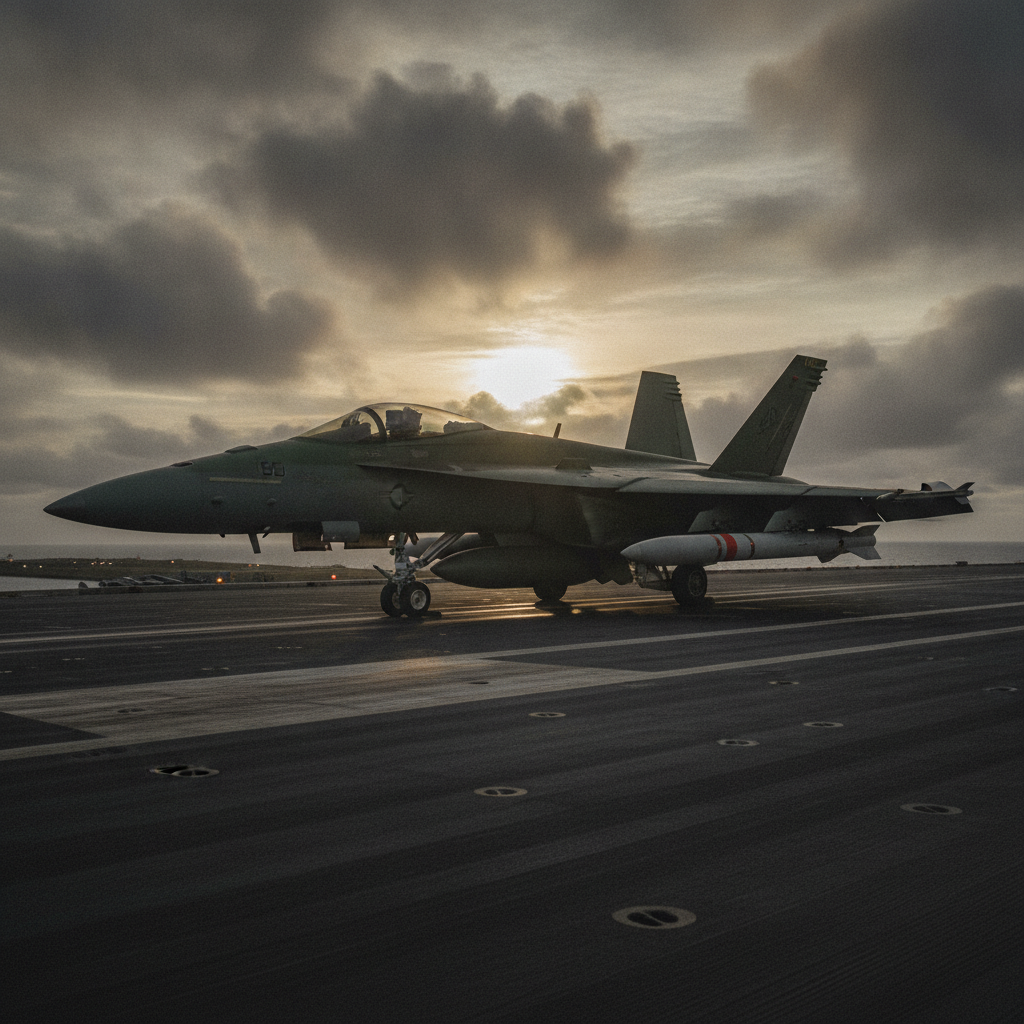
For the first time, the U.S. Navy has publicly shown Blackbeard hypersonic strike missiles flying under the wings of F/A-18E/F Super Hornets during actual flight testing — a milestone that arrives just as a Government Accountability Office report declares three of the Pentagon's other hypersonic programs at risk of delay or underperformance. [1][2]
The Navy's Office of the Portfolio Acquisition Executive for Aviation (PAE-A) released a video montage of Blackbeard in flight, tagging the official accounts for U.S. Central Command and U.S. Pacific Command in the post. [1]
Blackbeard is developed by defense start-up Castelion. The Pentagon struck a deal with the company valued at $43.65 million for the manufacturing, assembly, testing, and delivery of the first production lot of 444 fully functional tactical missiles. [1]
The weapon's design pairs a ballistic-missile-style booster with what appears to be an unpowered hypersonic glide vehicle on top. Hypersonic speed is defined as anything above Mach 5. Castelion has hinted the missile could hit targets out to just under 500 miles, and imaging infrared guidance — which is immune to radio frequency electronic warfare jamming — is a likely seeker mode for the ship-killing role the Navy has in mind. [1]
The acquisition program, formally called the Multi-mission Affordable Capacity Effector (MACE), was conceived from the start around volume and affordability. The U.S. Army is also pursuing a ground-launched variant. [1]
The contrast with the wider hypersonics portfolio could not be starker. While one program films flight-test footage and posts it publicly, the institutional machinery behind America's other hypersonic bets is grinding against its own timelines.
Published this month, the GAO review found that three major Pentagon hypersonic programs — the Air Force's Hypersonic Attack Cruise Missile (HACM), the Army's Long Range Hypersonic Weapon (LRHW), and the Navy's Conventional Prompt Strike (CPS) — are each at risk of being delayed or delivering systems that have not been fully demonstrated. [2]
Program officials told GAO that if a significant flight test failure occurs, it is likely that the program will not be able to complete all five tests within the five-year rapid prototyping timeframe. [2]
GAO found that 'missing, inconsistent and unclear work standards for missile production' have pushed delivery of the Army's second LRHW battery to at least six months behind schedule. The Navy's CPS program encountered similar quality problems on the production line and has postponed integrating the weapon onto its Zumwalt-class destroyers. Both services failed to conduct an industrial base assessment before production began — a step GAO says would likely have caught the problems early. [2]
The GAO also cautioned against the broader pattern: 'More broadly, these findings contribute to growing evidence that programs using the MTA pathway are not delivering fieldable capabilities faster.' [2]
Blackbeard was shaped precisely to avoid these failure modes — smaller company, smaller missile, smaller price tag, with scale baked into the contract structure from day one. Whether that formula holds through full-rate production is the test the video montage cannot answer.
If Blackbeard reaches service by 2028 as planned, it would likely become the first operational air-launched hypersonic weapon in the American inventory — a distinction that was supposed to belong to the Air Force. [1][2]