China's WZ-X Drone Has a Very Strange Wing
New ground-level imagery confirms the WZ-X's stepped wing planform—and raises fresh questions about its stealth, endurance, and ambitions.
By The Defense Desk
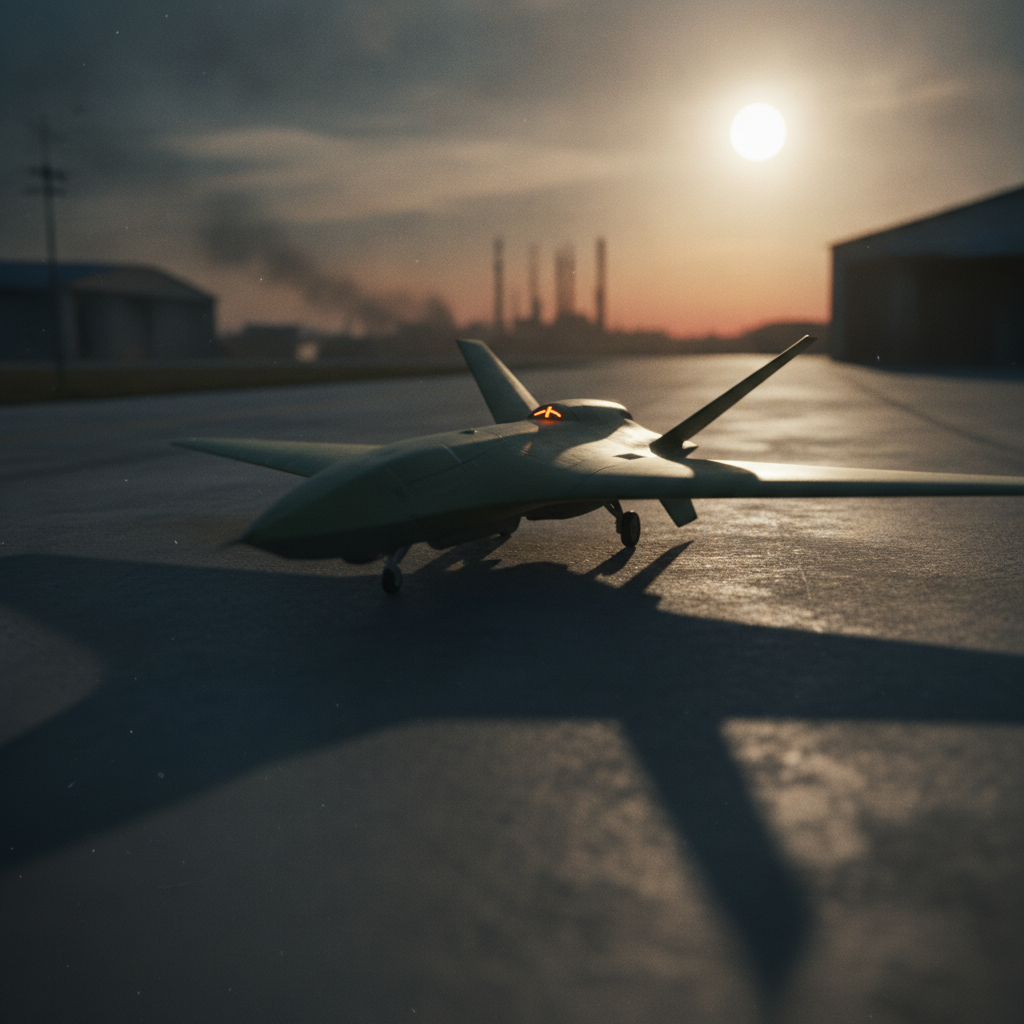
For months, China's WZ-X existed only in blurry satellite stills—a vast, bat-like silhouette parked at a remote test base in Xinjiang. Now, clearer imagery has surfaced, and the aircraft's most confounding feature is confirmed: its wings don't taper the way wings are supposed to. [1]
The WZ-X was first spotted in satellite imagery collected in May 2025 at the People's Liberation Army Air Force's test facility at Malan in Xinjiang. [1] New photographs and a fresh satellite pass have resolved what analysts weren't sure about: whether the apparent discontinuities in the wing were real design choices, visual countermeasures, or simply artifacts of low-resolution overhead imagery. [1]
They're real. The aircraft has a broader-chord inner wing section that transitions into a substantially narrower outer section—not a continuous taper, but a 'step down'-like fashion that leaves it with an exceptionally long, narrow outer wing. [1] The arrangement differs from the B-2 and other stealthy flying-wing designs because it has two outer wing sections, in addition to its diamond-like central fuselage, instead of just one. [1]
The engineering logic behind the step is plausible for a high-altitude loitering aircraft. Such an arrangement would increase effective aspect ratio and reduce induced drag during efficient cruise, potentially improving endurance and high-altitude performance. [1] It may also allow the designers to concentrate structural mass and internal volume closer to the center of the aircraft while still achieving a very large span. [1]
There is a potential low-observable tradeoff, however. [1] Modern very low observable designs try to minimize these exact types of features, with large continuous structures being the most advantageous to radar signature—a philosophy visible in the B-21's planform, which was also how the B-2 was supposed to look originally. [1] Regardless, the WZ-X does indeed have a semi-sawtooth trailing edge due to this intriguing feature. [1]
The tension between aerodynamic efficiency and radar invisibility is the oldest argument in stealth design. What makes the WZ-X interesting is how openly it wears that tension—a machine that seems to prioritize staying aloft over staying hidden, while still trying hard to do both.
Initial analysis of satellite imagery put the WZ-X's wingspan at approximately 170 feet, roughly comparable to the 172-foot span of the B-2—considerably larger than other Chinese flying-wing drones identified to date. [1] Andreas Rupprecht, an analyst specializing in Chinese military aviation and TWZ contributor, assesses that the WZ-X is likely a twin-engined design similar in configuration to the supposed U.S. RQ-180, but considerably larger. [1] Rupprecht estimates a length of approximately 46 feet. His estimates of a range exceeding 12,000 miles and a normal cruising altitude of somewhere between 59,000 and 66,000 feet remain unconfirmed. [1]
The new imagery reinforces what the airframe's proportions already suggested: this is built for persistence, not speed. The central body and inner wing section would provide substantial space for fuel, sensors, and communications systems, while the outer wing, combined with its lifting central body, could support highly efficient flight at high altitude. [1]
A strike capability cannot be ruled out, particularly given China's broader development of combat-capable flying-wing UCAVs, but the aircraft's proportions appear especially well suited to persistence and reconnaissance. [1] The WZ-X isn't alone at Malan: the GJ-X, a similarly large flying-wing aircraft with a cranked-kite planform, is also undergoing flight testing there, with an estimated wingspan of around 137 feet. [1] China is pursuing tailless flying-wing designs across an increasingly wide range of sizes and missions, alongside larger crewed aircraft programs including the J-36 and J-XDS and, eventually, the H-20 stealth bomber. [1]
What Malan represents is a systematic push across categories—not a single bet on one design, but a portfolio approach to operating unseen at altitude. The WZ-X may be the most legible expression of that ambition yet, precisely because its peculiar wing finally lets analysts read the intent.
Its official designation, manufacturer, propulsion system, performance, and intended mission remain unknown. [1] But the aircraft's configuration is no longer a mystery—and neither is the general direction China is heading.
A low-observable platform of this size could potentially conduct many types of wide-area surveillance and networking assistance while operating in or very near contested airspace where conventional high-altitude UAVs would face greater risks.TWZ analysis