Coldcard's Fix Goes Deeper Than the Hack
Coinkite's new firmware mandates hand-rolled entropy and hardens the entire signing pipeline — but old seeds stay burned.
By The crypto-money Desk
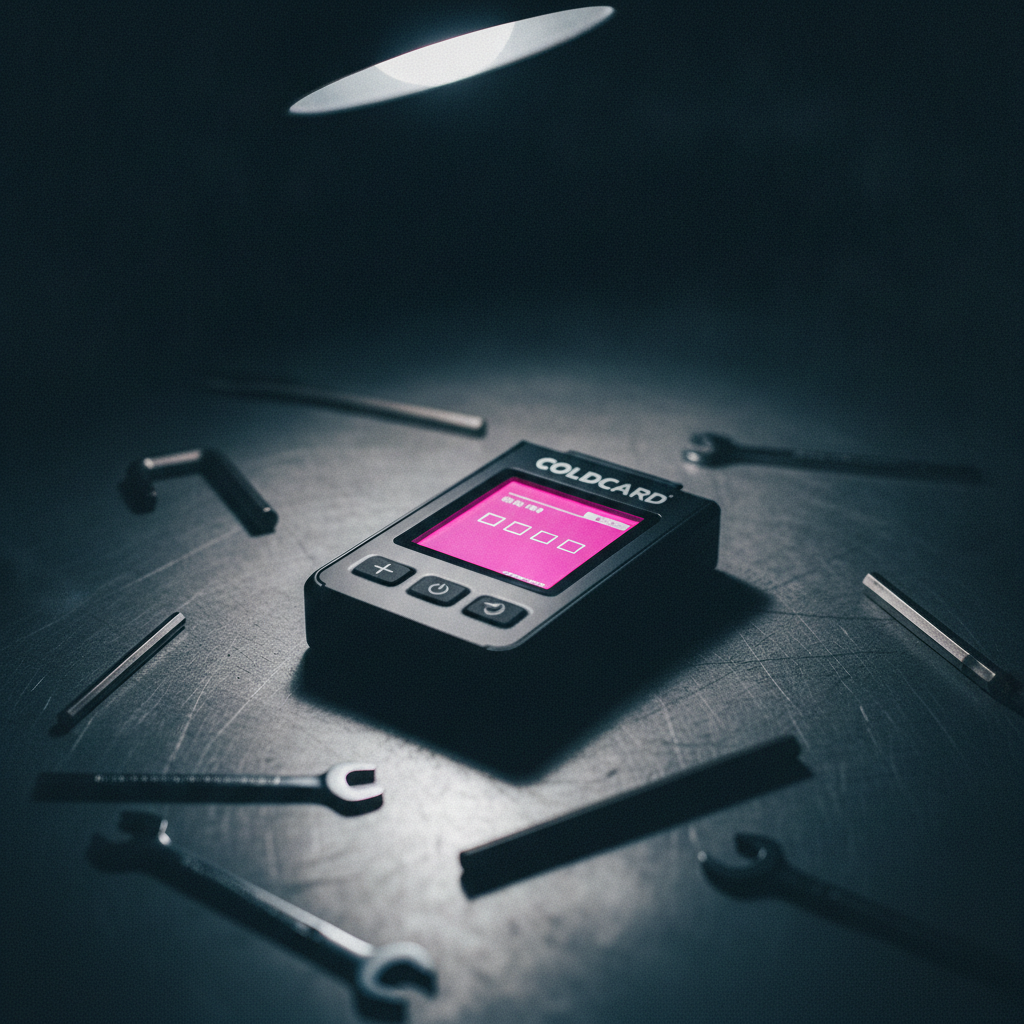
Weeks after a randomness flaw exposed Coldcard hardware wallets to a +$100M BTC theft, Coinkite has shipped firmware 5.6.1 for Mk4/Mk5 devices and 1.5.1Q for the Q model — and the fix is considerably wider than the original wound [1][2].
That sweep — which Coinkite says included review by Kimi and other frontier models — examined not just the RNG path but the whole system [2]. What came back covered seed generation, transaction signing, USB data handling, firmware-update validation, Delta Mode hardening, and wallet backups [2].
The most visible change is mandatory user-sourced entropy. Every newly generated seed now requires at least 65 key presses with unpredictable timing, 50 rolls of a physical six-sided die, or 128 physical coin flips [2]. The backup PRNG generator has also been swapped: SHA-256 Hash_DRBG replaces the older Yasmarang algorithm [2].
On the signing side, Coldcard now re-verifies a staged PSBT immediately before signing [2]. If a connected host changes the transaction after it was reviewed on the device, signing stops and COLDCARD displays Transaction modified [2]. Additionally, SIGHASH_SINGLE and SIGHASH_SINGLE|ANYONECANPAY are now blocked by default, because later transaction outputs can remain modifiable in those modes [2].
The architecture of trust in self-custody has always rested on the assumption that the device is the last honest actor in the chain. When that assumption fractures at the entropy layer, no downstream control can compensate — which is precisely why the scope of this review matters more than any single patch.
There is one boundary the firmware cannot cross. Seeds generated between 2021 and this July are still considered burned, regardless of the update [1]. Coinkite is explicit: installing firmware 5.6.1 does not make an existing vulnerable seed safe [2].
The company has also launched a public COLDCARD Security Status page carrying a fixed-release matrix, migration guidance, independent-validation evidence, and machine-readable status updates [2]. "FreeZ Agent" reported the staged-PSBT issue, "Rety" reported the Seed XOR issue, and Peter Todd shared ideas on inter-key timing entropy [2].
Hardware wallets sell a specific promise: that physical possession of the device equals physical possession of the coins. The gap between that promise and the entropy reality exposed here is a useful reminder that security guarantees are only as strong as the quietest assumption embedded in the firmware.
For Mk4, Mk5, and Q owners who generated seeds on affected firmware, the action item is unchanged: the update matters, but the migration is not optional. For a wallet intended to hold a meaningful balance, Coinkite recommends the standard Dice Rolls option executed honestly with genuine rolls, a strong and unique BIP-39 passphrase, and, where appropriate, a carefully designed multisig setup suited to your threat model [2]. The firmware is available from the official downloads page; users should verify the SHA-256 hash and PGP signature before installing [2].
Installing this update does not make an existing vulnerable seed safe. If your seed may have been generated on affected firmware from 2021 through July 2026, create a new seed using fixed firmware and move your funds by following our seed-generation advisory.Coinkite