Concorde Once Chased an Eclipse for 74 Minutes
In 1973, eight scientists strapped into a prototype supersonic jet and outran the Moon's shadow across the Sahara — a record that still stands.
By The space-quantum Desk
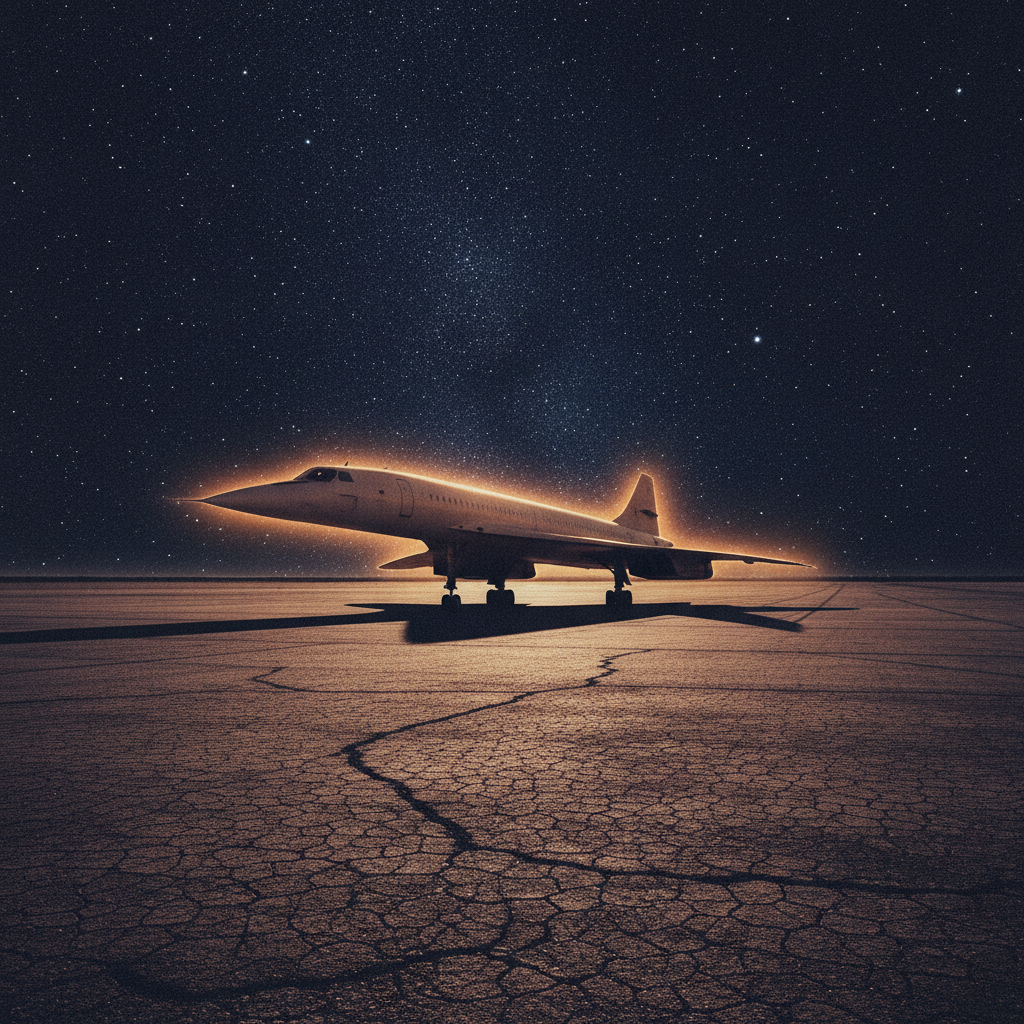
At the National Air and Space Museum of France, parked at Paris-Le Bourget airport, the Concorde F-WTSS 001 prototype carries a painted map along its nose — tracing the path of a June 1973 total solar eclipse across Africa. That map is there for a reason: eight scientists aboard this aircraft set a world record by observing totality for 74 minutes, flying at more than twice the speed of sound. [1]
The maximum duration of totality on the ground tops out at around 7.5 minutes near the equator. [1] The August 12 eclipse visible from parts of Europe will offer slightly more than two minutes. What Pierre Léna and his colleagues achieved in 1973 is in a different category entirely — and the record has not come close to being broken since. [1]
Léna, who was from the Paris Observatory, identified that the 1973 eclipse path near the equator would cause the Moon's shadow to move at a relatively slower speed — although still more than 2.2 times the speed of sound — making a chase just barely conceivable. Scientists from the French National Centre for Scientific Research, Kitt Peak Observatory in Arizona, Los Alamos National Laboratory, Queen Mary College in London, and the University of Aberdeen joined the mission. [1] Four portholes were cut into the ceiling of the aircraft, one per experiment, to study corona dust, oscillating hot gas, and the chromosphere. [1]
The flight departed Las Palmas in the Canary Islands and had to rendezvous with the eclipse shadow over Mauritania within 1 nautical mile and 15 seconds. [1] With the shadow moving east at a slightly higher speed than the Concorde's Mach 2.2, the scientists had 80 minutes of observation time before the aircraft fell behind the eclipse's shadow; headwinds reduced that to 74 minutes. [1]
What makes this story linger is not just the audacity of the engineering or the elegance of the science — it is the image of a pilot threading a supersonic needle through the shadow of the Moon, somewhere above the Sahara, with seconds to spare.
"No one has achieved even half of it during the past 53 years," Léna said. [1] The portholes cut into the ceiling of Concorde 001 are still visible to anyone who walks its aisle today.