Crew Dragon's Long Goodbye
SpaceX's workhorse capsule has more life in it than you might think — but the industry building around it is running out of certainty.
By The space-quantum Desk
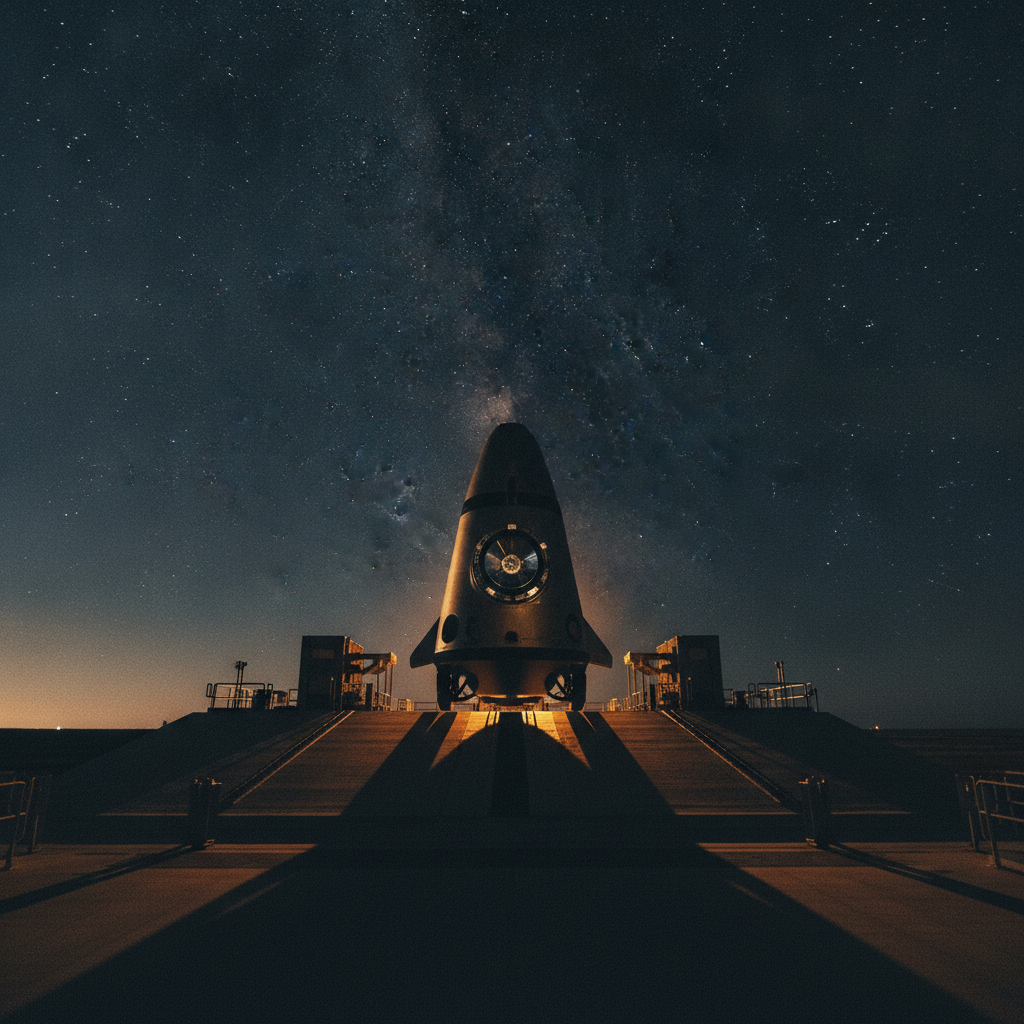
Crew Dragon was never supposed to be permanent. When SpaceX first flew astronauts to the International Space Station in 2020, the capsule was a stopgap measure dressed up as a milestone — proof that American commercial industry could do what NASA's shuttle program once did. Five years later, with Crew-13 set to become SpaceX's 18th human spaceflight mission to the ISS [1], the question is no longer whether Crew Dragon works. It is how long the industry can afford to depend on it.
On September 12, a Crew Dragon called Grace — the newest spacecraft in SpaceX's fleet — is scheduled to lift off on Crew-13, its second flight [1]. Grace made its debut last summer on the Ax-4 private astronaut mission. The flight is, on its surface, routine. Behind the scenes, it arrives at a moment of unusual ambiguity for the commercial human spaceflight market.
SpaceX has confirmed it does not plan to build additional Crew Dragon spacecraft beyond the five currently in service [1]. The hardware was originally certified for five missions each, but the company has been working with NASA to extend individual spacecraft lifetimes to up to fifteen missions each [1]. Julianna Scheiman, director of NASA science and Dragon programs at SpaceX, put the position plainly at an August 3 NASA briefing: "I see a significant amount of life remaining on our Dragon fleet. We do some of that math between NASA and SpaceX and see many more flights available on the hardware itself." [1]
The math, though, is only as useful as the market it serves. The commercial space industry is mid-pivot — away from a single, aging station and toward a constellation of privately owned destinations, each with its own architecture, its own partners, and its own assumptions about what kind of vehicle will ferry crews to its doorstep. The spacecraft that got the industry here may not be the one that takes it further.
Demand for Crew Dragon seats is, by any visible measure, high. In May, NASA filed plans to procure up to six more Dragon missions after the final mission on its current contract, Crew-14, citing delays in the certification of Boeing's CST-100 Starliner [1]. The European Space Agency announced in March that it is considering flying a dedicated Crew Dragon mission to the ISS for its astronauts [1]. Axiom Space, Vast, and Voyager Technologies all have private astronaut missions to the ISS in the pipeline, and Vast has multiple missions to its Haven-1 commercial station under contract [1].
"We anticipate Dragon supporting ISS for years to come," Scheiman said [1]. But the ISS is not the whole picture. The station is expected to be deorbited around the end of the decade, and the commercial stations intended to replace it — Haven-1 and others under NASA's Commercial LEO Destinations program — are currently in development. Those projects need transportation contracts now, or close to it, which means they need answers about Crew Dragon's availability that SpaceX has not fully provided.
A spacecraft with fifteen potential flights per vehicle sounds like abundance. Spread across five capsules, amortized against a growing queue of destinations and operators and national space agencies newly interested in buying seats, it starts to look like a finite and carefully managed resource — one whose steward is openly building its replacement.
That replacement is Starship. SpaceX has been transparent about its ambitions for the vehicle, and Scheiman did not obscure them at the August briefing. "I personally am really excited about the Starship vehicle enabling hundreds of people to be launching to space, low Earth orbit and beyond," she said [1]. The company insists the transition will not be a hard cutover. "We do anticipate flying Dragon and Starship at the same time," Scheiman said. "We see those operating at the same time as we continue to develop and make improvements on Starship." [1]
What overlap looks like in practice remains unresolved. Starship is a fundamentally different vehicle — far larger than Crew Dragon [1] — and the commercial stations being designed today are calibrated around current hardware. An eventual shift to Starship is not simply a swap of one capsule for another; it is an architectural renegotiation that touches every station's docking system, crew capacity assumptions, and logistics models. When asked directly whether SpaceX was continuing to sell Crew Dragon missions to commercial space station developers, Scheiman declined to confirm it [1].
Her answer was careful and revealing. "We have a plethora of missions that we're supporting and on contract for, to include missions to support the private astronaut missions, both those that go to the International Space Station as well as those to Vast, a private space station," she said [1]. The phrasing is precise: existing contracts are acknowledged, future ones are not. For a commercial space station developer trying to build a business model around crew transportation, that distinction matters enormously.
NASA's posture through all of this has been studied neutrality — the kind of detachment that functions less as indifference and more as deliberate system design. The agency helped create the conditions for commercial competition, and it intends to let that competition resolve the transportation question on its own terms.
Dana Weigel, manager of NASA's low Earth orbit program, articulated the agency's approach at the same briefing. "It had always been part of the agency's plan to have two different commercial crew providers, and so we're committed to that," she said [1] — a restatement of the dual-provider philosophy that has shaped NASA's commercial crew strategy since its inception, and also a reminder that Boeing's Starliner is still theoretically part of the equation. NASA continues to work with Boeing to certify Starliner for long-duration ISS missions [1], though that process has been slow enough that the agency felt compelled to seek six additional Dragon missions as a hedge.
For the next generation of stations, Weigel described a structure that shifts responsibility for transportation decisions away from NASA entirely. The agency's Commercial LEO Destinations program is designed around what she called an end-to-end service: destination and transportation bundled together, with the station operator selecting its own transportation partner. "The transportation side and the destination side are tied together in an end-to-end service, and so commercial industry, the destination providers specifically, are working directly with transportation providers and deciding who they're partnering with," she said [1]. NASA recently received comments on a draft solicitation for the next phase of the program and plans to issue a final solicitation "as soon as we can" [1].
The architecture is elegant in theory and uncomfortable in practice. It places the risk of transportation continuity on the companies least equipped to absorb it — the station developers, who are already managing the engineering complexity of building habitable structures in orbit while simultaneously trying to attract customers, raise capital, and negotiate with a launch provider that is openly pivoting to a different vehicle.
The irony is that Crew Dragon's success created this problem. SpaceX built a spacecraft so capable and so reliable that it became the default option for every operator with a crew to fly — and now the prospect of its eventual retirement, even a retirement years away and softened by a promised overlap period, is enough to inject real uncertainty into an industry that was just beginning to feel settled. The fleet of five capsules, each rated for up to fifteen missions, is a known quantity in a market where known quantities are rare. Losing it — or even losing clarity about it — changes the calculus for every commercial station being designed today.
Scheiman's phrase — "many more flights available on the hardware itself" [1] — is accurate and also incomplete. Hardware has a lifespan. Markets have dependencies. What the commercial space industry built around Crew Dragon is not just a customer relationship; it is an infrastructure assumption. The transition to Starship, whenever it comes and however it overlaps, will not just replace a vehicle. It will require every stakeholder in low Earth orbit to rebuild their assumptions from the docking port out.