Digit Goes to the Farm Belt
Agility Robotics is sending its humanoid to an AGCO plant in Kansas. What happens next will test whether bipedal robots can survive real manufacturing.
By The Robotics Desk
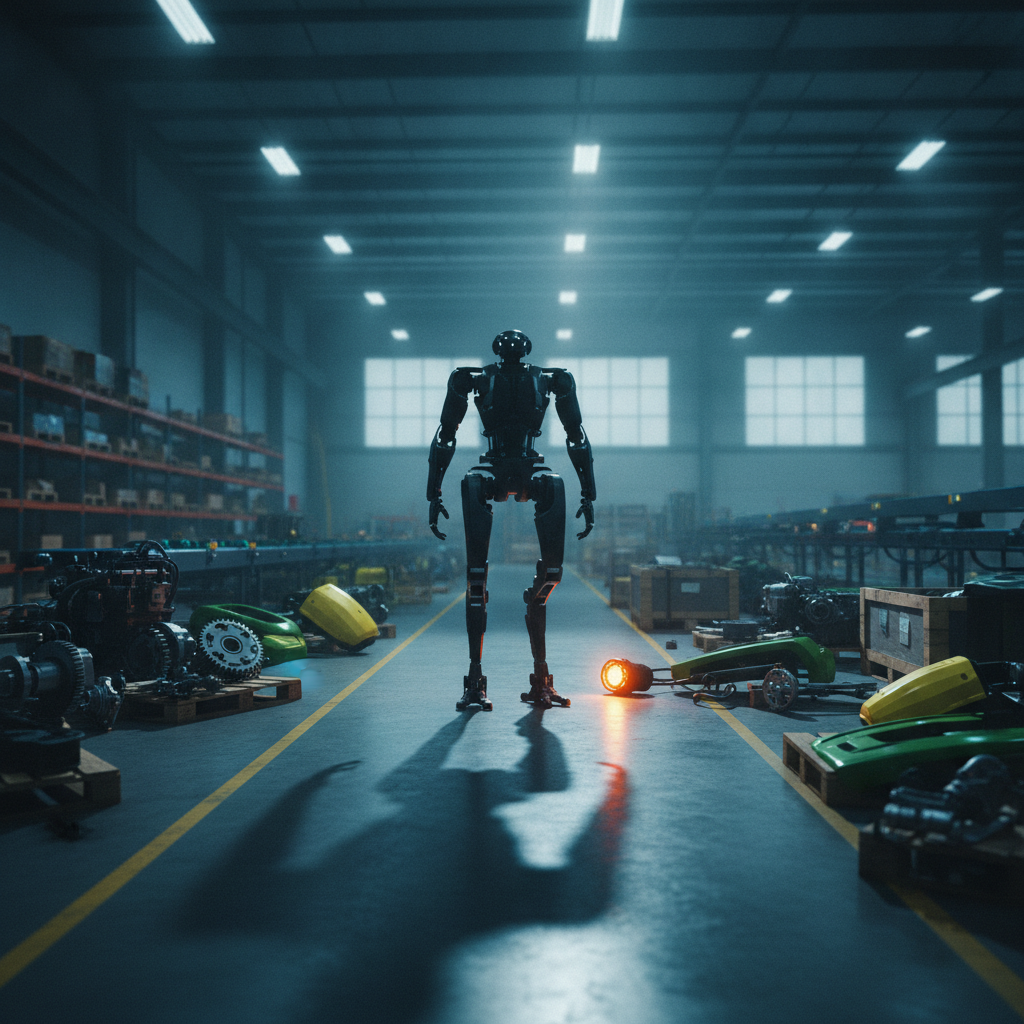
Agility Robotics and AGCO, the Duluth, Georgia-based maker of Fendt, Massey Ferguson, and Valtra machinery, have signed a commercial agreement to deploy Agility's Digit humanoid inside AGCO's manufacturing facility there. [1] It is not a research collaboration or a proof-of-concept lab. It is a factory floor, with production targets and shift supervisors.
[1] Agility describes these tasks as exactly the kind of repetitive, strenuous work that erodes worker health over a full career. Thomas Enghof, AGCO's director of manufacturing technology, framed the collaboration in terms that any operations executive would recognize. "By pairing human ingenuity with robust robotic engineering and strict safety governance, we create resilient manufacturing systems that empower the workforce and deliver measurable business value." [1]
AGCO joins a list that now includes Toyota, GXO Logistics, and Schaeffler. [1] That list matters because it is the evidence Agility needs ahead of its public debut. The Salem, Oregon company is preparing to merge with Churchill Capital Corp XI and list on Nasdaq under the ticker "AGLT," with the business combination expected to close in the fourth quarter of 2026. [1] For a company selling bipedal robots to skeptical plant managers, each signed commercial agreement is also a line in the prospectus.
The arrival of humanoid robots in heavy industry is not a sudden rupture. It is the slow accumulation of deployments, each one a negotiation between what the machine can do today and what the factory actually needs done.
Agility's commercial case rests on a specific design premise: a robot shaped like a person can work in places built for people. Warehouses, assembly lines, and logistics docks were not designed around fixed automation. Conveyors and robotic arms require facilities engineered around them. Digit, by contrast, is meant to slot into existing workflows via the Agility Arc cloud platform, which the company says allows companies to integrate automation "without requiring extensive infrastructure changes or costly facility upgrades." [1] That pitch resonates with manufacturers who have spent decades trying to retrofit automation into buildings that predate the concept.
The robot doing that work has just been updated. Last month Agility unveiled Digit 5, which brings new legs, upgraded batteries, and a more comprehensive safety architecture. [1] Safety architecture is not a minor detail in a setting where Digit will move alongside human workers. The Kansas deployment will be among the first tests of whether those improvements hold under production conditions rather than controlled demos.
Agility's co-founder and Chief Robot Officer, Jonathan Hurst, has spent his career on a specific technical problem: enabling robots to interact physically with the world as well as people do, creating hardware and control approaches that enable the compliance, dexterity, and mobility present throughout the animal world. [2] That research focus—now branded at Agility as Physical AI—is what Hurst describes as "a powerful new set of tools to enable complex locomanipulation behaviors on capable hardware." [2] In plain terms: a robot that can pick things up, put them down, and move through a facility without knocking anyone over.
The leadership team assembled to commercialize that research is notably heavy on enterprise-software and logistics pedigree rather than pure robotics. CEO Peggy Johnson spent six years as Executive Vice President of Business Development at Microsoft, reporting directly to CEO Satya Nadella, before serving as CEO of spatial computing company Magic Leap, where she led the pivot from consumer to enterprise. [2] Chief Business Officer Daniel Diez also came from Magic Leap, where he most recently served as Chief Commercial Officer and led Magic Leap's public transformation from a consumer technology startup to an enterprise technology company. [2] These are executives who have watched automation technology try to cross the gap between demo and deployment before.
What separates a robot company that survives its IPO from one that dissolves into a footnote is rarely the elegance of the hardware. It is the willingness of customers to keep the machines running past the first quarter.
The AGCO deal puts that question in sharp relief. Agricultural equipment manufacturing is not a forgiving environment for new technology. Tolerances are tight, production schedules are tied to seasonal demand, and downtime carries real cost. AGCO's brands—Fendt, Massey Ferguson, PTx, Valtra—serve farmers on multiple continents. [1] A failed automation pilot in Hesston does not stay in Hesston.
Agility says Digit uses AI to continuously learn and adapt to evolving workflows, which in theory means the robot improves as it accumulates hours on the floor. [1] The company also recently confirmed it is exploring wheeled robots for customers who do not need bipedal mobility, an acknowledgment that the humanoid form is not always the right answer. [1] That pragmatism—offering different configurations rather than insisting on a single product vision—is the posture of a company that has spent time with real operators rather than just investors.
The testimonials collected on Agility's own platform suggest early customers share a common vocabulary. [2] The pattern is consistent: the pitch that lands is not efficiency alone, but efficiency framed as relief for the people already on the line.
Daniel Diez positioned the AGCO agreement in similar terms. "By introducing Agility's Digit humanoid robots into AGCO's operations, we have an opportunity to strengthen manufacturing processes, support employees in demanding tasks, and demonstrate how advanced robotics can create measurable impact across modern production environments." [1] The word "measurable" appears often in Agility's public statements—a deliberate signal to an industrial customer base that asks for numbers before purchase orders.
Humanoid robots have been announced into existence many times before they have actually worked. The distinction now is that some of them are clocking shifts rather than press-release appearances. The question is whether the shift count grows fast enough to matter.
Hesston will not make or break the humanoid robot industry. But a factory in the Kansas wheat-belt, running Digit 5 through tote-stacking cycles while its maker prepares a Nasdaq listing, is about as concrete a test of the technology's commercial viability as currently exists. If Agility's robot can hold up through a production season in agricultural equipment manufacturing, the list of facilities willing to try the same will grow. [1] If it cannot, no amount of well-crafted IPO language will obscure the gap between demonstration and deployment.
Toyota Motor Manufacturing Canada has long been a leader in automotive manufacturing innovation. After evaluating a number of robots, we are excited to deploy Digit to improve the team member experience and further increase operational efficiency in our manufacturing facilities.President