ESA Picks Three Satellites to Map Climate's Blind Spots
ECO, Keystone, and CryoRad advance toward Earth Explorer 12 — targeting the planet's energy budget, secret atmosphere, and vanishing ice.
By The space-quantum Desk
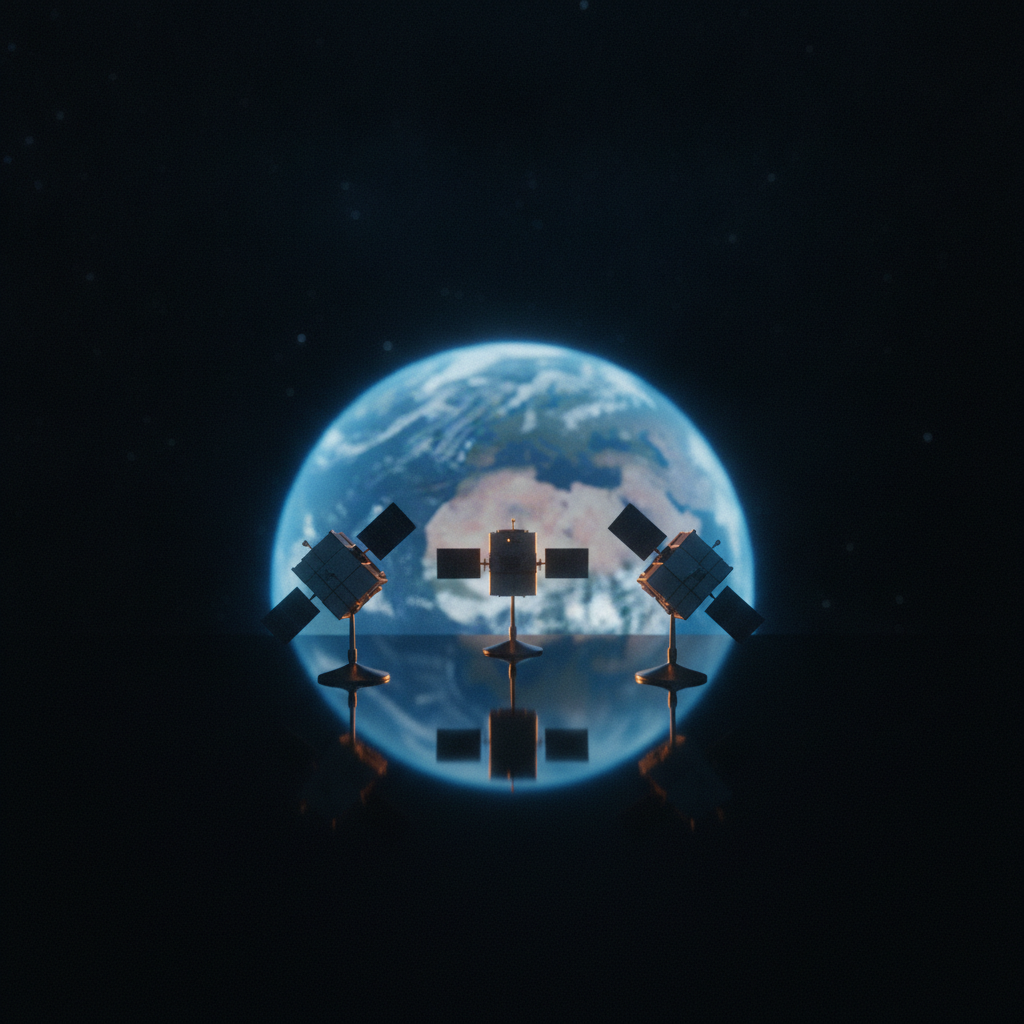
The European Space Agency has shortlisted three satellite concepts — ECO, Keystone, and CryoRad — to advance toward Earth Explorer 12, the agency's next flagship research mission. [1] One will be selected for implementation before the next ESA Ministerial Council and is expected to launch in the 2036 timeframe. [1]
The decision came from ESA's Programme Board for Earth Observation, which weighed both scientific merit and programmatic considerations. [1]
ECO sits at the top of the ranking because it targets what scientists consider the most consequential gap in climate knowledge. The mission would deliver the first direct measurements of Earth's Energy Imbalance (EEI), the fundamental driver of our climate. [2] Since the industrial revolution, the balance between incoming solar radiation and the Earth's radiation has been disrupted by the emission of greenhouse gases. [2] Using a unique satellite constellation combining Sun and Earth radiometers, and wide-field visible and infrared imagers, ECO would resolve the global radiation budget and provide timely objective evidence to steer climate action. [2]
Rene Forsberg, on behalf of the ACEO, said that ECO "would target global mean Earth Energy Imbalance (EEI), the most fundamental climate variable, and widely recognised as the most important longstanding knowledge gap in quantifying ongoing climate change and would assess the effectiveness of climate mitigation measures." [1] ESA acknowledged the mission is extremely challenging but chose to give it the opportunity to be further investigated precisely because of its scientific and societal relevance. [1]
Keystone takes aim at an almost entirely uncharted layer of the atmosphere: the 50–250 km altitude range. [1] Prof. Forsberg noted that by providing the first global direct observations of atomic oxygen together with co-located measurements of temperature, wind and relevant atmospheric constituents in that range, Keystone would address fundamental knowledge gaps in this underexplored part of the atmosphere. [1] Using a novel combination of limb-sounding techniques across the Terahertz, infrared and UV-visible spectral domains, the mission would significantly advance whole-atmosphere chemistry-climate system understanding and improve estimates of satellite drag. [2] A side benefit: Keystone would detect metal from space debris entering the atmosphere, an input stream projected to increase exponentially as orbital traffic grows. [1]
CryoRad turns its instruments toward the poles. The mission would directly measure temperatures and basal conditions within the polar ice sheets — data needed to understand ice-sheet dynamics and improve assessments of future global sea level. [1] For the first time, it would provide low-frequency passive microwave measurements from 0.4 to 2 GHz, with an unprecedented spatial resolution that allows the estimation of critical geophysical variables such as ice-sheet temperature profiles down to the bedrock. [2] CryoRad would also track the acceleration of ice sheet mass loss, the reduction of sea-ice thickness, and the freshening of the Arctic Ocean. [2]
What links all three missions is a shared refusal to measure proxies when direct observation is possible. Each addresses a domain where satellite data has historically been absent or too coarse to constrain models — and where better numbers would change policy calculus, not just scientific consensus.
The Earth Explorer programme has a strong record of outlasting its own ambitions. Since the first mission launched in 2009, this extraordinary family of missions, without exception, keeps on surpassing expectations, with many being extended way beyond their planned life in orbit. [1]
Simonetta Cheli, ESA's Director of Earth Observation Programmes, noted that each of the four candidates had been studied extensively over two years. [1] "Each represents an ambitious approach to advancing Earth science and innovation, aligned with the goals of the FutureEO programme and with the potential to deliver new insights into the complex and interconnected processes shaping our planet," she said. [1] The fourth candidate, Hydroterra+, would have been placed in geostationary orbit, where its C-band synthetic aperture radar would deliver data products multiple times a day over Europe, the Mediterranean and northern Africa to understand rapid processes tied to the water cycle over land and to extreme events in these regions. [2]
ECO, Keystone, and CryoRad now enter their next development phase. The final selection — determining which single mission gets built — will land before the next ESA Ministerial Council. Whichever survives, the programme's central bet remains the same: that measuring what was previously unmeasurable is the most direct path to understanding a planet in flux. [1]
ECO would target global mean Earth Energy Imbalance (EEI), the most fundamental climate variable, and widely recognised as the most important longstanding knowledge gap in quantifying ongoing climate change and would assess the effectiveness of climate mitigation measures.Rene Forsberg