Festo's Gripper Knows What to Grab
A new pneumatic gripper and an AI picking system are quietly rewriting the rules for collaborative robots on the factory floor.
By The Robotics Desk
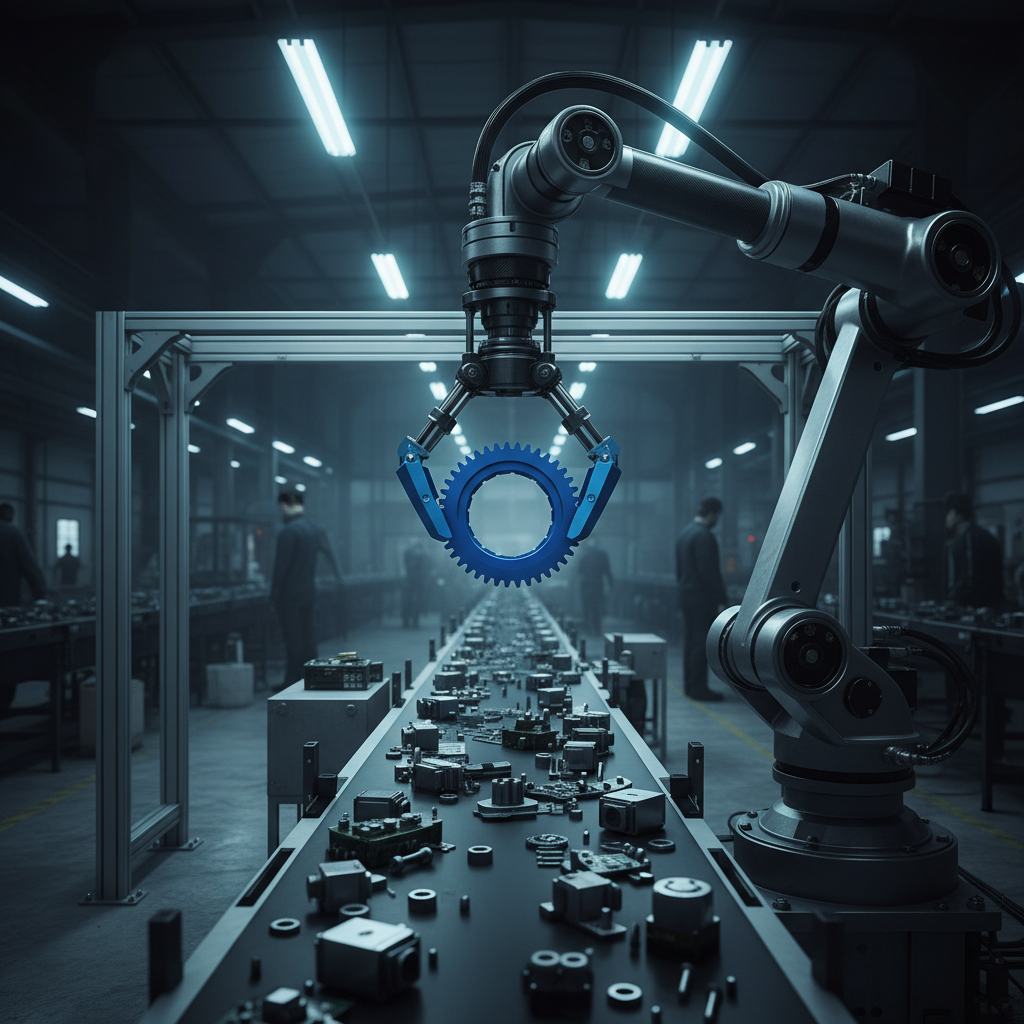
Picture a warehouse crate stuffed with a thousand different components — bolts, brackets, blister packs — none of them sorted, none of them facing the same way. A robot arm hovers above the pile, pauses for a fraction of a second, then plucks exactly the right part and drops it onto the correct conveyor belt. No programmer wrote a line of code for that specific object. The robot simply figured it out. That is the operating premise behind Festo's GripperAI software, and it is already running inside the logistics network of Würth Group, which carries about 1 million parts in its portfolio. [1]
Festo launched GripperAI alongside a new piece of hardware — the HPPH two-finger pneumatic parallel gripper — positioning the two products as complementary answers to a persistent tension inside cobot deployments: the physical machine is getting smarter and lighter, but the software scaffolding needed to run it has lagged behind. [1]
The tension is structural, not incidental. Every time an integrator bolts a new end-effector onto a collaborative arm, they are making trade-offs between weight, wiring complexity, safety compliance, and the sheer time it takes to teach the machine what it is supposed to touch. The industry has lived with those trade-offs for years. What is changing is the appetite to treat them as inevitable.
The HPPH addresses the hardware side of that equation by collapsing several external components into the gripper body itself. The pneumatic control valve, position sensors, and electrical interface are all integrated directly into the unit, which weighs 1.5 lb. (0.68 kg). Force- and power-limited robot arms typically operate within strict payload and mounting constraints, and pneumatic grippers that rely on external components add weight, increase footprint, and complicate routing along compact cobots, according to Festo. [1]
By folding everything inside, Festo claims the HPPH preserves payload capacity and simplifies mounting and wiring on collaborative robot platforms. The practical upshot: shorter installation and commissioning time, simpler ordering, and less wiring complexity. An IO-link version is available for enhanced diagnostics and remote configuration. [1]
Safety certification was built into the design from the outset. Festo developed the HPPH in accordance with ISO/TS 15066, the international standard that specifies safety requirements for collaborative industrial robot systems and the work environment, and supplements the requirements and guidance on collaborative industrial robot operation given in ISO 10218-1 and ISO 10218-2. [2] The gripper meets TÜV Süd certification when used with HAFH-B30-16-45-N gripper fingers, and its force-limited gripping mode caps at 31.5 lbf (140 newtons) — roughly the equivalent of a firm handshake — to reduce the risk of injury during close-proximity operation. [1]
That handshake figure matters more than it might appear. ISO/TS 15066 applies to industrial robot systems and does not apply to non-industrial robots, although the safety principles presented can be useful to other areas of robotics. [2] As cobots move deeper into shared workspaces — standing beside humans on assembly lines, packing lines, and sorting floors — the margin for error compresses. A ceiling on contact force is one of the cleaner ways to define that margin without relying solely on physical barriers.
The HPPH is not framed as a universal tool. Festo is explicit that it is not suitable for machining or environments with aggressive media, grinding dust, or welding splatter. The maximum gripper opening is 0.63 in (16 mm) and the unit is designed for objects weighing up to 2.2 lb. (1 kg). Applications that need more force can disable the limit, pushing gripping force up to approximately 40.5 lbf (180 newtons), which supports non-collaborative applications. The gripper is available through Festo's website and the Universal Robotics Marketplace. [1]
Hardware, though, only solves part of the problem. The deeper challenge for any picking system is perception — the ability to look at an object it has never seen before and decide, in real time, exactly where to grip it. That is where the software layer becomes the more interesting conversation.
GripperAI uses artificial intelligence to determine optimal grasping points for previously unseen or chaotically positioned objects, including bulk materials, without requiring programming or teach-in training. [1] The software is robot-agnostic — it works with cobots, classic robots, and Cartesian handling systems — and it can automatically perform a tool change to acquire the appropriate end effector for a picking task, selecting from available grippers based on what the camera sees in the bin.
The edge-computing architecture is deliberately modest. For simple tasks, a low-cost 3D RGB-D camera and a basic CPU (Core i3, greater than 4 GB RAM) are sufficient. For more complex applications such as gripping bags, irregular geometries, or chaotically stored parts, higher-end GPUs and cameras can improve speed and success rates. The software is modular and can be installed on-site or operated in the cloud, supporting REST interfaces for integration. GripperAI can be deployed on robot CPUs, industrial PCs, or even within the camera itself. [1]
The Würth Group pilot is the clearest proof-of-concept Festo has published. Working with a portfolio of about 1 million parts, Würth used GripperAI-equipped robots to empty crates filled with mixed, randomly oriented items. [1] The system identifies each object, selects the appropriate gripping tool, and efficiently transfers items for packaging or sorting, all without manual intervention or pre-programmed object data. The robot cell can operate in all of Würth's planned lines, and the companies have defined further development work and optimization steps.
Jan Seyler, head of advanced development analytics and control at Festo, described the methodology: "We built a copy of Würth's sorter conveyors in our laboratory, which allowed us to develop the robot's various capabilities: object-dependent gripper selection, gripping any objects from the trays, packing shipping cartons and handling the cartons and trays." [1] The lab-replication approach — rebuilding a client's actual infrastructure before touching the live environment — reflects a methodical instinct that sits at odds with the move-fast culture often associated with AI deployments.
What makes this combination worth watching is not either product in isolation. It is the direction the pairing points toward — a factory floor where the physical act of gripping and the cognitive act of choosing what to grip are treated as a single, integrated design problem rather than two separate engineering disciplines bolted together after the fact.
The HPPH joins more than 30,000 interoperable pneumatic, electric, and software products in Festo's automation portfolio. [1] That catalog depth matters for integrators: a gripper that slots into an existing ecosystem without custom wiring harnesses or bespoke control architectures lowers the activation energy for deployment, particularly at smaller facilities that cannot afford months of integration work.
GripperAI's adaptability positions it for logistics, manufacturing, and packaging environments where SKU count is high and object geometry is unpredictable. [1] The software's ability to run on minimal hardware also means the barrier to entry is defined less by capital expenditure and more by the willingness to rethink how picking cells are set up — swapping the programming-intensive teach-in process for a perception-first approach that treats the unknown object as the default condition rather than an edge case.
Festo is not claiming it has solved bin-picking. What it is claiming — with hardware specs, a safety certification, and a live pilot at one of Europe's largest distributors — is that the question of how a robot chooses to grip something deserves the same engineering rigour as the mechanism doing the gripping. That reframing, quiet as it is, may be the more consequential product of the two.