Four Nines or Bust: The Real Test of Robot Dexterity
A 99% success rate sounds impressive—until you do the math on a 100-step workflow. The bottleneck in physical AI isn't capability. It's reliability.
By The Robotics Desk
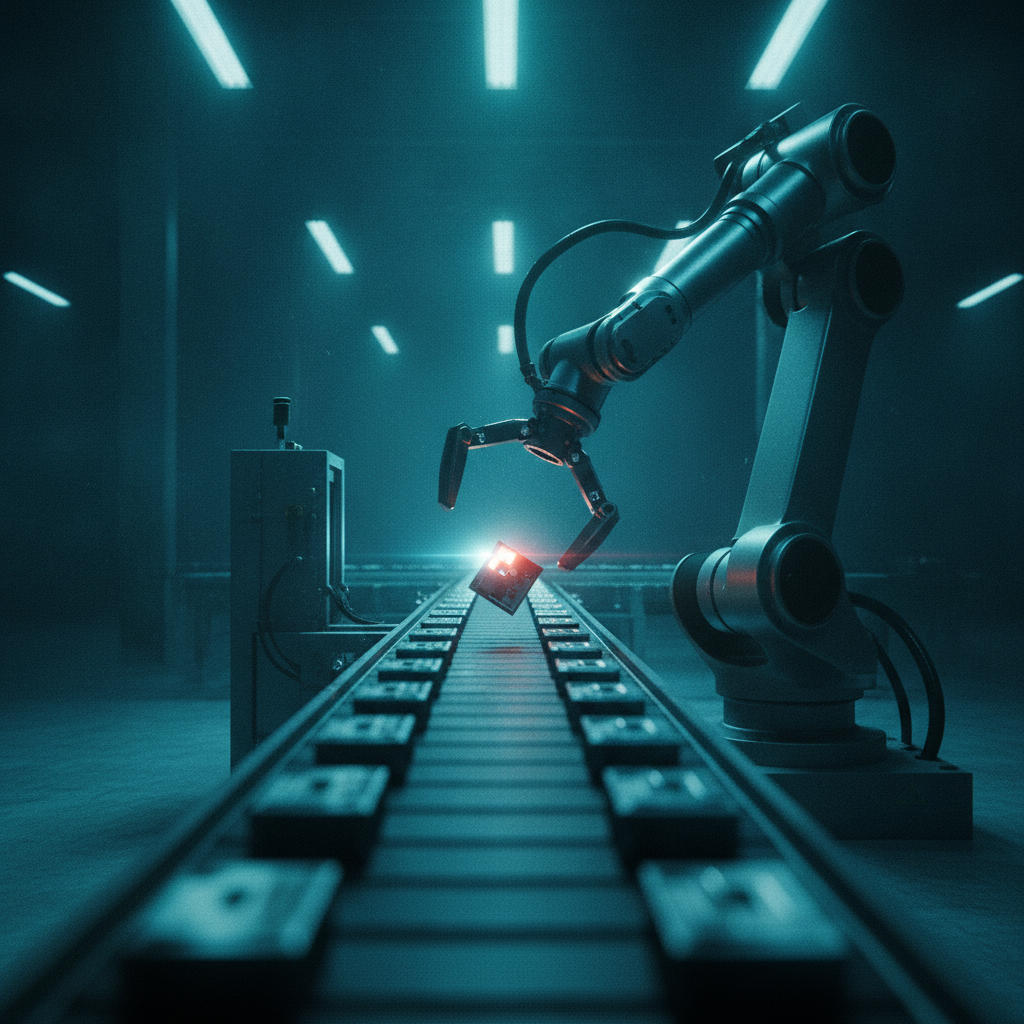
A robot picks up a part, moves it, sets it down. The demo goes perfectly. The crowd nods. But ask that same robot to repeat the action a hundred times in a row—while grip conditions shift, components wear, and the object drifts a centimeter out of position—and the story changes fast. [1]
This is the gap between demonstration and deployment, and it is wider than most product roadmaps acknowledge. Nicolas Sauvage, founder and president of TDK Ventures, frames it as a mathematics problem. Consider a workflow that requires 100 physical actions in a sequence. At a 99% success rate for each action, the probability that all 100 succeed on the first attempt is just 36.6%. Increase the success rate to 99.9%, and the probability of completing the workflow rises to 90.5%. At 99.99%, it reaches 99.0%. [1]
The implications are uncomfortable for an industry that benchmarks itself on individual-action success rates. A robot with a 99% success rate is not necessarily 99% automated. [1] That single sentence should be printed on every pitch deck in robotics right now.
The field has spent years celebrating what robots can do in controlled conditions. The harder conversation—the one the industry is only beginning to have—is about what robots can do when no one is watching, when conditions drift, and when the stakes are a complete workflow rather than a single clean action.
Sauvage calls the core misconception a hardware race: more fingers, more joints, more degrees of freedom. Those things matter, but as he puts it, the customer does not buy degrees of freedom. The customer buys useful work. [1] Completing that work requires a closed loop across vision, position, contact, force, pressure, grasp, movement, and adjustment. Power, safety, flexibility, and recovery also matter. [1]
Recovery is where the nines are actually won or lost. If a robot begins to lose its grip on an object, the useful measure isn't if the original grasp was perfect; it's whether the system can detect the slip early enough to correct it before a small error causes the entire task to fail. [1] A system that cannot catch its own mistakes mid-task is not autonomous in any meaningful sense—it is supervised automation with extra steps.
There is a certain aesthetic pull toward the human form in robotics—a tendency to measure sophistication by how closely a machine resembles us. That instinct leads engineers and investors toward the wrong questions, and toward robots that impress in boardrooms but struggle on factory floors.
Sauvage argues that the right physical form is the one that fits the work, not the one that fits our idea of what a robot should look like. [1] The form follows the function, not the other way around.
ANYbotics applies the same logic to a different environment. In one deployment, its technology has reportedly carried out more than 33,000 inspections across 450 inspection points. [1] That number is notable not because the robot looks impressive doing it, but because the system can do it repeatedly without constant human intervention.
Starship Technologies takes a different approach again. Its delivery robots travel along pavements, so a small, wheeled form is better suited to the job than legs. That purpose-built approach has helped Starship to report more than 10 million autonomous deliveries. [1] Three companies, three completely different physical forms—and the same underlying principle driving all of them.
The principle, stated plainly: the goal is not maximum dexterity. It is the minimum sufficient dexterity needed to complete valuable work reliably. [1] This is a subtler and more useful ambition than chasing the most anthropomorphic design on the floor. It also changes which engineering problems get prioritized. Sensing, control, and recovery software become at least as important as the mechanical architecture of the hand.
What gets measured gets improved. The industry's current metrics—demo success rates, joint counts, payload capacity—are proxies that tell us surprisingly little about whether a robot can actually be trusted to complete a shift.
Sauvage proposes a different set of questions. What percentage of complete workflows finish without human assistance? When something goes wrong, how often can the robot recover without help? How does performance change when the object, lighting, position, wear, or surrounding environment changes? [1] These metrics are harder to generate—they require real deployment, not controlled demos—but they are the ones that actually predict whether a system is ready for autonomous work.
Then there are what he calls the less glamorous questions that become extremely important at scale: what breaks first under repeated use, how quickly can it be diagnosed, repaired and returned to work, and what are the speed, uptime, and cost of each successfully completed job. [1] Maintenance loops, repair cycles, and uptime economics are not the sexy parts of the robotics story. They are, increasingly, the whole story.
This is also a data problem. Changing the hand changes movement, sensing, and calibration, so data collected with one physical design may not transfer directly to another. [1] Real-world deployment is therefore not just a proof-of-concept exercise—it is a critical part of the development process. Deployment reveals slips, poor grasps, wear, and failed recoveries, and those experiences become data that can improve software, simulation, sensing, control, and hardware. [1]
The feedback loop Sauvage describes—deploy, fail, learn, improve, redeploy—is not new to manufacturing or software. What is new is applying it systematically to physical AI, where the failure modes are often invisible until the robot is doing real work in a real environment. [1]
The industry that emerges from this phase will look less like a showcase of mechanical ingenuity and more like a discipline of systems engineering—one where the most important advances happen not at the level of the hand, but at the level of the whole loop.
The broader robotics community is beginning to converge on this framing. When RoboBusiness launched in 2004, Kiva Systems was a startup, iRobot hadn't gone public, and AI wasn't yet driving every conversation. [2] Twenty years later, robots are transforming industries from logistics and healthcare to agriculture and manufacturing, and AI is reshaping how robots operate. [2] The questions being asked now—about reliability, uptime, and workflow completion—are exactly the ones Sauvage is pressing.
The industry has made extraordinary advances in what robots are capable of doing. [1] The next phase is quieter, less photogenic, and considerably more difficult: turning those capabilities into systems that can be trusted to complete a job, fail gracefully, recover without hand-holding, and improve with every cycle. The difference between two nines and four nines may ultimately decide whether a robot is ready to work alone. [1] That is not a hardware problem. It is an engineering discipline that the field is only now learning to take seriously.
The customer does not buy degrees of freedom. The customer buys useful work.Nicolas Sauvage