France Commissions a Combat-Ready Ocean Drone
Naval Group is building a large autonomous underwater vehicle that can hunt, survey, and strike — with sea trials set for 2028.
By The Defense Desk
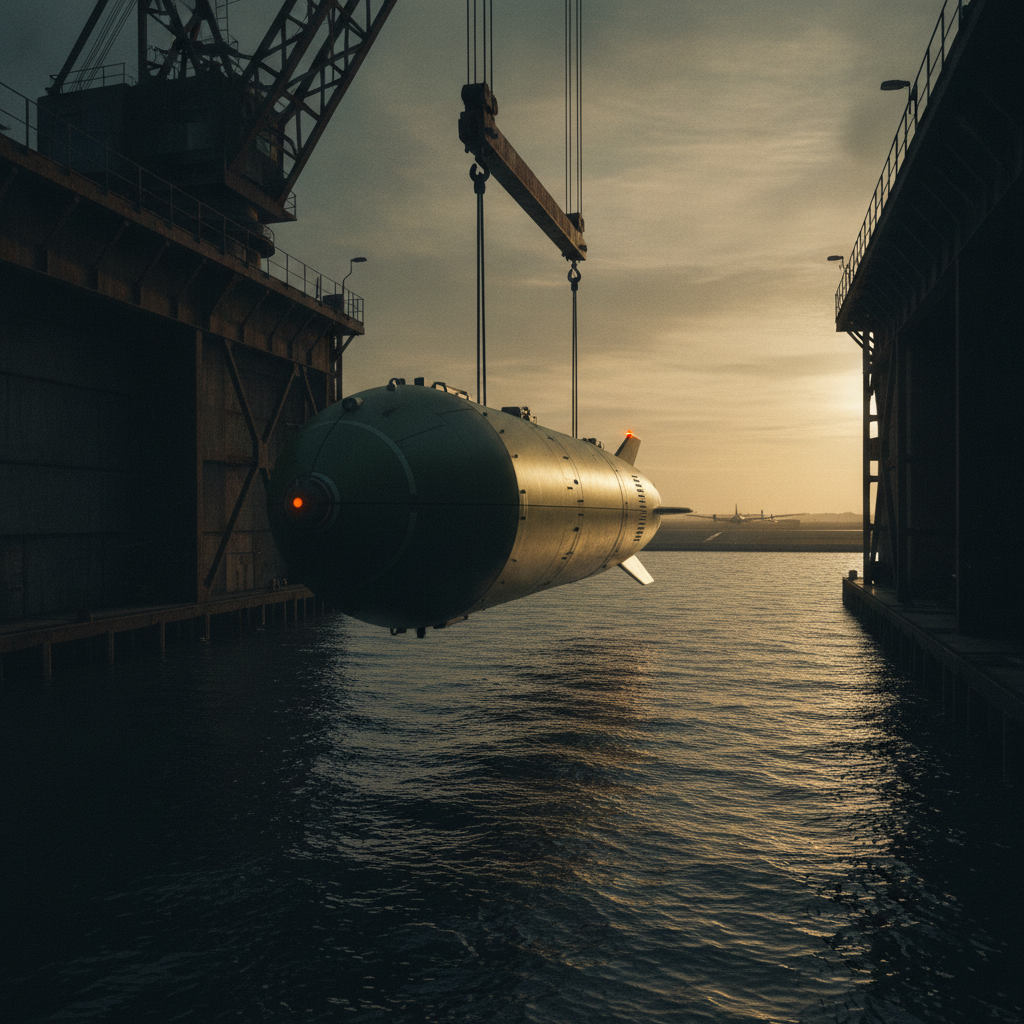
France has signed a contract with shipbuilder Naval Group to develop an operational demonstrator of a large-sized oceangoing underwater drone, with sea trials scheduled to begin in 2028. [1] The vehicle — formally designated an uncrewed combat underwater vehicle, or UCUV — must prove both endurance and autonomous decision-making capability before it can advance toward service. [1]
The French Armed Forces ministry says the UCUV will be capable of carrying out missions ranging from intelligence gathering, surveillance and reconnaissance to "more offensive neutralization actions." [1] That breadth of tasking — passive collection at one end, kinetic action at the other — reflects how seriously Western navies are now treating the underwater domain as a contested battlespace. [1]
The strategic logic is straightforward. France has the world's second-largest exclusive economic zone behind the United States, covering about 11 million square kilometers spread across the Atlantic, Pacific and Indian oceans. [1] A crewed submarine cannot be everywhere at once; a fleet of persistent, autonomous vehicles could change that calculus entirely. [1]
This is not France building a capability in isolation. It is joining a race that is already moving fast, with competitors deploying hardware while Paris has until now been running studies.
The competitive pressure is real. The U.S. Navy has been working with Boeing to develop the Orca uncrewed underwater vehicle. And Australia in September said it was buying a fleet of Ghost Shark extra-large uncrewed underwater vehicles from Anduril for A$1.7 billion (US$1.2 billion). [1] France, the ministry concedes, is now joining "the very select group of nations engaged in the definition and development of a large-sized unmanned underwater vehicle capability." [1]
Naval Group is not starting from scratch. [1] France in January 2024 ordered a technological demonstrator based on that prototype to test energy autonomy, sensor integration and autonomous operation. [1] The agreement between France's Defense Innovation Agency and Naval Group follows an initial market study started in 2023 with the Directorate General for Armament. [1]
The new demonstrator will carry a "controlled autonomous decision-making system" that allows the vehicle to adapt to tactical situations, the environment and potential breakdowns, either by itself or in collaboration with other systems. [1] It must also be air transportable and deployable from a pier or a surface vehicle — operational flexibility that matters when France's maritime interests span three oceans. [1]
France's 2026 defense budget allocated €30 million in commitment authorizations and €17 million in payment appropriations for the ocean-going drone demonstrator. [1]
Money and timelines are one thing; what the sea trials reveal will be another. The deep ocean is an unforgiving test environment, and autonomous decision-making at depth — with no real-time human override — remains the hardest engineering problem in unmanned maritime systems.
The ministry says the sea trials will validate technological choices for the demonstrator and provide a better understanding of the operational response to new forms of naval combat. [1] That phrasing — cautious, institutional — understates what is at stake: a successful UCUV would give the French Navy a persistent, deniable, long-range instrument that sits below the threshold of traditional naval confrontation. [1]
The underwater domain is becoming as contested as airspace. France is placing its bet on Naval Group, a proven surface-ship builder with a self-funded head start. Whether the UCUV reaches operational status or stalls as a demonstrator will say as much about France's industrial bandwidth as it does about its strategic ambition.