Germany Pulls the Plug on Boeing's Ghost Bat
Berlin abandons the MQ-28 and opens a crowded race for Europe's first combat drone wingman — with a 2029 deadline slipping fast.
By The Defense Desk
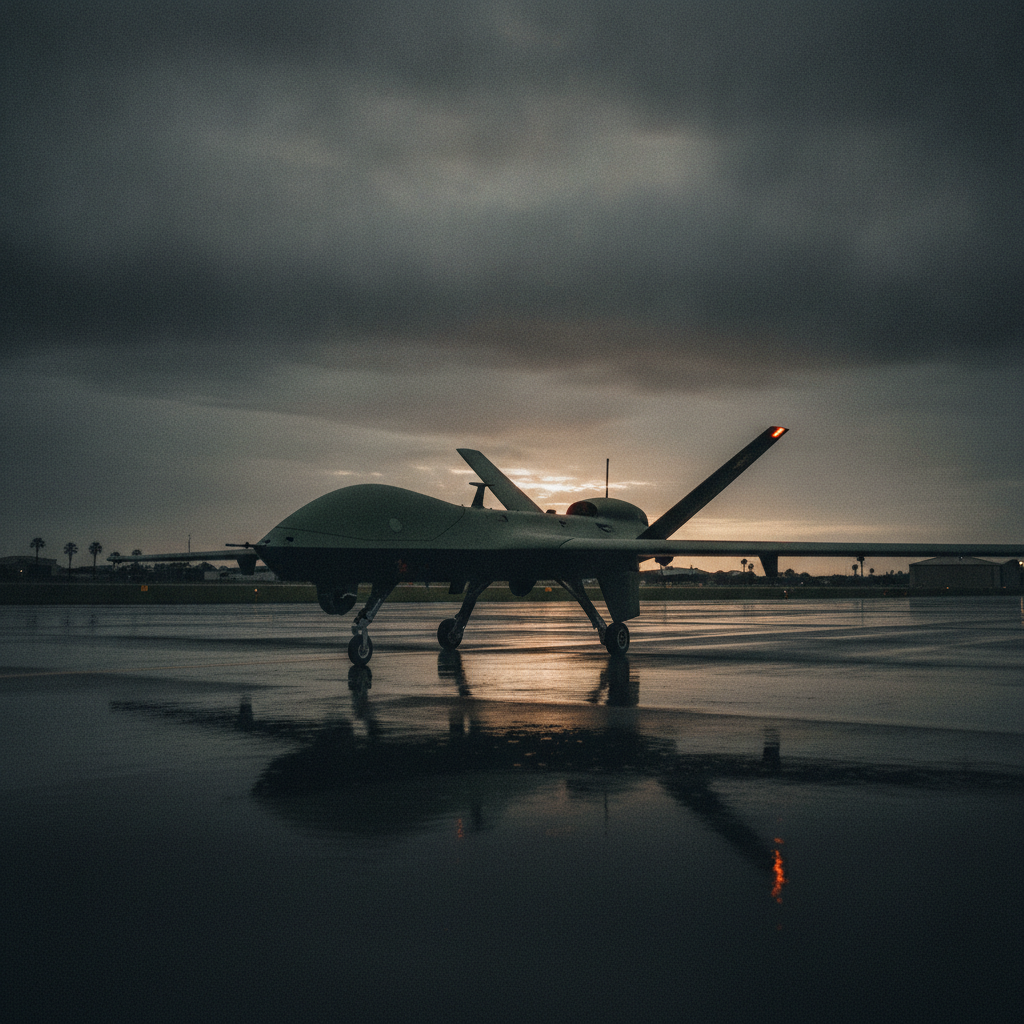
Germany's Ministry of Defence has formally told Boeing it will not procure the MQ-28 Ghost Bat drone wingman, walking away from what had been one of the most-watched Collaborative Combat Aircraft deals in Europe. [1] The decision, first reported by Politico, lands at an awkward moment: Berlin had publicly committed to fielding a combat drone wingman by 2029 — a milestone that would have made it the first European nation to do so. [1] That clock is now running against a program that no longer has a lead contender.
A Boeing spokesperson confirmed the ministry had "informed" the company of the move to abandon the Ghost Bat acquisition plan, deferring any explanation to Berlin. [1] The German ministry, for its part, offered little: a spokesperson said that based on a "matter of principle—and regardless of the specific case in question—we cannot provide information regarding potential procurement projects." The spokesperson added that this was due to regulations concerning procurement and public contracting law, as well as the requirement that such matters first be addressed by parliament. [1] The silence is standard operating procedure, but it does nothing to quiet questions about why one of NATO's biggest defence spenders has pivoted away from a platform it had been publicly considering.
The decision is less a rejection of a single aircraft than a restatement of European priorities. Sovereign capability, domestic industrial stakes, and alliance politics are now inseparable from any major platform choice — and no country in the alliance is navigating that triangle more visibly than Germany.
According to Politico, Berlin will now wait until the early 2030s for its CCA capability to materialise, with aircraft tests scheduled to begin in 2027. [1] Those tests are explicitly designed as a competition — a chance for Boeing and every other credible airframer to make their case before a formal selection. [1] The 2029 operational target, once a flagship ambition, looks like it has quietly become a casualty of this reset.
The field that will contest those tests is already taking shape. Germany's own Helsing is pitching the CA-1 Europa, which the firm says will be ready for operations by 2029. [1] Airbus has partnered with US manufacturer Kratos on the U740-Valkyrie; first flight of that platform was announced on Monday, and Airbus stated the aircraft was "on track to deliver a combat-ready uncrewed Collaborative Combat Aircraft by 2029, addressing the operational requirements of the German and other European Armed Forces." [1] General Atomics Aeronautical Systems is also in the conversation, offering platforms from its Gambit family. [1]
General Atomics Aeronautical Systems spokesperson C. Mark Brinkely told Breaking Defense in June: "We have certainly spoken to Germany many, many times about our CCA and what there is to offer." [1] That kind of sustained engagement matters in a procurement process where relationships with ministries are built over years, not months. Boeing, for its part, said it "stands ready to support" its German customer on next steps — language that keeps the door open without pretending the Ghost Bat is still the front-runner. [1]
What makes this contest genuinely novel is the industrial geography on display. A German AI-defence startup, a pan-European aerospace giant partnered with an American drone specialist, and a US defence prime are all converging on the same tender. The result is something the European defence market has rarely produced: a real, open competition with credible contenders on multiple sides of the Atlantic.
The CCA concept itself is worth holding clearly in view. The new wingmen will fly alongside fighter jets and carry out strike missions. [1] Germany's stated 2029 target, had it been met, would have placed the Bundeswehr ahead of every other European air force in fielding that capability. [1] The slip to the early 2030s narrows that lead considerably, and opens the question of which European nation might now beat Berlin to the milestone.
For Boeing, the setback is real but not necessarily terminal. The German ministry's decision does not close off every path — the 2027 test series gives Boeing a structured re-entry point, and the spokesperson's careful insistence that the company remains ready to support Berlin suggests the relationship has not been severed, only complicated. [1] Still, losing first-mover positioning in what could become a template procurement for other European nations is a meaningful setback.
There is a broader pattern worth naming here. Across European defence, the instinct to prefer sovereign or at least domestically anchored solutions is hardening. That shift does not make American platforms uncompetitive — but it does mean they must now win on merit inside a process where industrial policy carries real weight.
Helsing's CA-1 Europa is the most pointed expression of that instinct. A German firm building a CCA for the German Air Force carries an obvious political logic, and Helsing has been explicit that it aims to have the platform combat-ready by 2029 — the same year the ministry originally wanted to field its wingman. [1] Whether a company without the manufacturing scale of Airbus or Boeing can deliver on that schedule is the question the 2027 tests will begin to answer.
The Airbus-Kratos U740-Valkyrie sits in a different category: a European prime with American drone-manufacturing depth, structured as a transatlantic partnership rather than a purely domestic bet. [1] Its Monday first-flight announcement was timed precisely to land in the news cycle created by Germany's Ghost Bat decision — an unmistakable signal that Airbus views the now-open German tender as its to pursue. [1]
What happens in Germany over the next three years will set terms for the broader European CCA market. The country's procurement choices tend to anchor alliance-wide expectations, and every airframer competing in Belfast, Toulouse, or Munich knows it. This is not just one country buying one drone. It is the first draft of what collaborative air combat looks like on this side of the Atlantic.
The 2027 test window is now the only fixed point on a map that Berlin has otherwise left deliberately open. Boeing will compete. Helsing will compete. Airbus and Kratos will compete. Germany, meanwhile, will take its time — and the first European nation to field a combat drone wingman may not be the one that started the race. [1]