Helicon Wants to Make Carbon Fiber Like Steel
The LA startup raised $16M to automate composite manufacturing — cutting lead times from six months to two weeks.
By The Robotics Desk
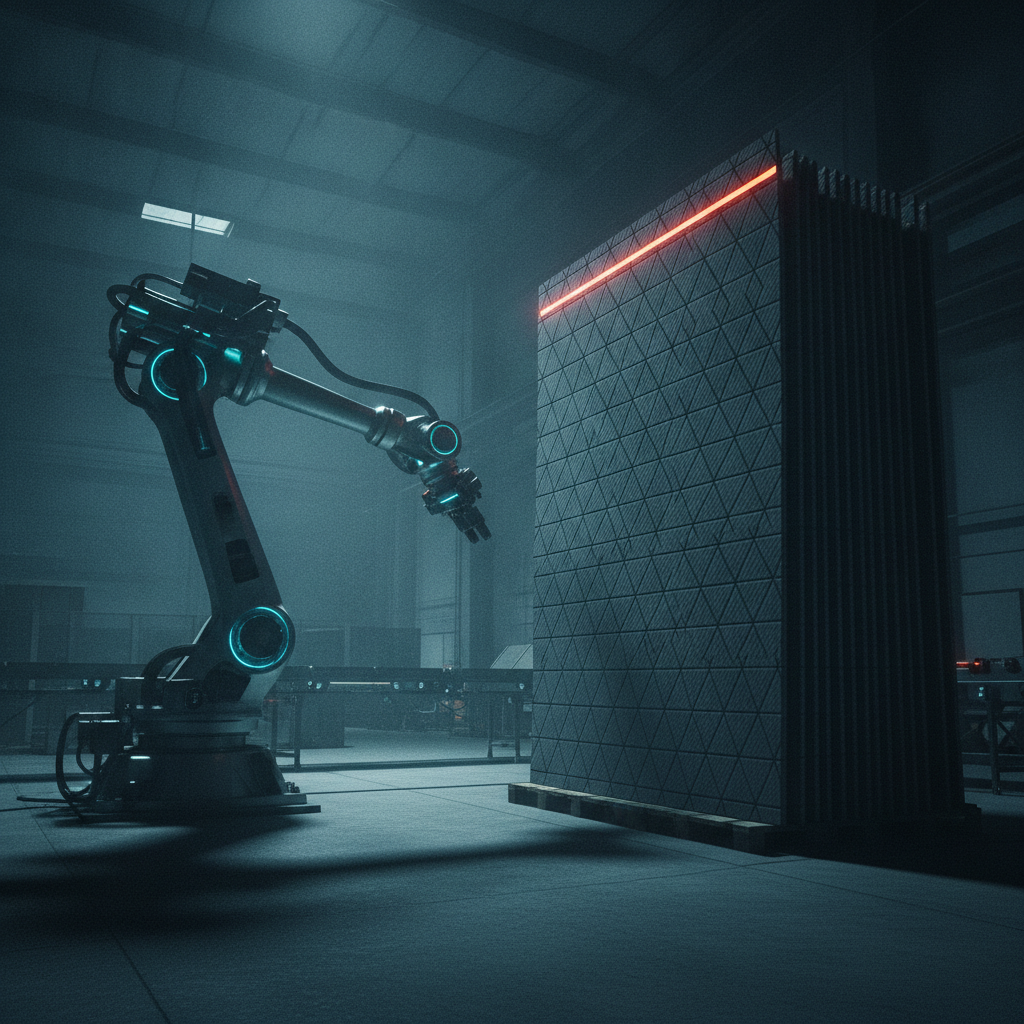
Carbon fiber is everywhere in the brochures and nowhere near the factory floor. The material that stiffens Formula 1 chassis and fighter jet fuselages still gets made largely by hand — sheets cut, laid, and cured by human workers in processes that can stretch six months from order to part. Helicon Industries, a Los Angeles startup, thinks that is about to change. The company emerged from stealth this week with $16 million in seed funding, led by AlleyCorp, and a pitch to compress composite manufacturing lead times to two weeks. [1]
Helicon is building automated manufacturing systems designed to move carbon fiber composites into high-volume production — the kind of scale measured in hundreds of thousands of parts, not hundreds. [1] The company is relocating to a 36,000 sq. ft. space in Torrance, California, and designing every process and piece of equipment around robots rather than retrofitting automation into a legacy workflow. [1]
The problem Helicon is attacking is structural. "Composite manufacturing is still a very manual process, it's difficult to automate, especially the manipulation of flexible materials like carbon-fiber textiles," said co-founder and CTO Edmundo Sanz-Gadea. [1] Traditional production begins with a mold, into which workers place carbon fiber material — either prepreg, which contains resin already, or dry fiber that gets resin added through vacuum infusion or resin transfer molding. [1]
A new tier of customers is less patient. "The challenge is figuring out how to manufacture lightweight, high-performance structures in the hundreds of thousands rather than the hundreds," Sanz-Gadea said. [1] Most of those companies currently buy flat carbon-fiber sheets from overseas suppliers, cut them to shape, and assemble the result with fasteners — an approach Sanz-Gadea describes as "a very inefficient way to build a structure." [1]
Helicon's answer is to redesign the process around what robots can reliably do. The company targets cycle times under 15 minutes, compared with hours for traditional layup and autoclave curing. [1] Its systems are designed so a robot can pick material, place it, extract the finished part, and handle downstream steps like trimming and quality inspection in a single cell. [1] "For robotics, we don't need massive industrial arms," Sanz-Gadea said. "The important part is designing the whole cell around repeatability and speed." [1]
The robotics market itself is among Helicon's target customers. "Most robotic systems today are made from aluminum, and our materials offer higher stiffness at 40% lower weight," Sanz-Gadea noted. [1] That weight reduction translates directly into longer battery life, smaller actuators, or higher payload capacity — meaningful gains as humanoid and mobile robot platforms move toward mass production. [1]
[2] "He understood what we were trying to build immediately," Sanz-Gadea said. "He flew from New York to San Francisco the next day to meet us." [1]
Carbon fiber sits at a similar inflection: the performance case is settled, the production story is not. Whether a seed-stage startup can close that gap is a different question, but the direction of travel is clear.
Helicon is now hiring across mechanical and structural engineering, software, robotics, and operations. [1] The founding vision, as Sanz-Gadea frames it, is not a single product line but "the manufacturing capacity to produce advanced composites at a real industrial scale" — starting in Torrance, with a much longer runway in mind. [1]