Infrared in Full Color, Not Just Green
A Beijing team's quantum-dot eyeglass translates heat into a color image — and may reshape how we think about prosthetic vision.
By The space-quantum Desk
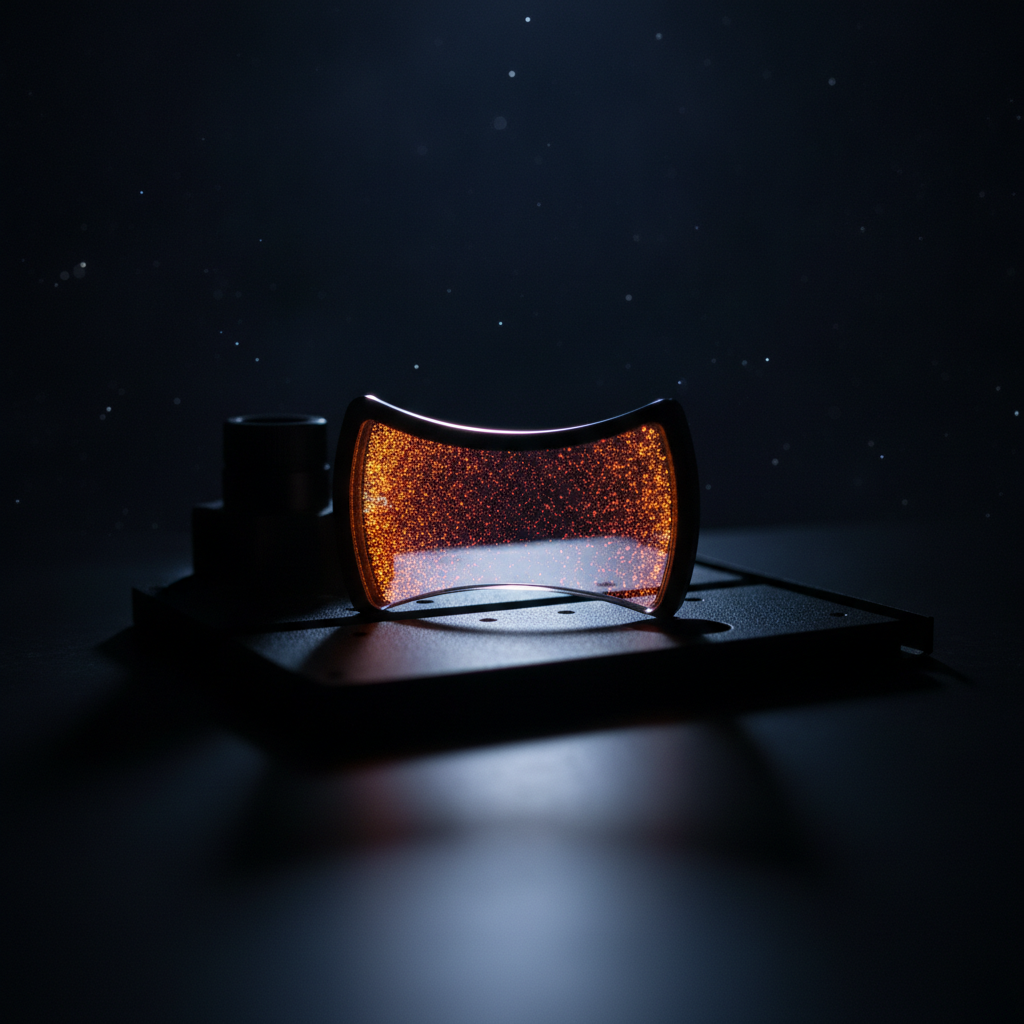
Night-vision gear has always shown the world in green — a single-channel brightness readout that leaves most of the eye's sensitivity unused. A team at the Beijing Institute of Technology, led by Xin Tang and Ge Mu, has now built an eyeglass that converts infrared radiation into full color, letting the visual system do what it actually does best. [1]
The device pairs mercury telluride colloidal quantum dots — roughly 4 nanometers across — with a dual-layer OLED. Because quantum confinement breaks their energy levels into discrete steps, photons of different infrared wavelengths excite different electronic transitions, rather than just producing more or less of a single signal. The blend shifts continuously with the scene.
The resulting eyeglass weighs 23 grams with an active viewing area of about 3.57 square centimeters, and the team calculates it should let users distinguish infrared power differences roughly 200 times smaller than a conventional brightness-only design would allow.
The gap between a lab demonstration and a wearable product is real, and the researchers are candid about what remains unresolved — toxicity, real-world clutter, power supply.
Still, encoding wavelength as hue rather than brightness is a fundamental shift in how infrared sensing works — one that points toward both military optics and, eventually, visual prosthetics. [1]