Inside Britain's Stealth Fighter Demonstrator
New factory photos and a scale model of the Combat Air Flying Demonstrator reveal just how ambitious the GCAP program has become.
By The Defense Desk
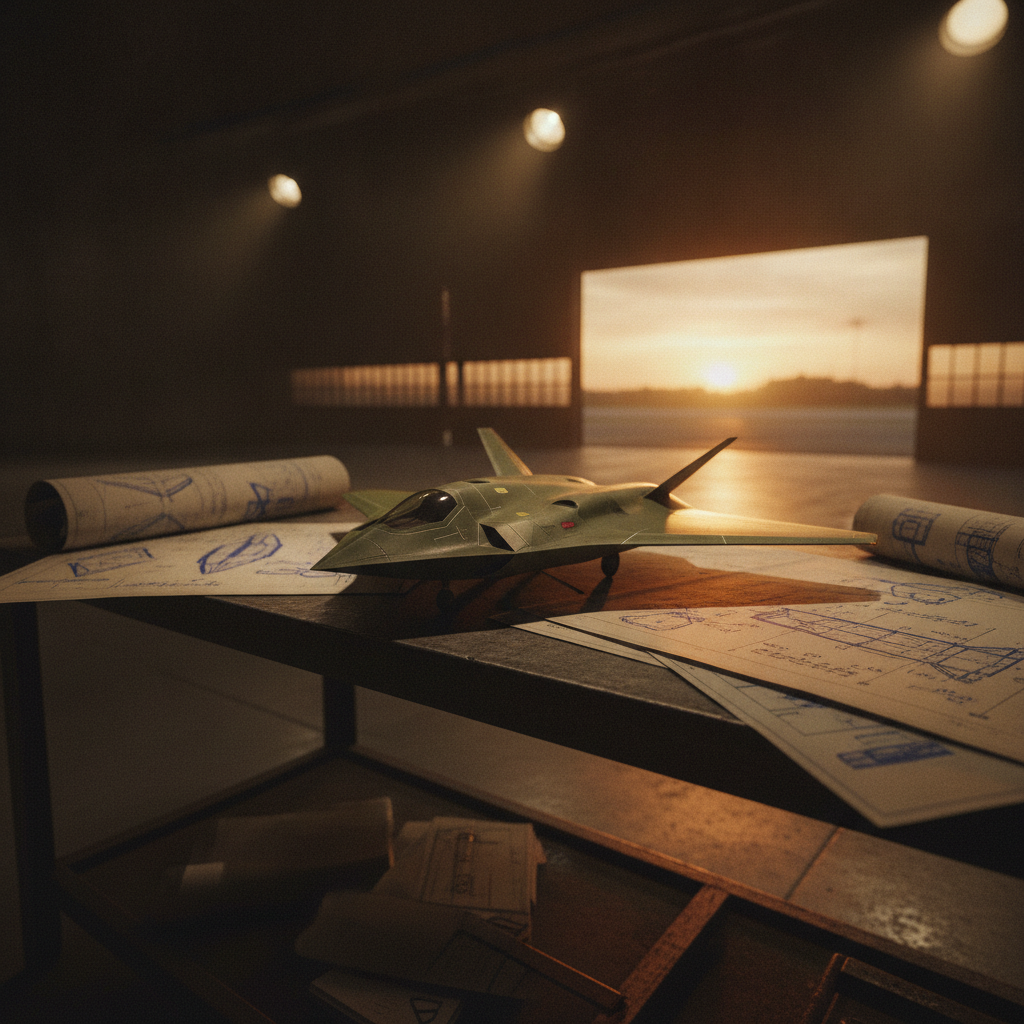
On the factory floor at BAE Systems' Samlesbury facility, a fuselage sits in assembly fixtures that tell a story before a single detail is confirmed. The wings and fins are being built separately at Warton. Together, they form the Combat Air Flying Demonstrator — the aircraft that will spearhead Britain's sixth-generation fighter effort — and new photographs, along with a scale model displayed at the Farnborough International Airshow, have finally given observers something concrete to analyze. [1]
The aircraft is due to fly before the end of 2027, according to BAE Systems. [1] What the factory photographs reveal, even before any official specification is released, is a centerbody that is notably broad and deep. Looking down the spine of the aircraft, the width of the centerbody is especially striking — a phrase that recurs in analysis of the new images because there is no other way to describe it. The absence of skin panels exposes a substantial internal space, which accommodates low-observable serpentine intakes, while the distance between the outer mold line on each side further hints at the generous internal volume available inside the aircraft. [1]
The scale model presented at Farnborough confirmed several design details that earlier renderings had left ambiguous. The twin-engine aircraft has outward-canted twin fins and no horizontal tails. [1] Its intakes are forward-swept in a diverterless supersonic inlet — DSI — configuration, and there is a prominent chine on the forward fuselage, features that give the demonstrator what observers have described as a definite F-35 look. [1] The inboard leading edge of the wing is slightly cranked, there is some forward sweep on the trailing edge, and the wingtips are severely cropped, producing something of a modified cropped-delta wing — very different to the lambda wing that appeared on the very first Tempest concept. [1]
The tailfins are trapezoidal rather than having the five-sided geometry of the latest Tempest mockup, and the canopy appears to offer limited rearward visibility. [1] The underside of the fuselage almost has area-ruled, hour-glass-like contours — a classical signature of supersonic aerodynamic design, embedded here in a low-observable airframe. The result is an aircraft that reads simultaneously as familiar and new: a machine assembled partly from off-the-shelf components to prove concepts quickly, while gesturing toward something considerably more ambitious. [1]
A demonstrator is, by definition, a provisional statement. It asks questions rather than delivering answers — a probe sent ahead to test the terrain before the main expedition commits.
Air Commodore Martin Lowe, the Future Combat Air System program director at the U.K. Ministry of Defense, has been precise on this point. The Combat Air Flying Demonstrator is not a Tempest prototype, particularly not 'in terms of shape or size.' [1] The final configuration of the Tempest has yet to be settled, and the demonstrator uses the same EJ200 turbofans as the Typhoon rather than the all-new powerplant now under development for the production aircraft. [1] Officials have nonetheless said that the demonstrator will have fighter-style handling, despite its size and lack of thrust compared to the Tempest. [1]
The last fighter demonstrator of this class built in the United Kingdom was the British Aerospace EAP, which first flew in 1986 and proved the concept for the Typhoon that followed it. [1] Four decades later, the Combat Air Flying Demonstrator occupies the same structural role in a development chain — a precursor to a prototype, which is itself a precursor to an operational aircraft. The lineage is tidy. The ambition is considerably larger. [1]
The Tempest itself is being developed for the air forces of the United Kingdom, Italy, and Japan, for service in the 2040s and beyond. [1] Canada recently joined the program as an observer, and there are reports that Germany might also be considering coming on board. [1] That coalition — and its potential expansion — signals that GCAP is being positioned not merely as a replacement aircraft but as an industrial and diplomatic architecture for the next generation of Western air power.
The requirements driving the Tempest's eventual size and shape are explicit. The future combat aircraft is being designed around 'really extreme range' and a payload approximately double that of the F-35A. [1] For the F-35A, internal and external ordnance capacity equates to more than 18,000 pounds, according to the manufacturer. [1] That would place the Tempest's internal payload at around 10,000 pounds, compared to the F-35A's 5,000 pounds. [1] Range, meanwhile, is heavily dictated by fuel load, which the Tempest will carry internally to preserve its stealth qualities — meaning the airframe must accommodate fuel, weapons bays, sensors, and the electrical systems to run all of them. [1]
Sixth-generation aircraft are expected to require unprecedented electrical power generation and cooling capacity to support advanced sensors, electronic warfare suites, communications systems, onboard computing, and potentially future capabilities such as directed-energy weapons. [1] Those demands explain why the demonstrator's centerbody reads as so generously proportioned: internal volume is not a luxury at this performance tier, it is a precondition. The demonstrator hints at how the Tempest solves that equation — even if it does not solve it yet itself. [1]
What separates serious industrial programs from aspirational ones is the transition from rendered concepts to machined aluminum and composite panels. Factory photographs, however partial, mark that crossing.
The latest full-size Tempest mockup, also presented at Farnborough, offers a counterpoint to the demonstrator's F-35-adjacent lines. Where the demonstrator echoes Lockheed's fifth-generation fighter, the Tempest mockup owes more to the F-22 Raptor — appearing, in at least one recent render, like a wider, squatter F-22, suggesting an even more generous internal capacity. [1] Those two reference points — demonstrator and mockup — bracket the design space GCAP is working through. One is already being built. The other is still being argued over. [1]
Those requirements also reflect similar concerns that have driven the development of the U.S. Air Force's Boeing F-47 under the Next Generation Air Dominance initiative. [1] The parallel is instructive: across two alliances and multiple industrial bases, the conclusion is the same. The aircraft that will matter in the 2040s will be larger, longer-ranged, and more internally capacious than anything currently in service. The demonstrator sitting in Samlesbury is, at this moment, the most concrete evidence that Britain and its partners intend to build one. [1]
The aircraft that eventually enters service will undoubtedly differ in various respects from what is being assembled now. [1] That is the point of a demonstrator. But the factory photographs from Samlesbury and the scale model on the Farnborough show floor have shifted GCAP from a program of intentions to a program of parts. The fuselage exists. The wings are being built. The questions it is designed to answer are, for the first time, being asked in metal.