Iran's Mountain Base Won't Stay Down
Struck at least three times in 2025, Eagle 44 is being rebuilt. Satellite imagery tells a story Washington hasn't acknowledged.
By The Defense Desk
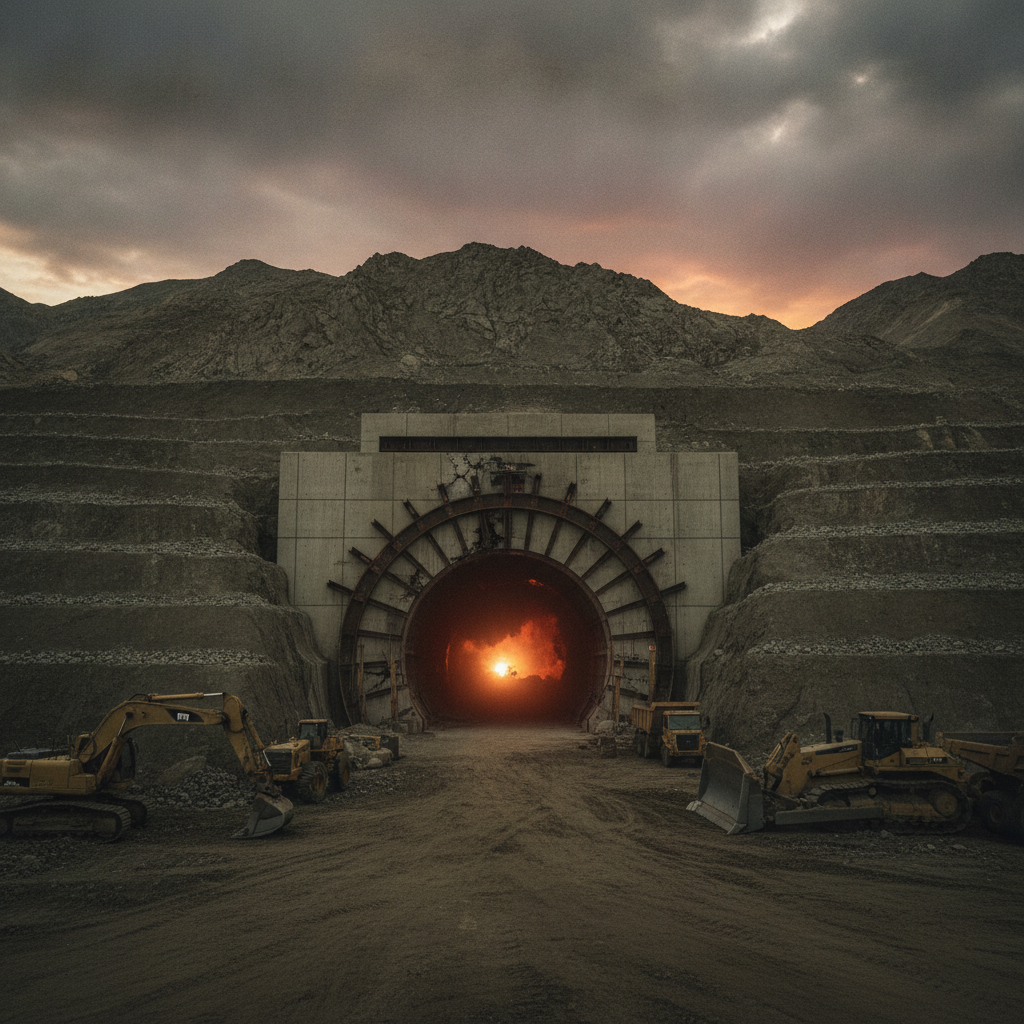
Somewhere in the Zagros Mountains, roughly 100 miles northwest of the Strait of Hormuz, construction crews are completing a new taxiway section leading into a ridge pass-through — its finished upper cement-concrete layer visible on the western taxiway — while on the other side of the pass, the next segment is underway with a subgrade layer of stabilized, compacted dirt laid down but not yet paved — work that continues on a facility cratered by airstrikes less than three months ago. Planet Labs satellite imagery from September 29, obtained exclusively by The War Zone, shows fresh pavement, cleared wreckage, and an obstacle-free runway at Eagle 44 — Iran's hardened underground airbase — despite the facility absorbing at least three rounds of strikes during 2025's conflict. [1]
The base, also known as Oghab 44 — named after the 44th anniversary of the 1979 revolution — was unveiled by Iranian state media in February 2023. One-way attack drones were visible in the background. The IRIAF had roughly 60 Phantoms in service at the time, its most numerous combat jet by some margin. [1]
Work on the underground tunnel complex at Eagle 44 began in 2013. Construction of a 2.7-mile main runway on the northern side of the base started roughly eight years later. [1] Two taxiways cut through a smaller ridge, connecting the runway to four tunnel entrances where jets and weapons are stored — though only one taxiway is currently operational. Inside, the 2023 promotional footage revealed at least one internal blast door, plus branching revetments for parking aircraft and drones. Iranian state media described the complex as "one of the army's most important air force bases, with fighters equipped with long-range cruise missiles and built in the depths of the Earth." [1]
Underground military architecture has a logic all its own. Dig deep enough into solid rock and you impose a calculus on your adversaries: every weapon capable of reaching you costs more than the concrete you pour. The question is never whether a facility can be destroyed, but whether it can be made irrelevant — and that is a much harder problem.
The United States kicked off Operation Epic Fury alongside Israel on February 28, launching strikes against Iran from the west and south. Eagle 44 sat within range of munitions carried by U.S. Navy carrier air wings in the northern Arabian Sea, missiles fired by the guided-missile destroyers that escort them, and Air Force tactical and strategic aircraft and Army assets in the region. [1] Low-resolution imagery reviewed through March 16 showed the base had been targeted, but visible damage was minimal. [1]
A second strike at the end of March produced more visible results. Battle damage assessments suggested the strikes were intended to sever the underground caverns from the runway, trapping whatever was inside. [1] Neither U.S. nor Israeli officials confirmed which aircraft carried out the attack; Israeli officials declined to comment. The U.S. was primarily responsible for pressuring Iran's southern flank, while Israel attacked the western front. [1]
After the April ceasefire collapsed and the U.S. imposed a second blockade, U.S. Central Command launched multiple strikes across Iran on July 15. Eagle 44 was hit for at least a third time. [1] An analysis by Soar Atlas, a satellite imagery provider, identified four aimpoints on July 16, with cratered taxiways and damage to additional infrastructure — structures the analysis linked to the base's construction unit, though The War Zone has not independently verified that claim. [1] Neither the Pentagon nor CENTCOM has named Eagle 44 in any public briefing. Iran has not acknowledged the strikes. [1]
The September 29 Planet Labs imagery catalogues what reconstruction looks like under active blockade and sanctions pressure. The main runway, previously blocked by obstacles, is now clear. On the western taxiway, a new section leading into the ridge pass-through is complete, its upper cement-concrete surface finished. Just beyond, on the other side of the pass, the next segment is underway: a subgrade layer of stabilized, compacted dirt laid down but not yet paved. Impact craters remain visible farther south, in front of the western tunnel entrances. [1] When finished, the second taxiway will give western hangars a direct link to the runway — ending the current bottleneck where all aircraft share a single route, and providing critical redundancy if the primary taxiway is struck again. [1]
On the eastern taxiway, two dark streaks extend off the pavement's edge — likely debris from equipment hit in July and then bulldozed clear rather than recovered. [1] In the main support compound, two buildings are destroyed and a third is damaged; none have been rebuilt. That ordering of priorities — taxiways first, structures later — is consistent with earlier reporting from The Times and Soar Atlas that the strikes degraded the base's construction capabilities. [1] Tehran appears to be concentrating resources on what keeps aircraft moving.
There is a particular quality to infrastructure that refuses to stay ruined. It does not argue or posture. It simply accumulates — layer by layer, pour by pour — until the original act of destruction becomes a footnote to the reconstruction. Military planners read this kind of persistence as signal, not noise.
Eagle 44 is not an isolated case. By the end of May, Iran had cleared 50 of 69 tunnel entrances struck at 18 underground facilities — including some classified as "missile cities" — according to CNN, and that number is likely higher now. [1] Planet Labs, Airbus, and Vantor imagery reviewed by The Wall Street Journal in July showed rebuilt entrances near Kangavar, fresh excavation at Dezful, and repairs near Kermanshah. Israeli Brig. Gen. Ran Kochav told the paper: "They have very impressive industrialization and reconstruction capabilities. They refilled their stockpiles." [1]
That assessment sits in direct tension with official U.S. statements. [1] CENTCOM Commander Adm. Brad Cooper told Congress in May that before Operation Epic Fury, the Iranian Air Force flew between 30 and 100 sorties each day; "today that number is zero." [1] At a campaign rally in Kansas on Monday, President Donald Trump said, "They have no air force… their 229 beautiful fighter jets are now scattered all over the runways, the beautiful runways of the Islamic Republic of Iran." [1]
Intelligence assessments reviewed by Bloomberg and other outlets tell a different story. A U.S. official told reporters in May that "the Iranians have exceeded all timelines the IC [Intelligence Community] had for reconstitution." [1] The four entrances to Eagle 44's main tunnel complex appear intact in the September imagery — though the viewing angle makes it unclear whether they are open or sealed. What is stored inside the mountain, and how much of Iran's fighter fleet remains functional, is not publicly known. [1]
Options for deeper damage exist but come at high cost. The GBU-57 Massive Ordnance Penetrator — the largest bunker-buster in the U.S. inventory — could potentially reach the main storage caverns, but the weapon is limited in number and can only be delivered by B-2A Spirit stealth bombers. [1] Analysts at The War Zone judge it highly unlikely the U.S. would expend such resources on Eagle 44 over higher-priority targets. Collapsing tunnel entrances, or striking the ridge pass-throughs that connect taxiways to the runway, would deny access without destroying whatever is stored inside — buying time rather than resolving the problem. [1]
The concrete laid on Eagle 44's western taxiway this autumn does not prove that Iran's air force is intact or that Eagle 44 poses an immediate threat. What it proves is narrower and, in some ways, more telling: that the regime considers the base worth rebuilding under blockade, after three documented strikes, while support buildings nearby sit in ruins. That calculus — runway before roof, mobility before comfort — is a statement of intent. Whether Washington is reading it is another question entirely. [1]