Italy's Frigate Factory Reboot
Leonardo and Fincantieri are merging their shipbuilding command structure to cut frigate delivery times by 18 months—and challenge Korea's pace.
By The Defense Desk
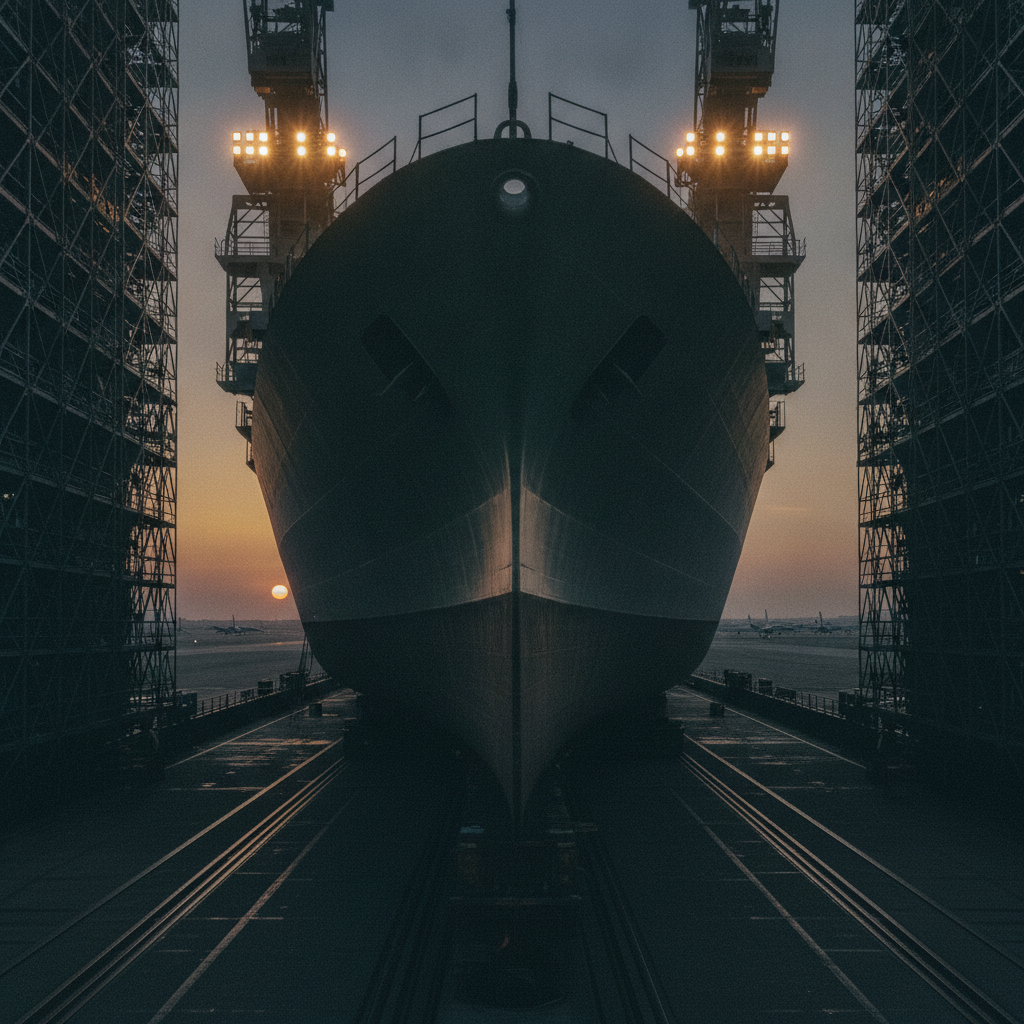
On the floor of Euronaval in Paris, two CEOs signed a Letter of Intent that could redraw the timeline of European warship production. Lorenzo Mariani of Leonardo and Pierroberto Folgiero of Fincantieri agreed to restructure their Orizzonte Sistemi Navali joint venture—a partnership now more than two decades old—around a single, unified integrator model that its backers say could shave 18 months off frigate delivery schedules. [1]
The restructuring is, in essence, a return to origins. OSN was originally conceived as an overarching integrator for entire warships, but over time Fincantieri and Leonardo drifted toward managing separate systems on the same hull. That fragmentation added coordination overhead—and, by implication, time. The new arrangement collapses those parallel tracks back into a single chain of command. [1]
The number Folgiero chose to anchor the ambition is specific: cut the FREMM frigate delivery window from 54 to 36 months, a key "test case" that could determine whether the companies' combined shipbuilding prowess can deliver a vessel on a timeline similar to the Korean industry. [1] Korea's yards have long set the global benchmark for throughput. Invoking them directly signals that OSN is not positioning itself as a prestige European atelier but as a volume competitor.
The logic is familiar from other industrial sectors: when two capable organizations stop negotiating at their interface and start operating as one, the schedule compresses. The question is always whether the org-chart change survives first contact with steel, suppliers, and sovereign navies who each believe their requirements are non-negotiable.
Folgiero framed the case in straightforward terms on the Euronaval sidelines: "Italy has a strong industrial setup in the naval domain, which enables us to perform effectively and deliver faster than in the past. One of OSN's key objectives will be precisely to shorten these lead times." [1] The ownership structure of the renewed venture remains unchanged—Fincantieri at 51 percent, Leonardo at 49—but the operating model is what the two companies are betting on.
OSN's current order book gives that bet some weight. In September, the joint venture signed a contract worth approximately €3.7 billion with OCCAR—the Organisation Conjointe de Coopération en matière d'Armement—for the development, production, logistic studies, and Initial In Service Support of two new-generation DDX destroyers for the Italian Navy. [2] Fincantieri's sub-supply share under that contract runs to approximately €1.8 billion; Leonardo's portion sits at approximately €1.7 billion, with options embedded in both figures. [2]
The DDX is not an incremental upgrade. The 180-metre platform displaces 13,500 tonnes, carries a crew of 251, and is rated for a range of 4,000 nautical miles. [2] It is designed to replace the Horizon-class destroyers and positions itself around integrated air and missile defence—including coverage against ballistic and hypersonic threats—through a new-generation SADOC 5 C5I system, a high-power, fully digital S-band AESA radar, and MBDA's weapon system. [2] Delivery of the first unit is scheduled for 2033; the second follows in 2035. [2]
Fincantieri's design philosophy for the DDX orbits a concept the company calls Navis Sapiens: a digital ship capable of collecting, correlating, and acting on data from every onboard system to support operational decisions, technical management, and lifecycle maintenance. [2] The platform features a DC power sub-network with an integrated energy storage system, an innovative stabilisation system integrated with the steering system, and an open, scalable architecture designed to absorb new technologies without requiring a redesign from the keel up. [2] At a speed of 15 knots, thanks to an innovative digital backbone developed by Fincantieri, each ship will be capable of managing unmanned assets such as underwater and surface drones in an integrated manner, strengthening capabilities for detection, discovery and protection against aerial threats, including ballistic threats, as well as surface and underwater threats. [2]
A warship that manages its own drone constellation while predicting its own maintenance failures is a different kind of asset from the ones it replaces. The question is not whether the technology is real—the contracts suggest it is—but whether the institutional structures around it can keep pace with the ambition written into the specifications.
Beyond the DDX, OSN's portfolio covers the FREMM EVO—an evolution of the Italian Navy's European Multi-Mission Frigate program—and the PPX, the Italian Navy's light multirole offshore patrol ship class. [1] In July, Portugal awarded Fincantieri a contract worth approximately €3.9 billion for three FREMM EVO frigates, with deliveries planned for 2029-2030. [1] In September, Italy and Greece finalized an agreement to transfer two Carlo Bergamini-class FREMM frigates from the Italian Navy to Athens, with Fincantieri overseeing the technical transfer and modifications. [1]
Taken together, the order flow—Portugal, Greece, the DDX program, and whatever export interest the restructured OSN can attract—puts real commercial pressure behind the 36-month target. Folgiero said that "The ships we have built together with Leonardo for the Italian Navy have a proven track record and are therefore well-positioned to benefit from the increased demand for military naval capabilities worldwide." [1] That demand is not abstract. European defence budgets are rising across the continent, and navies that spent the 2010s deferring procurement are now competing for yard slots.
The new OSN model also carries a signal about how European defence primes are rethinking industrial architecture more broadly. Rather than two firms with adjacent capabilities working in parallel—each managing its own P&L, its own engineering culture, its own supplier base—the integrator model concentrates accountability at the top. When the ship is late, there is one entity responsible. When it is early, there is one entity that gets credit. The alignment of incentive with outcome is the structural argument for why 18 months is achievable. [1][2]
Whether the architecture translates into steel on schedule will depend on factors that no Letter of Intent can fully specify: supplier capacity, workforce depth, the rhythm of sovereign approvals. But the ambition is clear, and the contracts are signed.
The 36-month FREMM target is not a marketing figure. It is a declared benchmark against which one of Europe's most capable naval industrial partnerships has chosen to be measured. If OSN hits it, the conversation about where NATO allies order their next frigate may start in Rome rather than Seoul. [1]