Japan's $55.6B Defense Budget Bets on Standoff
Tokyo's record budget request reveals a military pivoting toward anti-radar missiles, AI command systems, and drone swarms.
By The Defense Desk
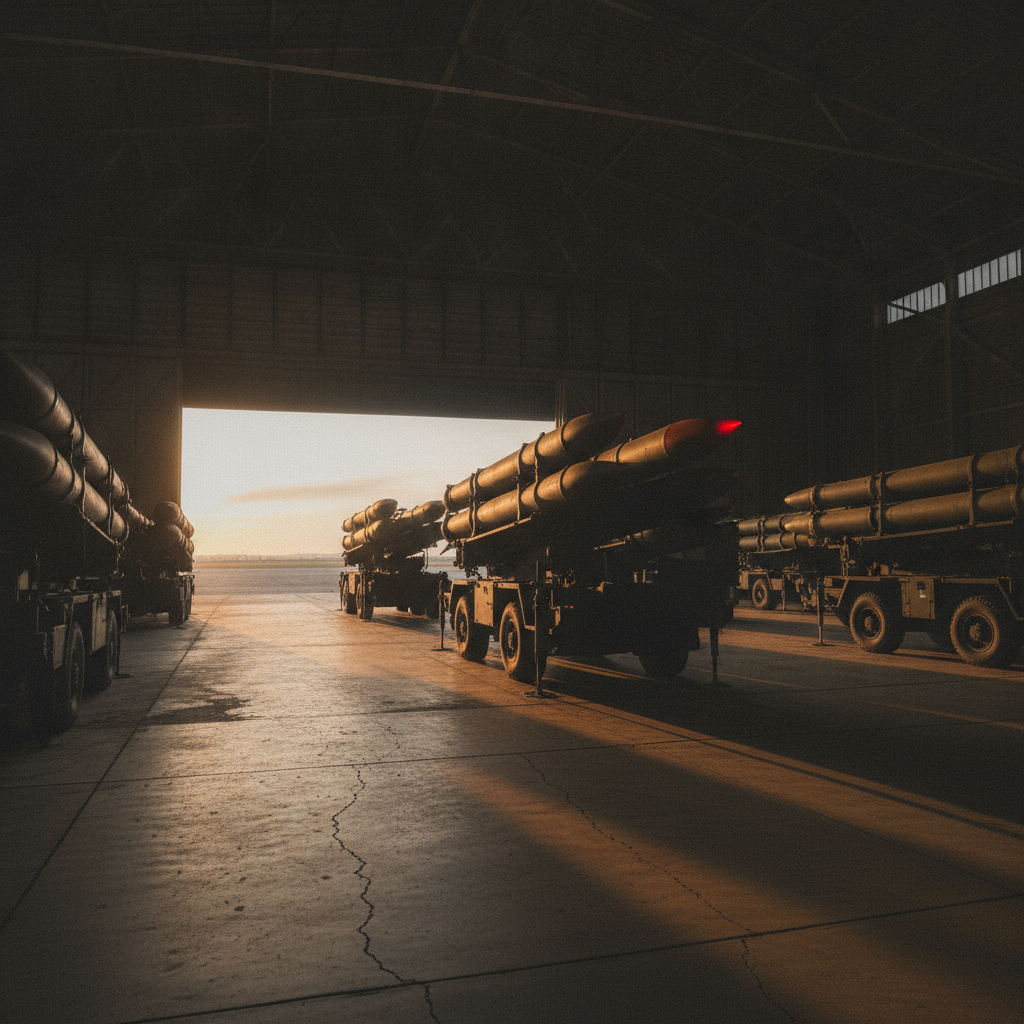
Japan's defense ministry has submitted a budget request of 8.89 trillion yen ($55.6 billion) for the coming fiscal year — a figure that would set yet another annual record — and the details inside reveal a force in the middle of a fundamental strategic shift. [1]
The headline item is a first: Japan has signaled intent to acquire Northrop Grumman's AGM-88G Advanced Anti-Radiation Guided Missile-Extended Range (AARGM-ER), making this the first time Japan has sought a dedicated anti-radar missile. [1] The weapon is designed to hunt and destroy enemy radar emitters, a mission set that marks a clear departure from Japan's traditionally defensive posture.
The budget request, released only in Japanese, also flags the purchase of unspecified low-cost cruise missiles — a mix of overseas-acquired systems to be followed by a domestically developed equivalent — and a submarine-launched guided missile, with 16.3 billion yen earmarked for that program. [1] A stand-off missile launch module for unmanned underwater vehicles is also on the list.
Perhaps the most ambitious weapons proposal is the plan to evolve Japan's existing ASM-3 supersonic air-launched anti-ship missile into a long-range air-to-air weapon. [1] Japan wants to join China, Russia, and the US in developing such weapons to counter adversaries with high-value air assets, such as airborne early warning aircraft and tanker aircraft — the platforms that make modern air campaigns function.
Read together, the missile requests sketch a military that is learning to reach further, strike earlier, and choose its targets more deliberately. The logic is not expansion for its own sake — it is about denying an adversary the ability to see, refuel, and coordinate before a conflict can be decided.
Drones are equally prominent. The request includes 292.2 billion yen to procure 17 additional General Atomics MQ-9B SeaGuardian Medium Altitude, Long Endurance drones for the Japan Maritime Self-Defense Force, adding to the three already operated by Japan's coast guard. [1] A further 7.6 billion yen targets interceptor drones — this could refer to the TerraDrone Terra B1 interceptor, which Japan's Acquisition, Technology and Logistics Agency selected as the winner of a rapid acquisition contract on Aug. 25. [1]
On the platform side, the request flags additional Lockheed Martin F-35 fifth-generation fighters, Boeing KC-46 tankers, Kawasaki C-2 transport and P-1 anti-submarine aircraft, and improved Mogami-class frigates — though no quantities or per-unit costs are listed. [1] Japan has not yet released three key national security documents — the National Security Strategy, the National Defense Strategy, and the Defense Buildup Program — that will confirm the country's procurement priorities and the numbers of platforms it will be acquiring. Those are expected later this year. [1]
The budget request also outlines a future AI-enabled command and control system intended to 'rapidly integrate and analyze data to secure a decision-making advantage through target selection and situational awareness,' eventually migrating to a classified, locally developed cloud-based platform resistant to adversary disruption. [1]
The ambition encoded in the AI command layer is significant. Speed of decision has become the core contest in modern warfare — whoever can close their observe-orient-decide-act loop faster shapes the battle. Japan is now building the architecture to compete in that contest.
The request now moves to Japan's Ministry of Finance for approval, expected later this year. [1] But even at the request stage, the document signals something durable: Japan is no longer budgeting for deterrence in the abstract. It is procuring the specific tools — anti-radar missiles, long-range air-to-air weapons, autonomous systems, AI-fused command networks — of a military preparing to contest its region at range.
rapidly integrate and analyze data to secure a decision-making advantage through target selection and situational awarenessJapan's FY2027 Defense Budget Request