Juice Is Coming Home — Before It Leaves for Good
ESA's Jupiter-bound spacecraft returns to Earth for a gravity assist that will bend its path 20 degrees and add 3.5 km/s — almost entirely for free.
By The space-quantum Desk
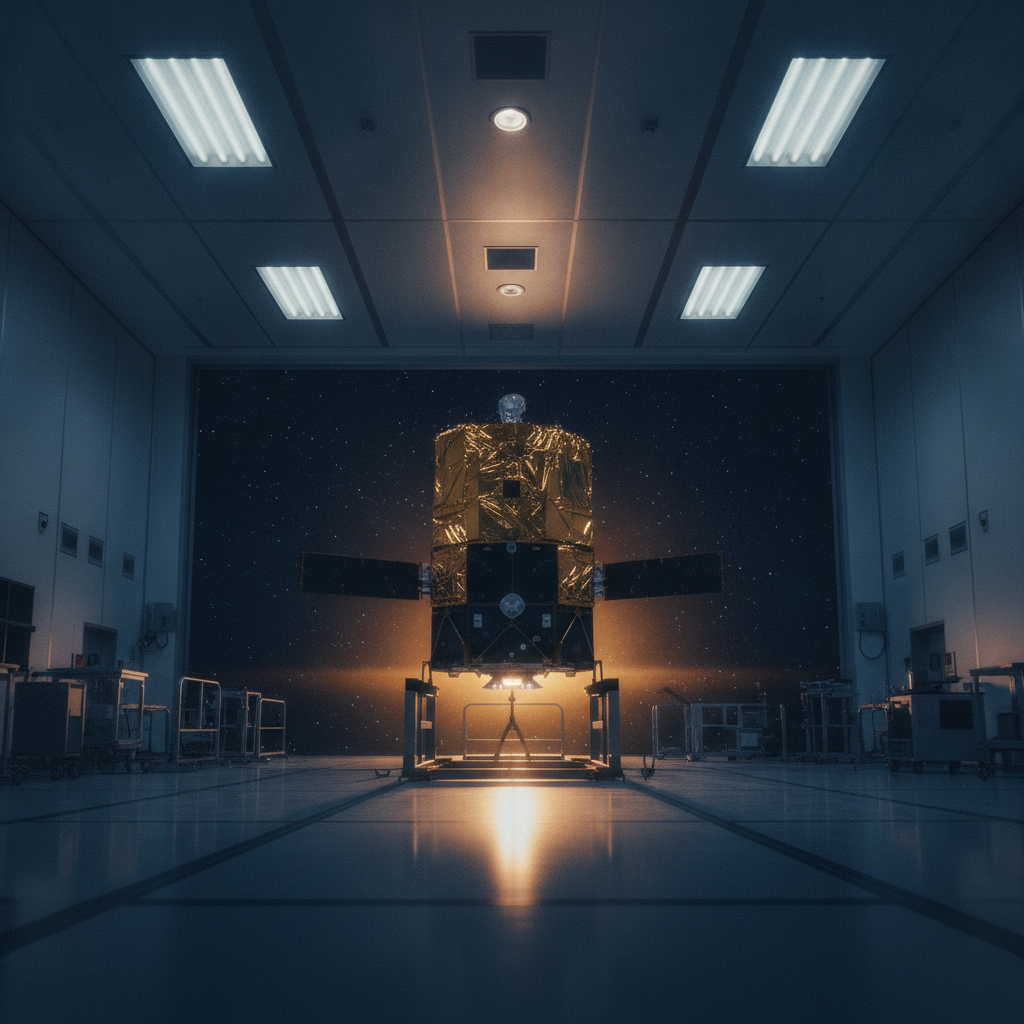
On 28 September 2026, a spacecraft the size of a small bus will skim within 8,640 km of Earth — closer than some satellites in medium orbit — before continuing its long arc toward Jupiter. [1] The European Space Agency's Jupiter Icy Moons Explorer, known as Juice, will not stop. It will not slow down. It will use our planet the way a billiard ball uses a cushion: arrive at one angle, leave at another, faster than before.
Juice launched on an Ariane 5 from Europe's Spaceport in Kourou in April 2023. [1] The 28 September encounter is the third in that chain, and it is the most consequential one yet.
The physics are straightforward, even if the choreography is not. On 28 September, Earth's gravity will deflect Juice's trajectory by about 20 degrees and increase its velocity by about 3.5 km/s. [1] The closest approach will be over the Indian Ocean at 13:45 CEST. [1] Between 15 and 30 minutes before that moment, the spacecraft will pass over Australia, travelling from the northeast of the country to the northwest — briefly visible to amateur astronomers with the right telescope or binocular equipment. [1]
There is something quietly strange about this moment. A machine built to study alien oceans passes over our own continent, close enough to observe, then vanishes into the dark. The planet it is heading for is more than five times farther from the Sun than we are. The moons it will eventually orbit are worlds unto themselves.
The gravity-assist strategy exists because the alternative is prohibitive. Flying directly to Jupiter and braking on arrival would have required an enormous rocket and an amount of fuel that mission planners describe as unthinkable. [1] Instead, flight controllers devised a strategy to make the most of the planets and their gravity — so that Earth, the Moon, and Venus do the heavy lifting almost entirely for free. [1] The fuel saved by this approach means Juice will have enough propellant remaining to enter orbit around Jupiter in 2031 and then around giant moon Ganymede in 2034. [1]
After the September flyby, one more Earth encounter remains. In January 2029, Juice will swing past again, placing itself on the optimum path to intercept Jupiter in July 2031. [1] At Jupiter, it will conduct 35 flybys of the three large ocean-bearing moons — Ganymede, Callisto, and Europa — before changing orbits to Ganymede. [1] The mission's scientific goal is to characterise those moons using a suite of remote sensing, geophysical, and in situ instruments, and to assess them as potential habitats for past or present life. [1]
Getting to the flyby precisely is itself a technical achievement. What ESA operators call the 'navigation campaign' began on 17 August, with six timeslots set aside — including at four weeks, two weeks, one week, and three days before the flyby — to make tiny corrections to Juice's trajectory. [1] Until the time of reporting, only one manoeuvre — at the four-week mark — had been needed. [1] At 08:00 CEST on 28 September, flight controllers will be prepared to execute a final emergency manoeuvre to fix critical navigation errors or avoid a collision with other satellites, though all indications suggest it will not be needed. [1]
[1] That economy of effort is the product of meticulous trajectory modelling. [2]
This is what modern deep-space operations look like behind the headlines: not dramatic last-minute heroics, but months of quiet iteration — data checked, kernels updated, windows computed and recomputed until the margin of error shrinks to almost nothing.
The flyby carries one complication that the navigation campaign cannot simply optimise away. From 21:24 CEST on 27 September to 06:03 CEST on 28 September, Juice will pass through Earth's shadow. [1] With no sunlight reaching its solar panels, the spacecraft will run on battery power alone, and the team will prioritise only the most critical instrument observations during that window to avoid depleting the batteries completely. [1]
The shadow passage is a constraint, but the broader observation window is an opportunity. Juice's 10 science instruments will be switched on to collect data on Earth and the Moon between 23 September and 3 October. [1] The flyby is, in effect, a dress rehearsal: by calibrating instruments on a known surface now, teams will be better prepared to extract clean data from Ganymede and Europa later. [1] Project Scientist Claire Vallat noted that because this flyby is much simpler from an operational perspective than the 2024 lunar-Earth encounter, controllers will be able to turn Juice in all different directions to point its science instruments at different parts of Earth and the Moon. [1]
One data product stands apart from the calibration work. [1] The magnetotail is, by ESA's own description, a very complex structure, and Juice's extended transit through it makes this one of the more scientifically distinctive moments of the entire cruise phase. [1]
Meanwhile, Juice's navigation camera — designed ultimately to help the spacecraft steer around Jupiter's moons — will point toward the horizon of our own Moon during the flyby. [1] The images will test a new technique to improve the accuracy of optical navigation, providing a real-world validation that cannot be replicated in a simulator. [1] Two onboard monitoring cameras will photograph the encounter throughout, with their final images from the event taken on 29 September. [1]
The instruments face outward, but the flyby turns the mission briefly inward — a moment of self-calibration in the middle of a very long journey. Every data point collected here is a hedge against uncertainty at a place six hundred million kilometres away.
Juice is a mission under ESA leadership with contributions from NASA, JAXA, and the Israel Space Agency, and it is the first Large-class mission in ESA's Cosmic Vision programme. [1] Its ambition is proportionate: to study the Jupiter system as an archetype for gas giant systems across the universe, and to look for conditions that could support life in the subsurface oceans locked beneath kilometres of ice. [1] None of that begins until 2031. For now, Earth does its part.
At 13:45 CEST on 28 September, Juice will be the closest it will ever be to the planet that built it, launched it, and is now, one last time, giving it a push. [1] Then it goes.
All flybys are risky, requiring very careful planning and continuous monitoring.Claire Vallat