Lockheed's Vectis Bets Five Drones Can Change the Math
Skunk Works is building four additional Vectis stealth drone prototypes, aiming for a $20M unit cost that puts it squarely in the CCA fight.
By The Defense Desk
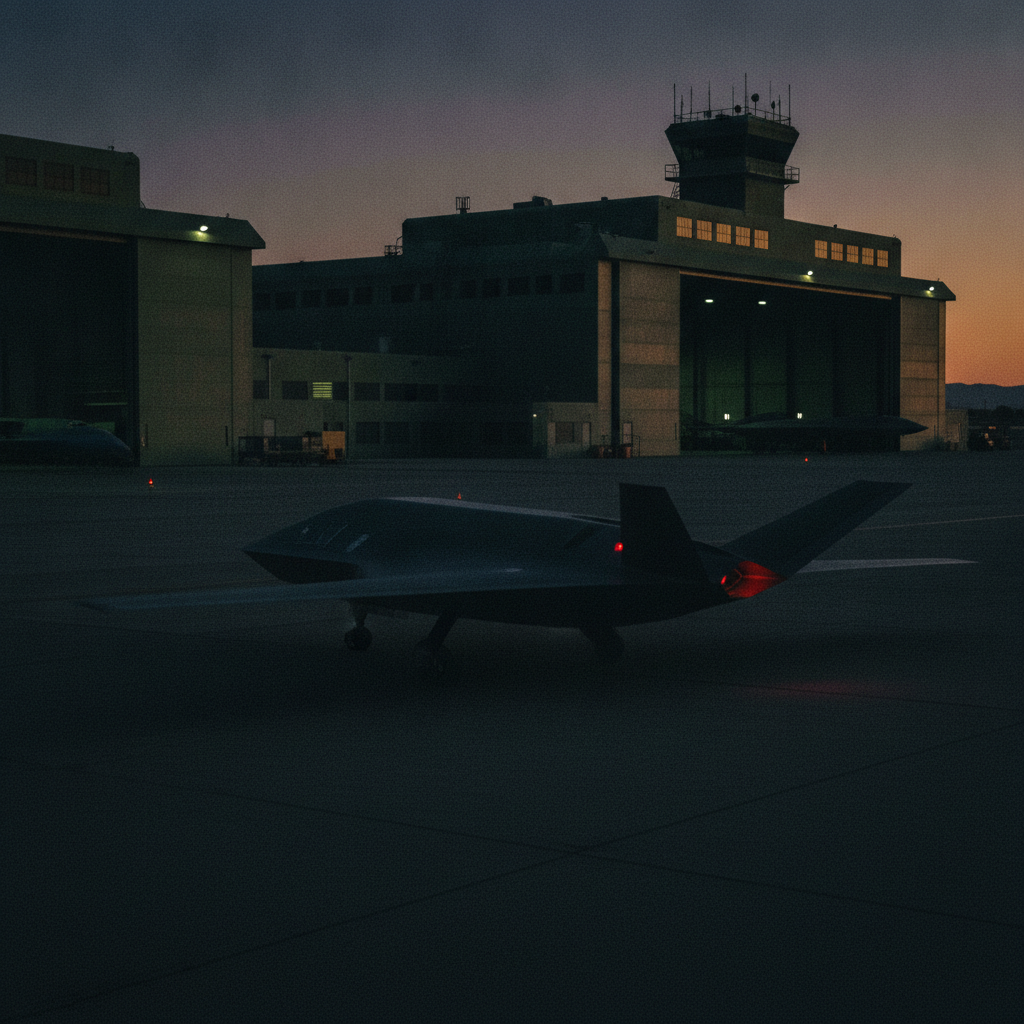
On the floor of the Association of the Air and Space Force conference in National Harbor, Maryland, a full-scale model of Lockheed Martin's Vectis stealth drone sat in open view — no curtain, no velvet rope. That kind of visibility is deliberate. [1]
Ron Fehlen, who runs Lockheed's Skunk Works advanced development division, said the company will "build and we will fly these four vehicles even more quickly" than the first prototype, which is set to fly by the end of 2027. [1] The additional aircraft are intended to accelerate testing and validate production processes — the kind of parallel-path investment that defense primes typically reserve for programs that already have a government contract behind them.
Vectis is a large "Group 5" stealth drone, designed to be adaptable to multiple mission sets — including air-to-air, air-to-ground and ISR — with payloads and mission systems that can be customized for the customer. [1] That breadth is its central pitch: not a single-purpose strike platform, but a configurable airframe that a buyer can tune for whatever the next conflict demands.
What makes this moment worth watching is not just the hardware. It is the posture. A company choosing to build five prototypes on its own dime, without a named customer, without a disclosed budget, is making a statement about where it believes the market is heading and how quickly it expects to get there.
[1] Lockheed also highlighted a submerged inlet on the top of the aircraft, which Fehlen said helps reduce drag and prevent debris from being sucked into the aircraft — a practical consideration for an aircraft that might operate from austere forward bases rather than manicured runways. [1]
On cost, Fehlen was precise: Lockheed is targeting unit costs "to be [at] the CCA competitive price." [1] The reference point is well-established. For the first increment of the Collaborative Combat Aircraft program — won by General Atomics and Anduril — the Air Force settled on a $20 million per aircraft cost target. [1] Matching that number without a production contract to spread tooling costs across is a significant engineering and manufacturing challenge.
To hit that target, Skunk Works is using a technique Fehlen called "minimal tooling determinate assembly," which he likened to putting together furniture from Ikea. [1] The approach is designed to reduce the amount of touch labor required and improve first-pass yield. Fehlen said the team has seen, "in many cases, an 80 percent reduction in labor hours to build up the aircraft itself" using the method. [1] That figure, if it holds at production scale, would represent a meaningful shift in how large military airframes are built.
Manufacturing philosophy rarely generates headlines in defense coverage, but it may be the most consequential variable in the autonomous aircraft race. Speed of production and cost per unit are becoming as decisive as radar cross-section or payload capacity. The drone that a military can afford to lose — and replace — is more useful in a high-tempo conflict than one that must be preserved at all costs.
The development pace Fehlen described inside Skunk Works is striking on its own terms. He said the team moved from "a design on a napkin" to wind-tunnel validation in two months, completed the first digital build in six months, and achieved the first part release in eight months. [1] That tempo is unusually fast for a Group 5 aircraft and reflects both the compressed tooling philosophy and the competitive pressure Lockheed feels from newer entrants to the autonomous platforms market.
On the question of customers, Fehlen offered nothing. "There is no reason to say, 'Well, it's one customer or another,'" he told reporters. Fehlen indicated Vectis is more aligned with CCA-style missions, where autonomous aircraft partner with crewed fighter jets, rather than with long-endurance unescorted strike work. [1]
The distinction matters because it defines which acquisition pathways Lockheed is positioning itself to enter. A platform optimized for teaming with fighters is a different business proposition than a replacement for the Reaper — different customers, different doctrines, different congressional conversations. Choosing CCA alignment while declining to close the door on anything else is a deliberate hedge.
By showing a full-scale model at AFA and releasing new specifications simultaneously, Lockheed is doing something defense primes rarely do at this stage: treating an internally funded prototype like a production-ready product. [1] The model on the show floor is not a rendering or a scaled mockup — it is the size and shape of the aircraft Skunk Works is actually building, giving potential customers and Pentagon officials a tangible reference point before a single flight test hour has been logged.
[1] That is either a well-calibrated long-term play or an expensive demonstration of confidence. Fehlen's framing suggests Skunk Works believes those two things are the same.
The first Vectis prototype is expected to fly by the end of 2027. Four more will follow, each one a data point in Lockheed's argument that the company can build a competitive autonomous combat aircraft faster and cheaper than the defense establishment expects. [1] Whether the Pentagon agrees is a question that will take years to answer — but Lockheed appears unwilling to wait for anyone to ask it first.