Lost in Translation, 250 Miles Up
The Space Force's laser-linked satellite backbone can't talk to its own missile-tracking birds. Fixing it will cost roughly $1 billion—and counting.
By The Defense Desk
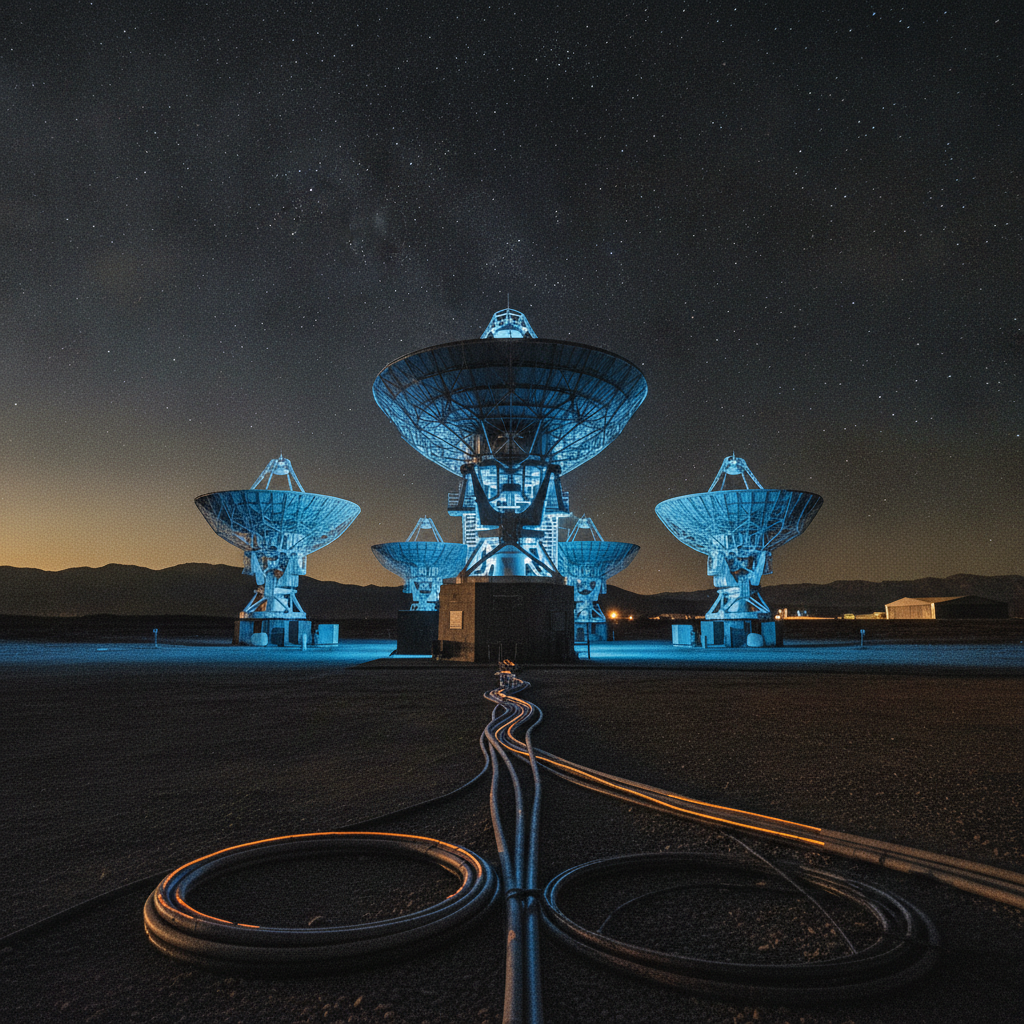
Somewhere above the Earth's atmosphere, three sets of military satellites are humming along, flashing laser pulses between themselves and the ground—yet unable to exchange a single bit of data with each other. The Space Force's Space Data Network Backbone, SpaceX's proprietary optical terminals, the Space Development Agency's Tracking Layer, and Space Systems Command's Medium Earth Orbit missile-warning birds all use laser links. They just speak mutually incompatible dialects of light. [1]
The mismatch is not a minor footnote. The SDN Backbone—a space-based network of networks designed to connect sensors to shooters—is the data spine of the Trump administration's Golden Dome missile defense initiative, which carries a 2028 implementation deadline. SpaceX won a $2.29 billion contract in May to fast-track that backbone. [1]
The crux of the problem: SpaceX is using proprietary optical communications terminals on its SDN Backbone satellites, dubbed "Plasers," that cannot directly exchange data with those equipping both the SDA and SSC missile warning and tracking satellites, according to multiple industry, former government, and current Space Force sources. To complicate matters, the OCTs used by SDA and SSC are also incompatible with each other. [1]
The Space Force's answer, so far, is a proposed constellation of 12 to 13 additional satellites—known as Space Exchange Points, or SEPs—that would act as orbital translators between all three sets of terminals. [1]
This is the kind of problem that emerges when speed and institutional momentum outrun coordination. Each program moved fast; none moved together. The result is a costly retrofit that multiple sources say never needed to happen.
The roots of the incompatibility run deep. The SpaceX, SDA, and SSC optical communications terminals are based on different technical standards governing the precise optical waveforms used—and thus how many gigabits of data per second the laser links can transmit. Part of the reason for the standards mismatch is the decision made in 2025 by the Department of the Air Force to shift from using SDA's Transport Layer of data relay satellites as the SDN backbone to relying instead on SpaceX's constellation. By that time, SDA had already been developing both the Transport Layer and Tracking Layer satellites based on its own open-source OCT standard, a first version of which was published in 2022. [1]
"The optical waveform/terminals on SDA's Transport Layer and Tracking Layer satellites, which carry the SDA OCT Standard, are not directly compatible with the Plaser waveform," an SDA official confirmed. [1]
The disconnect between SDA and SSC is harder to justify. Both developmental programs began at roughly the same time in 2019, meaning they could have worked together to develop compatible OCTs. One former Pentagon official said the missed opportunity was a failure of early coordination. One industry source offered a partial defense: SDA focused on terminals optimized for low Earth orbit, where satellites are close together, while SSC concentrated on medium Earth orbit, where the distances between satellites are far greater. The physics differ; the terminals diverged accordingly. [1]
Even that explanation does not fully satisfy critics inside and outside the government. Several sources expressed frustration with the situation, saying it could have been avoided had the Pentagon focused on standardization at an earlier date. Instead, the service is now having to scramble to fix a problem that, the sources emphasized, never needed to happen. [1]
Standards failures are rarely dramatic. They accumulate in procurement offices, in independent program offices running on different clocks, in the gap between what a system was designed to do and what a larger architecture eventually demands of it.
SSC initiated the SEP program on Aug. 13 with awards to five companies worth $12 million each—Amazon LEO for Government, Lockheed Martin, Northrop Grumman, Rocket Lab, and York Space System—to build prototypes. The SEP birds are described in an SSC release as "specialized spacecraft that act as orbital routers, allowing disparate networks and government satellite systems to connect directly" to the SDN Backbone. [1]
The SEP satellites are designed to carry the Enterprise Space Terminals—SSC's own OCT program, in development since 2024 at an estimated total cost of $100 million. This April, General Atomics and CACI announced Phase 3 awards to develop EST terminals for flight hardware production and demonstration. In July, SSC awarded California-based startup K2 Space $22.9 million to host tests of two ESTs on two of its Gravitas satellites. [1]
The plan, as it stands, is for each SEP to carry both SDA and SSC standard OCTs along with software to route data to the SpaceX Plaser and the SDN Backbone satellites. One former Space Force official acknowledged the networking complexity involved: "The technical challenges from the hardware side are pretty straightforward. … But there is some networking translation that has to happen in addition to just the hardware configuration." [1]
A second solution sits further down the schedule. A new version of SDA's optical waveform standard, v.4.0.0, developed in consultation with SSC, includes two modes: the first essentially is the same standard SDA is using for LEO-to-LEO and LEO-to-ground communications; the second would enable LEO-to-MEO optical data transmission. If fielded, it could directly link the two missile warning and tracking constellations, eliminating the need for a third OCT payload on each SEP satellite. The SDA spokesperson said version 4 "is not yet on contract to be fielded in any SDA Tranches, but is in consideration for Tranche 4." [1]
Tranche 4 is some way off. The Space Force's first operational Tracking Layer satellites—Tranche 1—are now expected to launch in spring 2027, nearly two years later than originally planned. [2] That delay ripples forward through Tranches 2 and 3, pushing the timeline for any v.4.0.0 fielding further into an uncertain future, even as the Space Force plans to orbit an "operational prototype" of the SDN Backbone by 2027. [1]
Meanwhile, the SEP satellites as currently designed are not compatible with either SDA's Tracking Layer or the Transport Layer—which is being transferred to SSC for further development as a separate enclave of the SDN focused on connecting to legacy military platforms such as fighter jets. That raises the question, which sources did not dismiss, of whether yet more development and funds will be needed beyond the current $1 billion estimate. [1]
Translator satellites are a workaround, not a solution. They acknowledge that the architecture beneath them was not designed to cohere. Every layer of translation adds latency, cost, and a new surface for failure in a system built for speed and resilience.
The concept of a translator satellite is not a new idea—SDA was working on the idea in 2022 to allow data from commercial satellites eventually to flow into the Transport Layer. But the ambition of the current SEP program is significantly larger, sitting at the center of a missile defense network that the administration has staked both diplomatic credibility and significant procurement dollars on. G.P. Sandhoo, head of both SDA and the Space Force's new Missile Warning and Tracking Portfolio Acquisition Executive office, acknowledged at a Silicon Valley Space Week panel in Mountain View, California, on October 28 that his office will eventually need to figure out how to integrate data from sensors in different orbits. The SDA spokesperson added that interoperability between the OCTs for the LEO and MEO missile warning and tracking constellations is currently "being evaluated" by the Space Force. [1]
SSC declined to comment on the technical compatibility of its MEO satellites with SDA's LEO birds or SpaceX's Plaser, and declined to comment on the SEP program's projected costs and deployment timeline. SpaceX did not respond to a detailed inquiry from Breaking Defense. [1]
The Space Force is spending $2.29 billion to build a spine for its missile defense network, then roughly another $1 billion to build the connective tissue that makes that spine functional. The translator satellites may work. The waveform standard may eventually converge. The deadlines may slip far enough that the architecture has time to catch up with itself. But the bill for a standards conversation that did not happen in 2019 is now arriving in the middle of a budget fight—and the meter is still running. [1]