Move or Die: The Pacific's New Rules of War
Army commanders are rewriting doctrine for a China fight, drawing hard lessons from Ukraine's drone hell and Iran's missile barrages on static U.S. bases.
By The Defense Desk
The lesson is brutal in its simplicity: if you can be seen, you can be hit. And if your enemy knows you're about to return fire, they will shoot first. That is the operational reality Army Pacific commanders brought home from watching two wars they weren't fully fighting — and it is now reshaping how the U.S. Army plans to survive a potential conflict in the Pacific. [1]
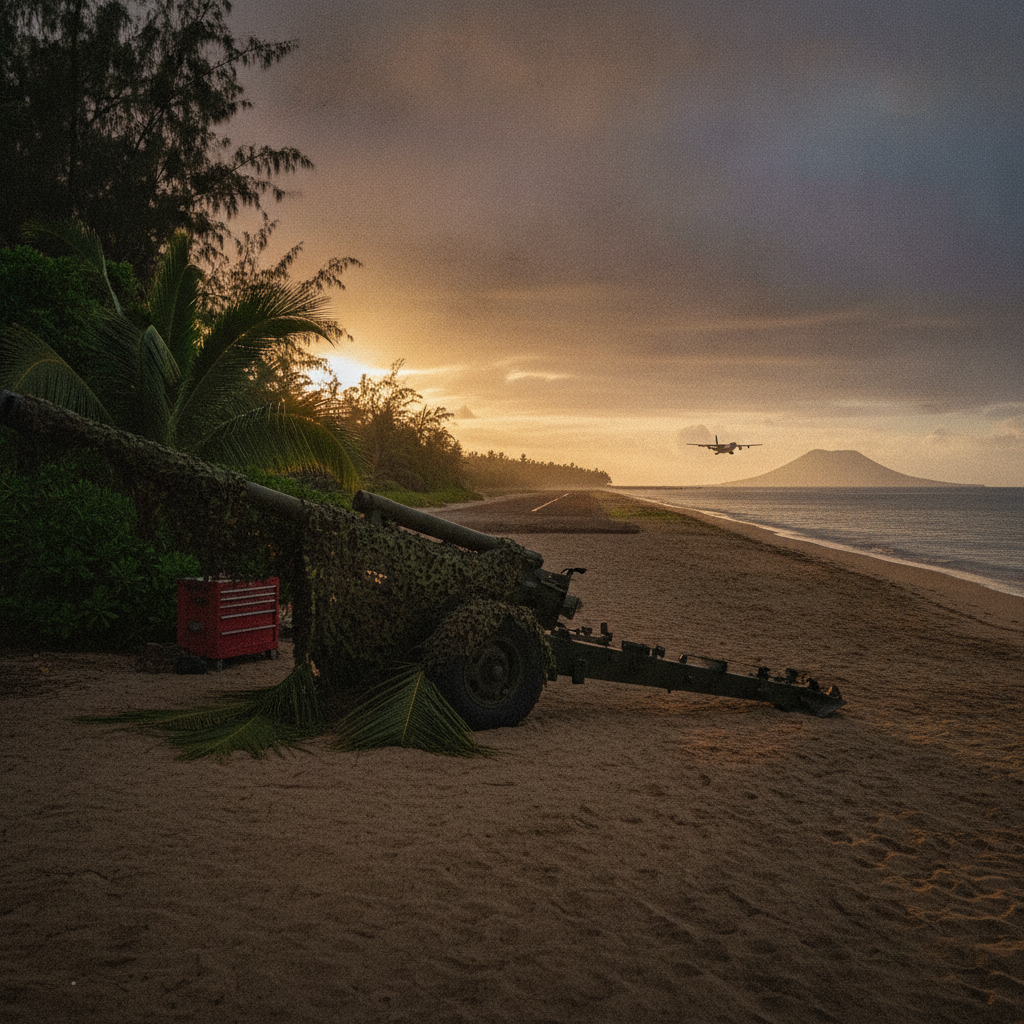
At the Association of the U.S. Army annual convention in Washington, D.C., Gen. Ron Clark, commander of U.S. 'Specifically, I am thinking through mobility and camouflage,' he told reporters at a media roundtable. 'So it's one of those age-old Army forgotten sciences of how to hide in plain sight and how to camouflage ourselves from observation, because the ability to be able to see surface entities is almost ubiquitous.' [1]
That observation tracks directly with what drone footage and satellite imagery have confirmed in Ukraine: the ubiquity of drones providing constant overwatch and strike capabilities has made static positioning acutely dangerous. Both sides have been using smokescreens to hide from drones and paint schemes designed to obfuscate vehicles and other equipment from AI-enabled targeting systems. [1] The wars in Ukraine and the Middle East are functioning as live-fire laboratories, and the Army's Pacific leadership is taking notes.
What emerges from these theaters is not a single tactical fix but a philosophical reversal — away from the massive, predictable footprint that defined Cold War-era garrison thinking and toward something more fluid, more elusive, and considerably harder to destroy.
The Iranian dimension sharpened that lesson with particular force. The Iranian missile and drone barrages on fixed U.S. [1] The radar for a THAAD system was struck and apparently destroyed in Jordan, while two other THAAD radar systems may have been hit in the UAE, satellite images showed. The pattern was consistent: static assets, once located, became targets.
In South Korea, Col. Rosanna Clemente, commander of the 35th Air Defense Artillery Brigade, described how her unit has absorbed those lessons in practice. 'Drawing from those lessons learned, a lot of it is trying to understand how our systems are being hunted by the adversary,' she said. Her soldiers now train on what she calls 'mobility and survivability jumps' — rapidly repositioning systems to alternative locations based on threat warnings — while maintaining ballistic missile defense coverage across the peninsula. [1]
Passive defensive measures extend beyond physical hardening to include deception — moving assets around, creating distractions, and manufacturing dilemmas for adversaries trying to locate defended positions. [1] The vocabulary is old; the urgency is new.
The Pacific, however, is not Ukraine. The terrain is archipelagic, the distances are oceanic, and the adversary is categorically different from either Russia or Iran — a point that changes the calculus of every lesson borrowed from those fights.
Clark was direct about the distinction. In Europe and the Middle East, 'it's not a near-peer adversary that we will be working against,' he said — a reference to Russia and Iran respectively. 'Whereas in our theater, it absolutely is.' He did not name China. He did not need to. [1]
Fighting inside an archipelagic environment demands a different geometry of movement entirely. Any Pacific conflict will require soldiers to hop islands and move through vast swaths of ocean, constantly hunted and frequently inside the Chinese weapons engagement zone. [1] The Army's organic fleet — landing craft, small tugs, modular causeway systems operated by the 8th Theater Sustainment Command — is described as vital for that kind of maneuver. The problem: the Army is struggling to keep its aging fleet of 70 vessels operational, and it shed additional ships in prior years. [1]
Gen. Xavier Brunson, commander of United Nations Command, Combined Forces Command, and United States Forces Korea, reframed the maneuver problem in terms that apply whether the terrain is steppe or shoreline. 'Maneuver is always going to be maneuver,' he said. 'You're going from A to B, but you might go from A to A1 to A2 to A3 to get to B, and that's what I think we realize in this distributed fight that's going on in Ukraine.' [1] Efficiency of movement, in other words, is no longer the primary variable. Survival is.
The distributed fight changes not only where forces move but how they train to think — and the institutional habits that have calcified over decades are precisely what commanders are now trying to break.
Clark wants to upend training culture in South Korea, where exercises have historically concentrated on two large annual events centered on fixed command posts. 'We recognize… that largely the two big exercises every year in Korea focus on large command posts,' he said. 'We've got to move away from that.' [1] In discussions with his deputy, Republic of Korea Army Gen. Sungmin Kim, Clark is exploring what it would look like to train across the full peninsula — from Jeju all the way up to Gyeonggi Province in the north — rather than returning to the same location each cycle. [1]
The goal, Clark explained, is to deny adversaries the pattern recognition that static training creates. He postulated what it would mean to say to North Korea: 'You can't utilize the things that you've learned in the fight and the battlefield in Ukraine on us, because we learned the same lessons and we've distributed ourselves in such a way that we don't make ourselves the target. We won't be moored in place.' [1]
Logistics and sustainment present their own version of the same problem. In Ukraine, both sides are using aerial and ground drones to supply frontline forces and evacuate the wounded because human efforts have now become too deadly, thanks to drones. Tara Murphy Dougherty, CEO of Air — a company that provides AI-based sustainment solutions to the Army and surpassed unicorn status in 2025 — argued at the convention that simulation and automation can help reduce convoy exposure before fully autonomous systems arrive. [1][2] 'One of the advantages that you get from using simulation and automation, and really using models and compute in order to create convoy plans, as opposed to humans with Excel spreadsheets, is you are able to do many fewer actual convoys because you're using all of your capabilities so much more effectively and efficiently,' she said. [1]
Murphy Dougherty's end-state vision is explicit: autonomous convoys replacing human drivers in the most exposed situations, with AI-driven planning reducing the number of runs required in the interim. 'I see the end goal outcome as having as many autonomous convoys as possible,' she said. 'In the interim, until we get to more autonomy in medevac and more autonomy in convoys when it's non-soldier material that's going out to the battlefield, let's try and put fewer out there while actually getting more material and capability into the force where it needs to be.' [1]
What threads through every conversation — from island-hopping doctrine to supply chain automation — is the same underlying tension: institutions built for a previous era of warfare, now racing to adapt before the next conflict tests them for real.
Clark's bottom line carries the weight of that tension. 'Our ability to be able to use electronic warfare, to be able to use just good old-fashioned camouflage, and the ability to deceive our adversary is a must,' he said. [1] In a theater defined by a near-peer adversary, satellite surveillance, and hypersonic weapons, the Army's most important technology might be the oldest one: not being where the enemy thinks you are.
The Pacific has no front line in the European sense — no continuous trench to hold or ridge to contest. It is a vast, sensor-saturated domain where the force that stays still longest dies first. The Army knows this now. The question is how fast it can move. [1]