NASA Planes Are Sniffing Out Farm Pollution
The FarmFlux mission sends low-altitude aircraft over Texas feedlots and Midwest cropland to map agriculture's murky emissions footprint.
By The space-quantum Desk
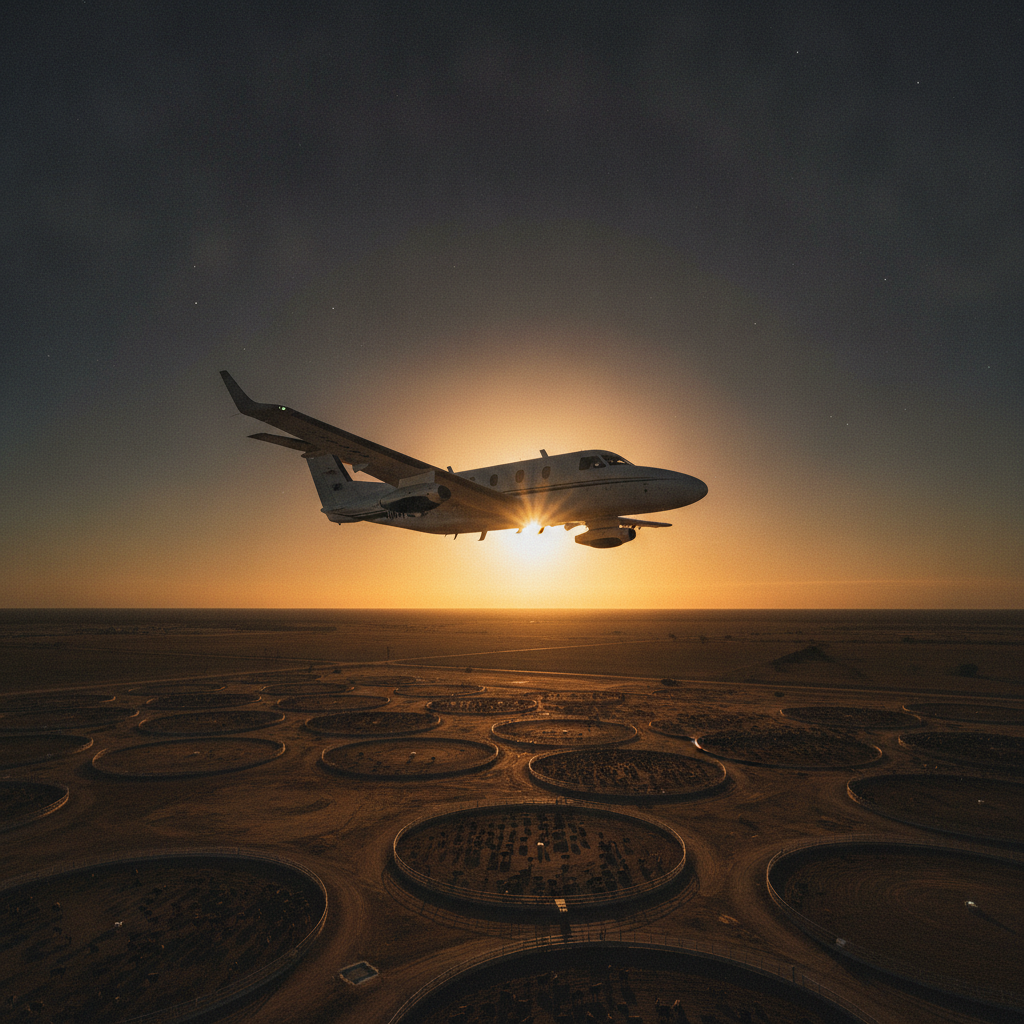
Agriculture is the single largest source of ammonia, methane, and nitrous oxide in the United States — yet scientists still struggle to quantify how much of it actually escapes into the air [2]. NASA's FarmFlux mission is trying to fix that, one low pass at a time.
A NASA Dynamic Aviation A200 aircraft will conduct low-flying research flights over farmland near Transit, Texas, from Oct. 22 through Nov. 9 [1]. The target: gaseous and particulate emissions drifting up from animal feeding operations below.
The mission is jointly led by NASA's Goddard Space Flight Center in Greenbelt, Maryland; Colorado State University; and Boston University [1]. Additional low-altitude research flights with a NASA P-3 Orion aircraft are scheduled for the March to July 2027 growing season in the Midwest and California's Central Valley with a focus on cropland [1].
The gap in knowledge is partly structural. Ground monitoring networks are sparse in rural areas, making it hard to track emissions at the scale farms actually operate [2]. Fertilizer application and manure management inevitably release nitrogen-containing gases — ammonia, nitrous oxide, nitrogen oxides — in addition to methane and other carbon-containing gases [2]. Those compounds don't stay put; they travel, react, and transform as they move through the atmosphere.
What makes FarmFlux notable isn't the ambition — atmospheric science has always dreamed big — it's the timing. Instrument miniaturization has finally caught up with the problem's scale, putting precision tools on platforms small enough to fly low and slow over working land.
Airborne instruments are faster, more precise, and more compact than they were a decade ago [2].
The data won't just sit in a research archive. Observations from both aircraft will feed air quality models used to forecast near-term air quality and simulate strategies for long-term air quality improvement [2]. That pipeline — field measurement to model to policy tool — is the practical payoff NASA is betting on.
There's a quiet irony in sending space-agency hardware to stare at pig farms and cornfields. But the atmosphere doesn't distinguish between industrial smokestacks and manure lagoons — and neither, increasingly, do the scientists tasked with modeling the climate.
Agricultural emissions represent an important and understudied part of Earth's land and atmosphere systems [1] — and FarmFlux is the most systematic attempt yet to turn that vague acknowledgment into actual numbers. When the P-3 takes its turn over the Central Valley in 2027, researchers will finally have a two-aircraft, two-year baseline to work from. The gap is closing, one flyover at a time.
Agriculture is the single largest source of ammonia, methane, and nitrous oxide in the United States, and it is a rising source of other atmospheric emissions.NASA FarmFlux Mission Overview