NASA's 'Free' Moon Rover Could Cost Over $1 Billion
The PROMISE lunar rover sounds like a bargain—repurposed Mars hardware, existing parts. A new analysis suggests otherwise.
By The space-quantum Desk
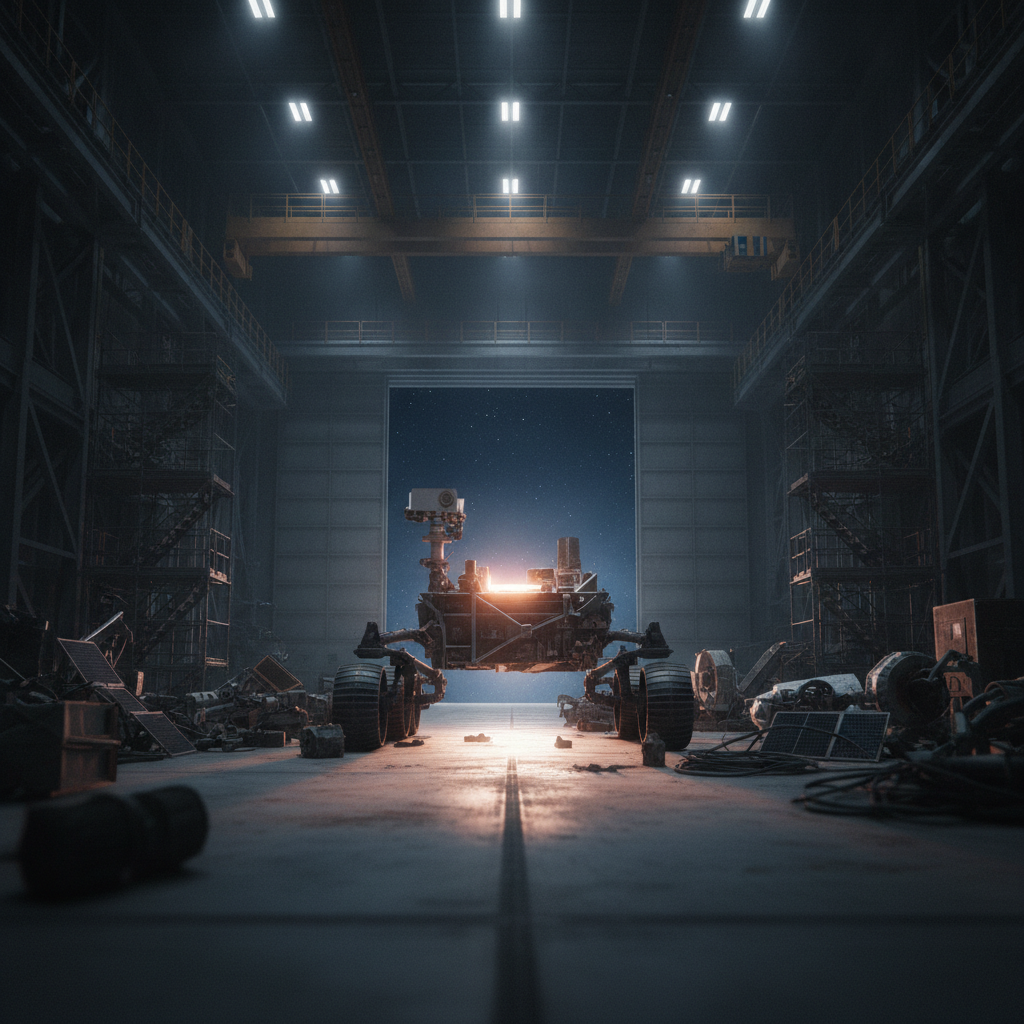
NASA wants to drive a Mars rover on the Moon. Why not send one to the lunar south pole? On June 30, NASA announced it was considering sending to the Moon a rover it called PROMISE—Polar Rover for Observation, Mapping and In-Situ Exploration—as exactly that kind of opportunistic hardware reuse. [1][2]
The Planetary Society's analysis, published July 30, put a number to the opportunity: between $723 million and $1.33 billion to develop and launch PROMISE, including one year of operations on the Moon. [2]
The gap between the pitch and the price tag comes down to what the testbed rovers actually are. OPTIMISM, Perseverance's engineering duplicate deployed in 2021, carries avionics, a computer, drive cameras, and a sampling system—but no plutonium power source, no communications system, and no flight-ready instruments. [2] Engineers plug it into the wall and communicate via cables. According to a paper published by JPL engineers in 2022, the rover lacks the sensors and failsafes necessary to protect itself from the temperature swings a spacecraft endures in space. [2]
NASA's updated plan makes the engineering picture more complicated, not less. PROMISE would now be a hybrid of both the Curiosity and Perseverance testbeds—merging hardware built more than a decade apart. [2] Adapting both systems for spaceflight will likely prove harder still.
Power is the single largest constraint. Perseverance runs on a radioisotope thermoelectric generator fueled by 4.8 kg of plutonium-238. NASA has one spare flight-ready RTG. [1][2]
Mass is the next wall. Absent a launch vehicle databook with credible failure statistics, NASA cannot complete the safety analysis required to launch nuclear material—a process that can itself take years. [2]
The historical precedent most often cited for hardware reuse—the Phoenix Mars lander, which reused 70% of hardware from an earlier lander mission canceled in 2000—actually illustrates the limits of the comparison. Phoenix reused hardware that had been built for spaceflight and stored in a cleanroom. Even then, the mission cost approximately $640 million adjusted to fiscal year 2025 dollars, exceeding its original cost cap by nearly 40%. [2] The PROMISE testbed rovers were stored in a garage, never intended for spaceflight, and NASA has no prior example of successfully flying non-flight-qualified hardware on a major science mission at this scale. [2]
Isaacman pushed back on July 31, arguing in a social media post that launch and landing costs are a reality for any mission. "Launch and landing costs are a reality for any mission, so setting those aside, if PROMISE costs even 20% of your low-end estimate, we simply will not fly it," he wrote. [1] He also pointed to the plutonium-238 already in NASA's stockpile, which decays and loses roughly 2% of its potential each year, as justification for acting quickly rather than waiting for a competed mission that does not yet exist. [1]
The RTG question has already disrupted NASA's next planetary science competition. [1]
The tension here is not simply about one rover. It is about what kind of decisions space agencies make when budgets are shrinking and political timelines are compressing—and whether reframing sunk costs as savings changes the arithmetic of exploration.
[2] The detailed engineering assessment is currently underway at JPL. Whatever it finds, the cost of deciding will itself cost something.