NASA's Glowing Wing Rewrites Wind Tunnel Testing
A pressure-sensitive paint that makes wings glow pink-purple is giving researchers a new way to see airflow in real time.
By The space-quantum Desk
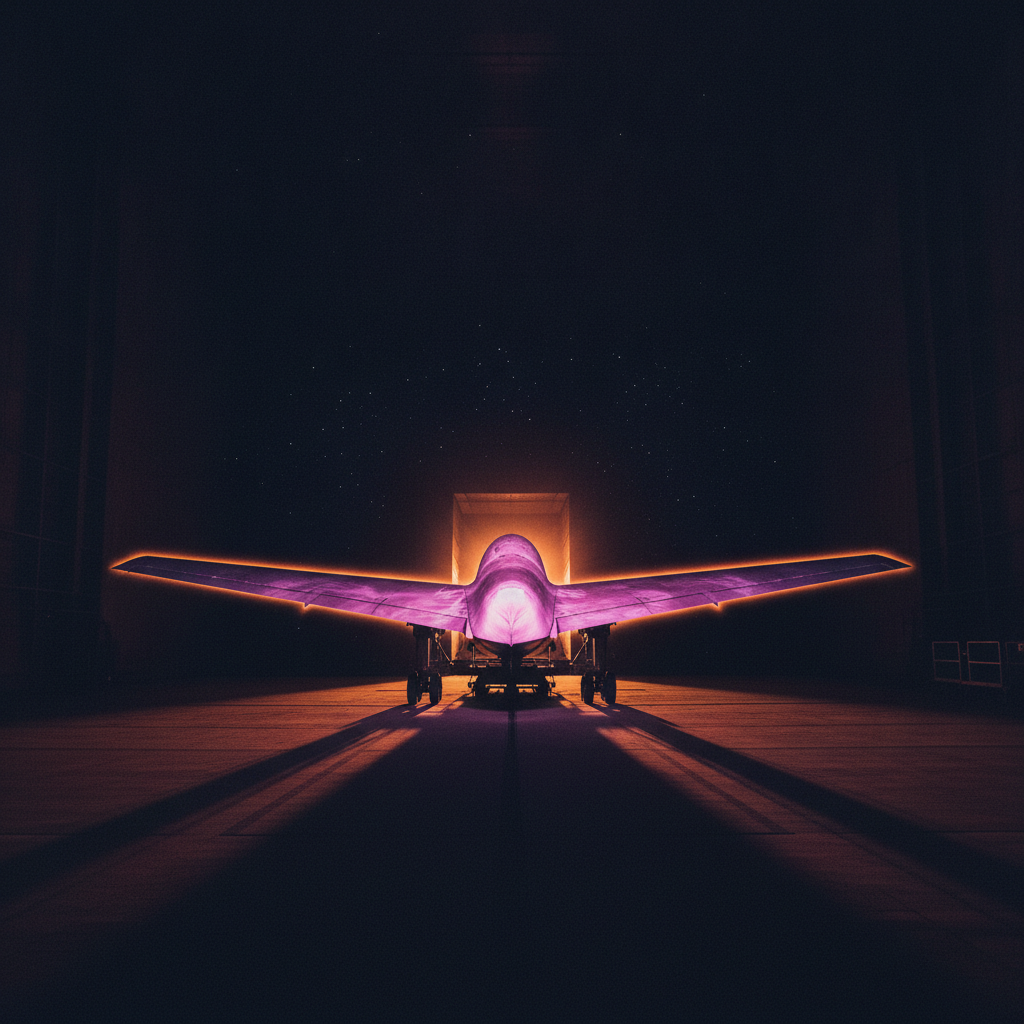
At NASA's Langley Research Center in Hampton, Virginia, a model wing recently lit up pink-purple under ultraviolet light — not for spectacle, but for science. Researchers applied unsteady Pressure Sensitive Paint to the Benchmark Supercritical Wing and ran it through the Transonic Dynamics Tunnel, capturing every pressure shift with high-speed cameras. [1]
The paint works by varying in brightness according to how much pressure airflow applies to the wing's surface. High-speed cameras capture those changes, feeding data directly into computer models used to simulate flight. [1] It's a technique NASA researchers at Langley and Ames Research Center in California's Silicon Valley have been refining for aircraft and rocket testing alike. [1]
This test marked the technique's first use on a large-scale, freely moving model in a low-oxygen environment — an achievement made possible by the Transonic Dynamics Tunnel's unique testing capabilities. [1] The Benchmark Supercritical Wing itself is a universal model, not tied to any specific aircraft, designed to sharpen the computer simulations that underpin future designs. [1]
What looks like a physics curiosity is, in practice, a methodological shift in how engineers close the gap between physical testing and digital simulation. The more faithfully a tunnel test speaks to a model, the less guesswork survives into a finished aircraft.
Next up: flexible aircraft models designed to bend and adapt during flight. NASA expects the paint to find many more wind tunnel applications as those tests get underway. [1]