NASA's Moon Toilet Turns Waste Into Food and Plastic
A trailer-sized bioreactor lab shipped to North Dakota aims to prove that a lunar crew's sewage can close the loop on food, water, and even manufacturing.
By The space-quantum Desk
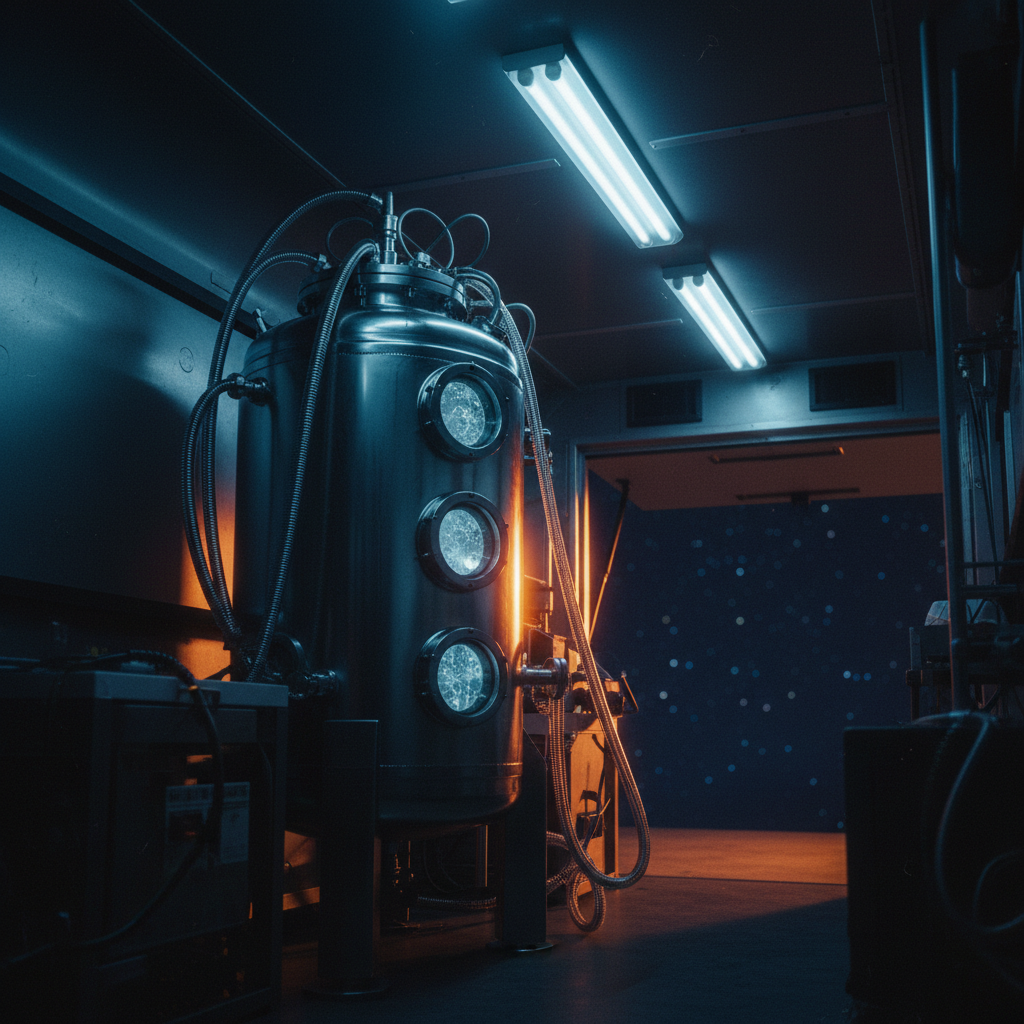
A mobile wastewater treatment facility housed inside an 8.[1]
The system, called the Divergent Deployable Wastewater Treatment Facility, fits inside an 8.5-by-24-foot trailer and brings together three biological reactor systems, a vertical garden, water-polishing hardware, environmental monitoring, autonomous control software, and safety systems. [1] It was outfitted at NASA Kennedy to function as a deployable laboratory and to travel between at least two simulation test sites as the technology matures. [1]
The design philosophy behind the facility is deliberately divergent: unlike wastewater systems on Earth, this facility keeps waste streams separate. [1] That matters because wastewater from four to eight people can be highly concentrated. [1] Urine, hygiene water, laundry water, fecal waste, and food waste each contain different levels of salts, solids, carbon, nitrogen, phosphorus, and other compounds, so treating them separately allows each stream to be processed by the reactor best suited for the job. [1]
Three bioreactors divide the labor. The Anaerobic Phototrophic Membrane Bioreactor processes fecal and food waste and converts it into a nutrient-rich wastewater that can support plant growth. [1] The Suspended Aerobic Membrane Bioreactor processes urine and flush water, while the Membrane Aerated Biological Reactor treats graywater from hygiene and laundry activities. [1]
At the University of North Dakota, the facility was connected to the university's Integrated Lunar/Martian Analog Habitat through a bathroom interface that includes a urine-diverting toilet, under a NASA EPSCoR grant. [1] That plumbing detail is not trivial: separating waste streams at the source is what makes the downstream chemistry manageable for a crew operating without a resupply chain. [1]
What happens when a closed environment must account for every gram of biological waste is less a sanitation problem than a systems design one. The further from Earth a crew travels, the more completely each output of daily life must become the input for something else.
The work sits inside NASA's broader Bioregenerative Life Support Systems effort, which is developing biological approaches to reduce dependence on Earth-supplied consumables. [1] Researchers are also exploring how nutrient-rich water from bioregenerative wastewater systems could feed microbes that produce lactic acid, which can be turned into polylactic acid — a material that could one day serve as a binder for 3D printing with lunar or Martian regolith, or could be used for replacement parts. [1]
[1] Lessons learned could inform future higher-fidelity tests, including potential integration with NASA's next generation of yearlong simulated Mars missions via isolation analogs at Johnson Space Center in Houston. [1]
The gap between a plumbing experiment in Grand Forks and a functioning lunar habitat is still considerable. But the logic of circularity — waste in, water and food and raw material out — is precisely the kind of unglamorous engineering that determines whether long-duration space habitation is possible at all.
If the North Dakota tests hold, lessons learned could inform potential integration with NASA's next generation of yearlong simulated Mars missions via isolation analogs at Johnson Space Center — which would put the system through conditions closer to what a real crew would face on a long-duration mission to the Red Planet. [1]
The work may begin with wastewater, but its goal is much larger. We want to help future crews live sustainably on the Moon, learn how to operate farther from Earth, and carry those lessons forward to Mars.J.J. Edelmann