Netherlands Buys Its Own GlobalEye on Top of NATO's Order
The Hague signs a letter of intent for a dedicated Saab surveillance aircraft, hedging against reliance on a shared NATO fleet.
By The Defense Desk
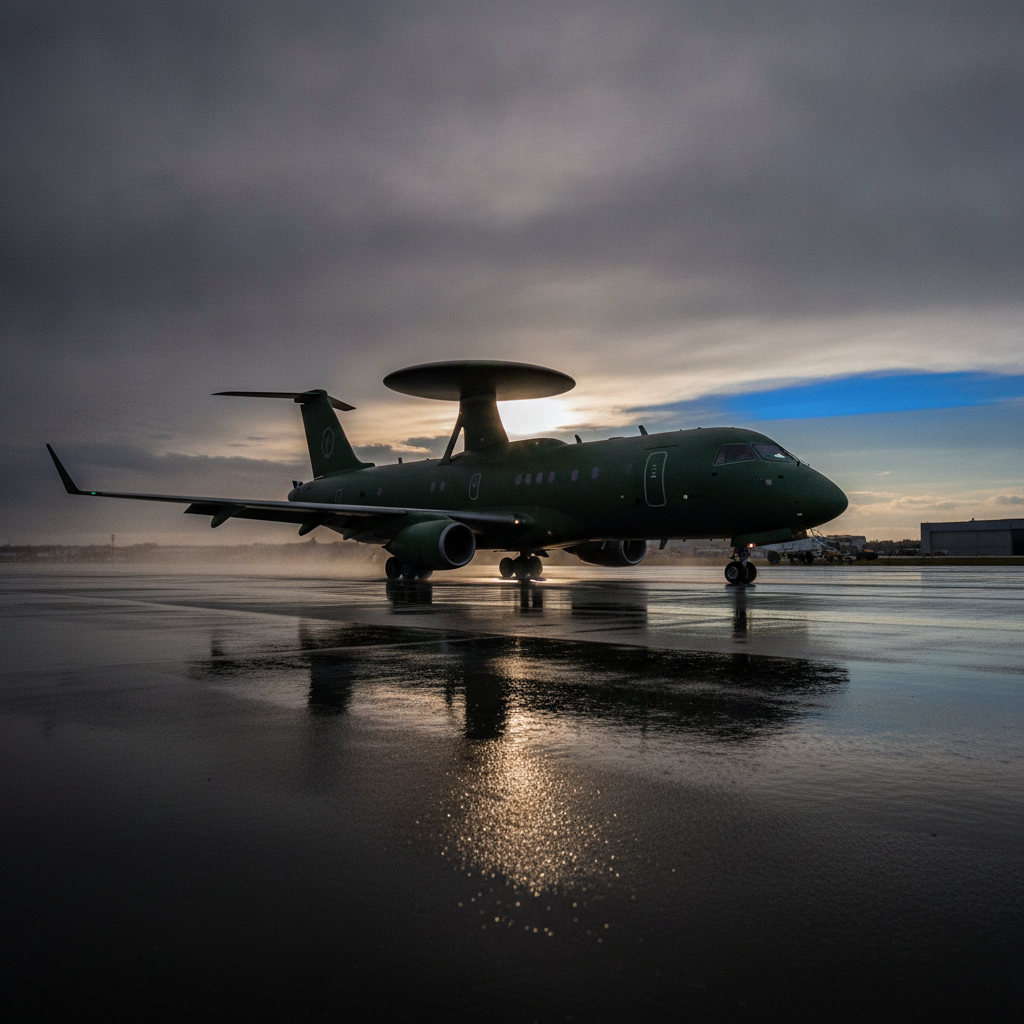
The Netherlands has signed a letter of intent with Sweden to acquire a Saab GlobalEye airborne early warning and control aircraft, with delivery scheduled for 2031 — a bilateral purchase that sits on top of The Hague's participation in a separate NATO buy of up to 10 GlobalEye aircraft announced earlier this year. [1][3]
Dutch crews will be able to train on Swedish GlobalEye systems as early as 2028, ahead of the 2031 delivery. [1][2]
The deal fills a specific gap in Dutch sovereign capability. The Netherlands has previously had no aircraft capable of airborne surveillance and command-and-control, relying instead on NATO's AWACS fleet. A dedicated national aircraft, operated in close coordination with the Swedish air force, gives The Hague an organic asset rather than a share in a pooled resource. [2]
Saab clarified that the parties have not yet entered into a contract and the company has not yet received an order from the Netherlands — it "stands prepared and awaits the next steps of the procurement process." [3] The distinction matters: a letter of intent is a political signal, not a binding commitment, and procurement bureaucracies on both sides still have work to do.
The announcement arrives at a moment when European defence ministries are racing to reduce their dependence on alliance-wide assets and plug gaps that decades of underinvestment left open. A bilateral aircraft deal, layered on top of a collective NATO order, is one answer to the question of what sovereign capability actually looks like in practice.
The Netherlands purchase is the latest in a string of GlobalEye wins for Saab. [1]
In May, Canada announced plans to acquire GlobalEye and said the deal would include a production line in the country for both domestic and export markets, though no contracts have been signed as negotiations continue. [1] Weeks after that, Saab received an order for two GlobalEye aircraft from an undisclosed customer in the Middle East, valued at 10.1 billion kronor — roughly $1 billion — with deliveries scheduled for 2030. [1]
GlobalEye is an advanced multi-domain AEW&C solution with an array of active and passive sensors that provide long-range detection and identification of objects in the air, at sea and over land. By providing real-time information to air forces, armies and navies, GlobalEye enables enhanced situational awareness of the surrounding areas and early detection of threats. [3]
What ties the Netherlands deal to the broader pattern is the logic of redundancy — not duplication for its own sake, but the political and operational calculus that a dedicated national asset gives a smaller ally genuine agency inside a larger alliance structure.
The announcement may also be among the final defence decisions Jonson signs off on. Swedish parliamentary elections fall this weekend, with polls showing a very slim lead for the center-left opposition over the ruling right-wing block. [1]
For Saab, the pipeline now stretches from Stockholm to The Hague to Ottawa to an unnamed Middle Eastern capital. For NATO's smaller members, the GlobalEye order book is quietly becoming a map of who is betting on European-made air sovereignty — and who still hasn't decided.
GlobalEye will enable the Netherlands to detect threats earlier, respond faster, and strengthen both national and collective defence.Micael Johansson