North Korea's Stealth Drone Is Mostly a Prop
Pyongyang unveiled a flying-wing UCAV mockup at its biggest-ever drone expo. The shape is real. The capability almost certainly isn't.
By The Defense Desk
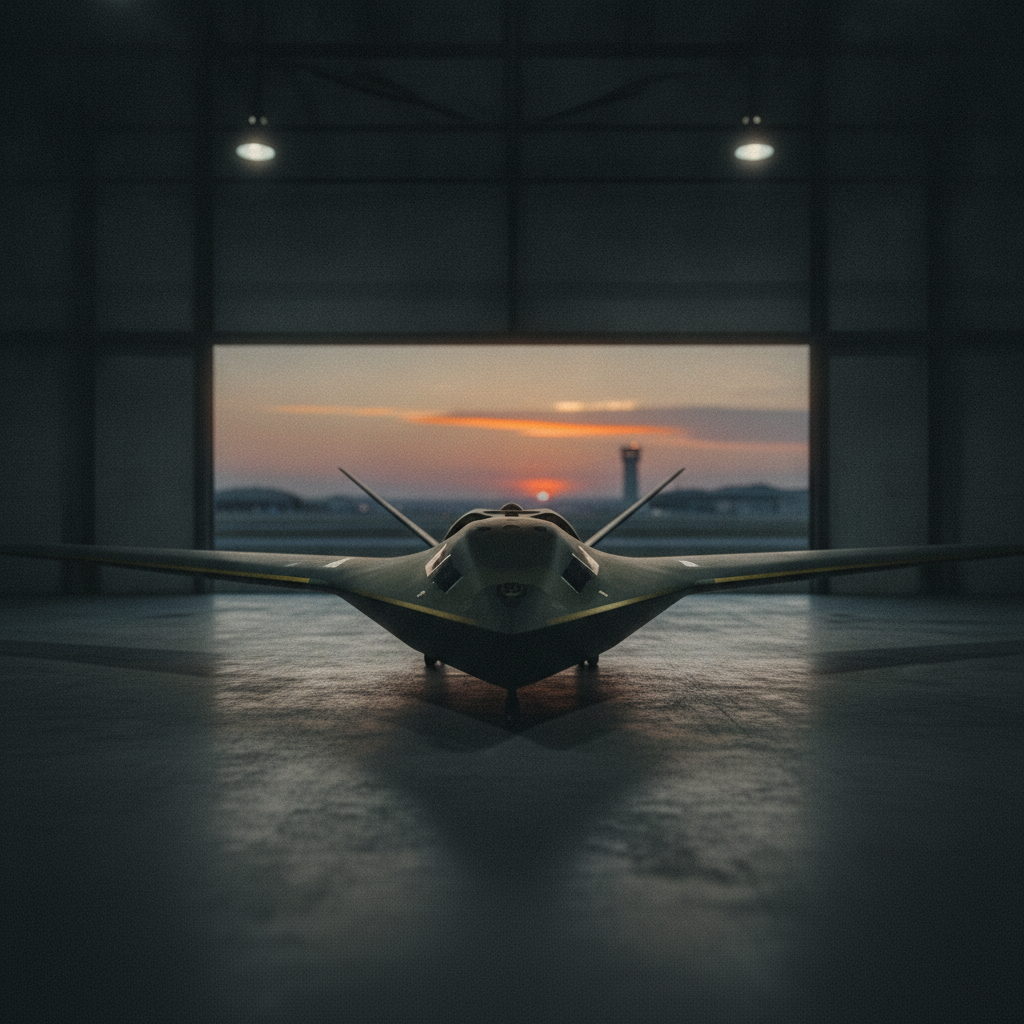
Kim Jong Un presided over the exhibition titled Unmanned Aeronautical Technology Development-2026 last Thursday, unveiling a tailless flying-wing drone mockup alongside more than 30 types of UAVs that reportedly appeared at the exhibition — reflecting North Korea's efforts to diversify its uncrewed aviation capabilities in one of the most expansive displays of such hardware the country has staged. [1]
The centerpiece drew immediate comparisons to the most advanced stealth drones in the world. Hong Min, a senior research fellow at the Korea Institute for National Unification, estimated the wingspan at roughly 56 to 66 feet and its height at around 10 to 11.5 feet based on available photographs. [1] Standout features include a dorsal air intake, a relatively large center fuselage section integrated into the flying wing, and retractable tricycle landing gear — details that mirror, in visual terms, designs like Northrop Grumman's X-47B, China's GJ-11 Sharp Sword, and Russia's S-70 Okhotnik. [1]
The resemblance is real. The capability is another matter. North Korea has not provided any technical information about the aircraft's propulsion system, payload, intended mission, or flight performance. [1] A flying-wing configuration is only one part of a far more complex puzzle in achieving a genuinely low radar signature — other factors include the engine inlet and exhaust arrangements, radar-absorbing materials, surface treatments, manufacturing tolerances, and the alignment of individual edges and surfaces. [1] It is highly questionable whether Pyongyang can produce a functional prototype at all.
Iran offers the most instructive precedent. After recovering a U.S. RQ-170 Sentinel reconnaissance drone that came down inside Iranian territory in 2011, Tehran announced it had successfully reverse-engineered the aircraft. [1] In 2014, Iranian authorities displayed what they presented as a domestically produced copy, claiming it would soon undertake a test flight. [1] Outside observers questioned whether the displayed aircraft was anything more than a non-functional replica, noting apparent shortcomings in its construction and the use of components inconsistent with a sophisticated operational aircraft. [1] Iran has since demonstrated flying examples — the Shahed-171 Simorgh and smaller Shahed-191 — but they fall far short of replicating the RQ-170's actual low-observable qualities, let alone its sensors and avionics. [1]
The wildcard is Russia. North Korea's military relationship with Moscow — including the deployment of North Korean troops to support Russia's war in Ukraine — could provide a channel for the exchange of technical knowledge. [1] Russia has developed and flown the S-70 Okhotnik UCAV, exposing it to some operational trials in Ukraine, and could have passed related information to Pyongyang. [1] There is, however, so far no proof of technology transfer from Russia, and Russia's own UCAV program has been anything but a smooth and rapid advancement to an operational state. [1]
The flying wing is the spectacle. What sits behind it — unglamorous, mass-producible, and already battle-tested in another theater — is the real story.
The rest of the exhibition made the point plainly. The Saetbyol-4 and Saetbyol-9, first displayed in 2023, are visual clones of the U.S. RQ-4 Global Hawk and MQ-9 Reaper, respectively. [1] Loitering munitions resembling Israel's Harop and Russia's Lancet appeared alongside smaller drones with configurations similar to the U.S.-made Switchblade family. [1] Hundreds of small quadcopter drones were displayed on storage racks, some carrying cylindrical containers associated with fiber-optic control systems — a technology that has become prominent in the Russia-Ukraine war and is largely immune to conventional radio-frequency jamming. [1]
The strategic logic tracks with Pyongyang's broader military situation. Its crewed combat aviation fleet is aging, and South Korea's air force thoroughly outmatches it. [1] Relatively inexpensive UAVs offer a path to reconnaissance and strikes against military infrastructure without exposing pilots to enemy air defenses. [1] Mass-produced one-way attack munitions in the Shahed/Geran class could saturate South Korean air defenses, which are generally tailored to address more conventional threats. [1] The shorter distances involved on the peninsula could allow a greater proportion of a drone's weight to be allocated to its warhead. [1]
[1] That kind of accumulated knowledge — not a flying-wing showpiece — is what could tilt the balance of power on the peninsula, forcing Seoul to develop new countermeasures such as directed-energy weapons and cheap interceptors. [1]
Pyongyang doesn't need stealth to create a genuine interdiction problem for South Korea — it needs volume, iteration speed, and fiber-optic guidance. All three appear to be exactly what it is quietly building. The flying wing makes for a striking photograph; the racks of quadcopters behind it are the real signal worth watching. [1]
the new flying-wing concept does not represent a realistic technological undertaking — at least for now. Very few countries have managed to develop and fly drones in this class, and fewer still have been able to field them operationally.The War Zone