One in Four F-35s Can Fly All Its Missions
A GAO report finds the Pentagon's costliest weapon has a 25% full mission capable rate—and a $13.7B fix that may arrive too late.
By The Defense Desk
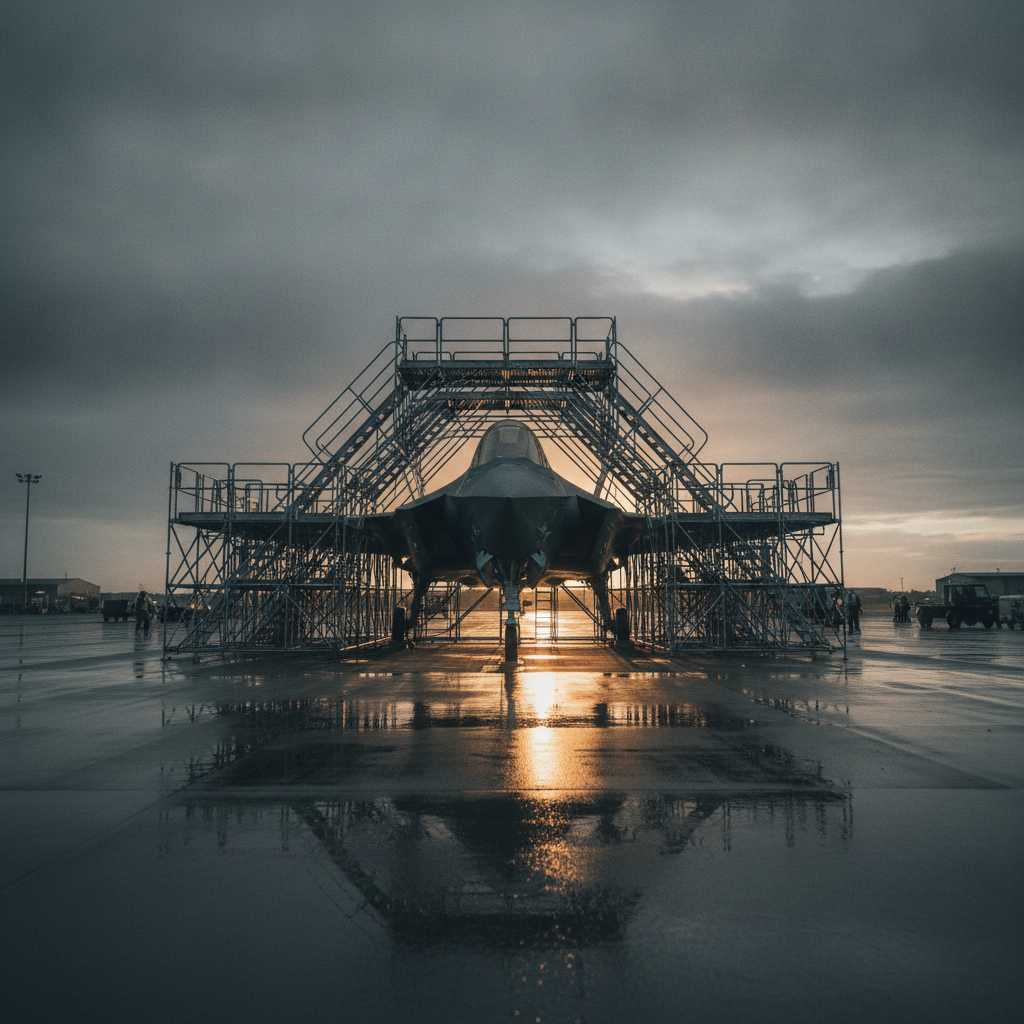
Only one in four F-35 Lightning II fighters can perform every mission it is assigned. The mission capable rate—covering aircraft that can complete at least one tasked mission—dropped from 67% to 44% over the same period. [1]
The Pentagon operates more than 800 F-35s and plans to buy roughly 1,700 more by the mid-2040s, with lifetime U.S. sustainment costs estimated at $1.6 trillion as of 2024. [1] The program is already DOD's most expensive weapon system, and GAO's report makes clear it has not met its performance goals.
The F-35 Joint Program Office launched the Global Support Solution Reset in June 2025, targeting an 80% mission capable rate and a 65% full mission capable rate by 2030. [1] Getting there carries a steep price: JPO estimates the effort will require $13.7 billion more than previously planned through fiscal 2031. Only about $2.2 billion of that total funds the GSS Reset itself; the remaining roughly $11.5 billion covers the gap between what the services budgeted and what F-35 sustainment actually costs. [1]
JPO officials told GAO that readiness will likely worsen before it improves, with program documentation suggesting meaningful gains may not appear until late 2026 or later. [1] A 2025 Lockheed Martin study identified 48 parts the supplier base cannot produce in sufficient quantities, including canopies—a component GAO has repeatedly flagged as a top driver of grounded jets. [1] The report warns that JPO will rely on the private sector to deliver more than $7 billion in additional parts and material, even as capacity constraints persist for key components. [1]
The cost trajectory makes the fix harder to sustain. By the mid-2030s, GAO projects the services will face a roughly $1.2 billion annual gap between what their F-35s cost to sustain and what they say they can afford. [1] Those figures may also undercount the problem: GAO noted that fiscal 2027 projections were developed before Operation Epic Fury and may not capture the costs of additional flight hours incurred during that operation. [1]
The report also documents a years-long breakdown in contractor incentives. [1] In 19 of 39 performance periods, JPO and Lockheed adjusted the recorded full mission capable rate upward—citing factors outside the company's control—qualifying the contractor for higher payments. Had fees been calculated on raw rates alone, GAO estimated Lockheed would have earned roughly half as much. [1]
GAO also found JPO could not produce consistent records of its incentive fee payments. [1] GAO has now issued 46 recommendations on F-35 sustainment since 2014; as of March 2026, the Pentagon had implemented 14. [1]
The pattern is a familiar one in large defense programs: procurement ambition racing ahead of the logistical and industrial infrastructure needed to keep existing fleets airborne. Buying more jets while a quarter of the current fleet sits grounded raises questions that budget documents alone cannot answer.
4 billion across all three variants. [2] The catch: only 32 of those aircraft are funded through the base discretionary budget. The remaining 53 depend on a $350 billion mandatory funding request tied to a reconciliation bill that has not yet been introduced. [2]
Critics are not reassured by the headline number. Retired Lt. Gen. David A. [2] Meanwhile, Block 4—the upgrade adding new sensors, weapons integration, and electronic warfare capability—has already slipped roughly five years from its original schedule, with hardware problems in the Technology Refresh 3 processor cited as the primary cause. [2]
The GSS Reset, the budget request, and the Block 4 upgrade all point in the same direction—but their timelines, funding mechanisms, and industrial dependencies do not yet converge. A fleet of 800 jets with a 25% full mission capable rate is not a readiness crisis in waiting; it is one already underway. [1]