One Million Cars, Zero Drivers Inside
Embotech and BMW have quietly automated a million factory vehicle moves — and the intelligence never touches the car.
By The Robotics Desk
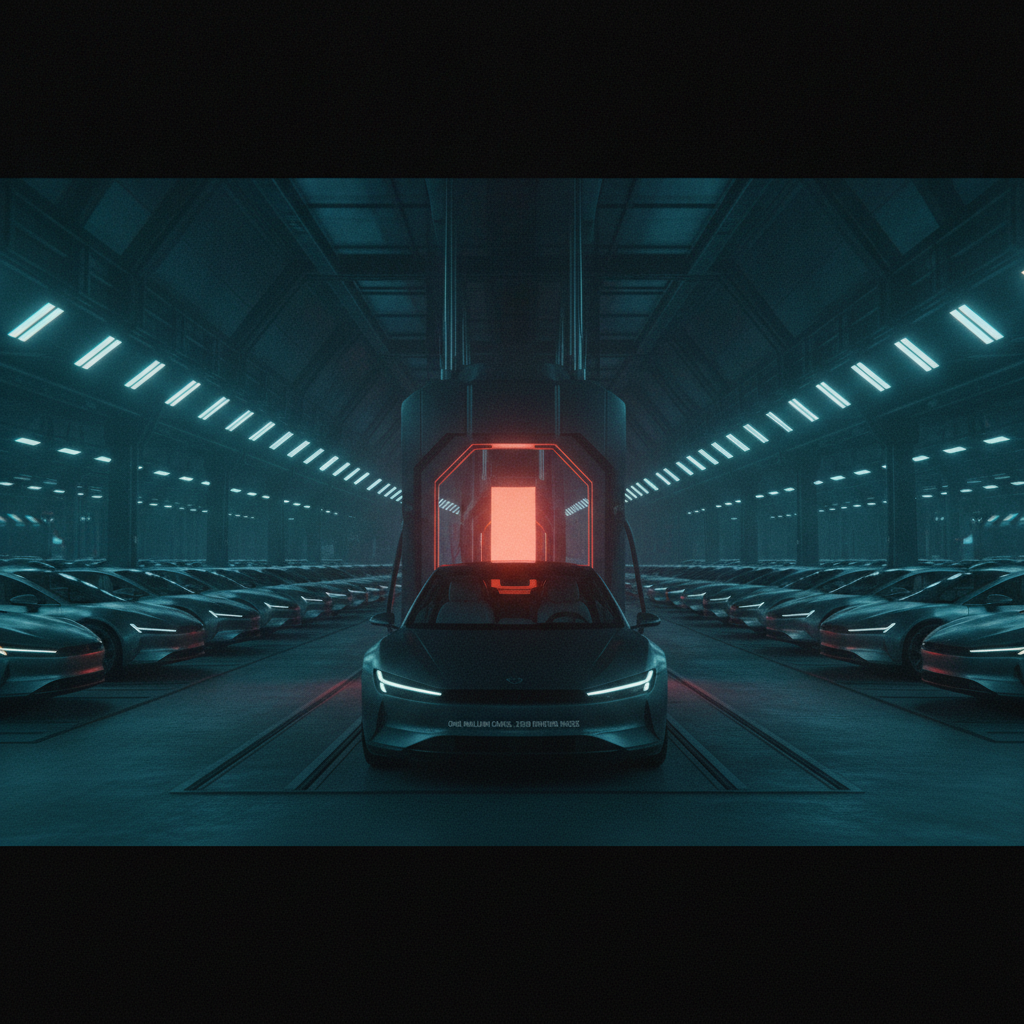
Every car that rolls off a production line still needs to get somewhere — to a parking bay, a truck, a distribution yard. Traditionally, that means a human climbing in and driving it there. Embotech and BMW Group have now done that job autonomously one million times across four factories in Germany and the U.K., with no driver, no onboard sensors, and no modifications to the vehicle itself. [1]
The milestone covers sites at Dingolfing, Leipzig, and Regensburg in Germany and MINI Plant Oxford in the U.K., and spans different brands, vehicle types, and production processes. [1] The system now handles roughly 3,500 vehicle movements a day at more than 99.5% availability — a figure that matters enormously in factory environments where a single outage can cascade across the whole line. [1]
The technical approach is counterintuitive. Rather than equipping each vehicle with self-driving hardware, Embotech puts the intelligence in the building. Hesai lidars mounted in the factory infrastructure localize every car with centimeter-level accuracy, feeding an offboard autonomy stack that handles perception, prediction, and motion planning. [1] Driving trajectories are transmitted wirelessly to each vehicle ten times per second in data packets of around 150 bytes, guiding it through the factory floor without a single sensor bolted to the chassis. [2]
That infrastructure-first model carries a practical advantage: the Automated Vehicle Marshalling system is vehicle- and OEM-agnostic, connecting to existing drive-by-wire capabilities without hardware modification. [1] It can operate at speeds up to 30 km/h, certified for safety, and navigate mixed-traffic environments alongside workers, forklifts, and manually driven vehicles in real time. [2] Embotech claims the system delivers roughly a 50% reduction in direct driver costs. [2]
Spun out of ETH Zurich in 2013, Embotech claims it is the first company worldwide to hold multiple TÜV-certified Level 4 solutions — its Automated Vehicle Marshalling and Autonomous Tractor Solution share a common platform deployed across automotive factories, ports, and logistics yards. [1] A separate, deterministic safety architecture, independently certified by TÜV SÜD, defines and enforces the operational boundary. [1]
The pace of deployment is accelerating. Embotech and BMW reached their first 500,000 automated vehicle movements in 15 months; the second 500,000 took just seven. [1] Raymond Wittmann, the member of BMW AG's board responsible for production, said the company "recognized the potential of Automated Driving In-Plant early, tested it in a pilot phase, and systematically developed it to series maturity." [1] The next stop is BMW Spartanburg in South Carolina, where a rollout is planned for next year — the same facility where BMW has tested Figure AI humanoid robots. [1]
The broader signal here is about where automation is actually taking hold. Not in the glossy consumer product, but in the unglamorous connective tissue of manufacturing — the moves between steps, the logistics that nobody films for a reveal video. That's where the compounding gains live.
Much of the industrial autonomy market, Embotech notes, remains at the pilot stage — running limited vehicles in controlled conditions. [1] The BMW deployment is one of the clearest examples of a factory autonomy system graduating from proof-of-concept to live production network. Embotech is also expanding its customer base: in July, the company entered a strategic partnership with HTEC to scale deployment across additional vehicles, customer programs, and industrial sites. [1]
Looking ahead, Embotech sees AVM as a stepping stone rather than an endpoint. As vehicles are eventually fitted with Level 5 self-driving capabilities, the system can autonomously transport a vehicle "skateboard" chassis to production islands before it is fitted with its autonomous driving hardware — supporting modular and flexible production architectures, reducing dependency on traditional linear assembly lines. [2]
A million movements without a driver is a convincing proof point. The harder question — how fast Embotech can replicate this at Spartanburg, and then beyond — is what determines whether factory-floor autonomy becomes a standard feature of auto manufacturing or remains a story about one very well-instrumented partnership. [1]
With BMW Group, we completed the first 500,000 automated vehicle movements in 15 months and the next 500,000 in just seven.Andreas Kyrtatos