One Operator, Every Pile: Meet the X1 Piling R6
Xpanner's new autonomous pile-driving robot wants to solve solar construction's skilled-labour crisis — one post at a time.
By The Robotics Desk
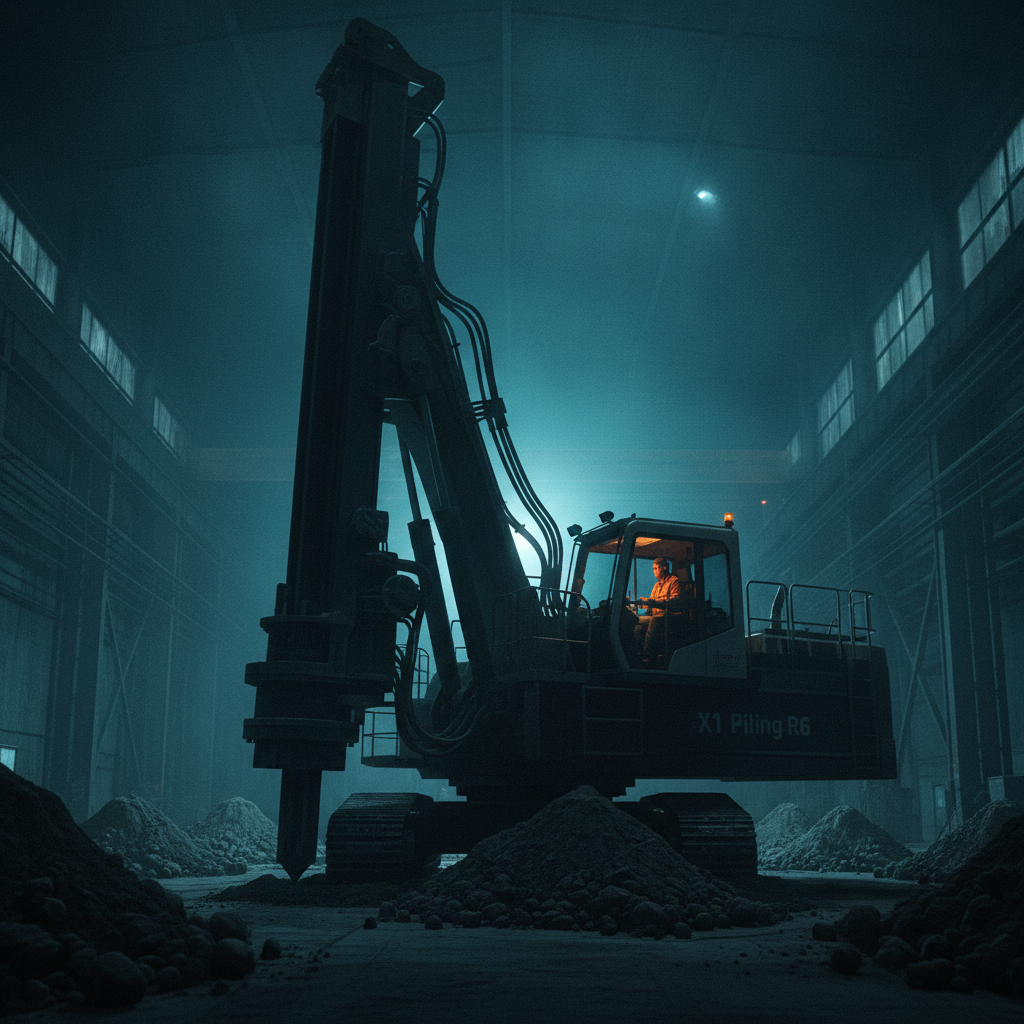
Somewhere on a utility-scale solar site, a crawler machine moves methodically down a row of staked ground, lowers a hydraulic hammer, drives a steel post flush to grade, logs the position, and moves on — all without a crew of labourers surrounding it. The only human in the picture is a single operator watching from a safe distance. That machine is the Xpanner X1 Piling R6, and it was built specifically because the people needed to do this job the old way are increasingly hard to find. [1]
Santa Fe Springs, California-based Xpanner announced the X1 Piling R6 as a fully automated pile-driving robot designed to autonomously install posts for utility-scale solar and battery energy storage, or BESS, sites. [1] The system is built on Xpanner's Everstar R6 crawler base machine and is equipped with the company's automation stack — onboard sensors and controls that autonomously complete the pile-driving process for each post, navigating between pile locations using high-precision GNSS antennas and receivers. [1]
The pitch from Xpanner co-founder and CEO Henri Lee is direct: "Solar and BESS builders are racing to bring new power online for the grid and for AI data centers, and they can't find enough skilled crews to keep up." [1] That shortage is not a temporary blip. The acceleration of grid build-out — driven by both renewable energy mandates and the electricity appetite of AI data centres — has outpaced the available pool of trained piling crews. The X1 is Xpanner's answer to that structural gap. [1]
Construction robotics has long promised to do for the job site what factory automation did for manufacturing. The gap between that promise and delivery has historically been wide — soil is unpredictable, worksites shift daily, and the coordination demands of a live construction environment are far messier than a controlled production line. What changes the equation is not raw automation capability alone, but whether a machine can slot into existing workflows without demanding that contractors reinvent how they operate.
The workflow Xpanner has designed around the X1 leans hard into that logic. An operator uploads a pile plan, walks the machine to the row using a remote control interface, and then supervises as the robot handles the rest. [1] The R6 uses the Xpanner-developed automation controller alongside precision sensors to navigate autonomously to each subsequent pile location. [1] One operator manages the full installation process remotely — the machine is doing the physical work; the human is the supervisor, not the labourer.
Fine positioning is handled without what engineers call tramming — the time-consuming process of repositioning heavy equipment. The guide rail slides 11.8 in. (300 mm) forward and back and 19.7 in. (500 mm) left and right, and the upper body rotates 180 degrees, putting the hammer on target from a single setup. [1] That range of micro-adjustment means the machine does not need to reposition its full chassis for every pile — a meaningful time saving when you are driving posts across hectares of open ground.
The X1's hardware specifications are built for real-world soil variability. The system runs a 97 kW (130 hp) engine and a high-frequency hydraulic hammer with up to 1,260 J (929 ft.-lb.) of impact energy and three energy settings to match soil conditions. [1] It can drive piles up to 23 ft. (7.0 m) long, with a maximum driving depth of 15.7 ft. (4.8 m). [1] Because the hammer lowers near the ground and piles can be driven flush to grade, one machine handles standard tracker piles, short motor piles, and BESS foundation piles without an adapter — a point of practical versatility that matters when a single site may require several pile types. [1]
Versatility matters in construction robotics in ways that pure performance does not. A machine that can only do one thing well requires a contractor to manage it alongside several other specialised pieces of equipment. A machine that adapts to the task at hand — without swapping attachments or calling in a second unit — changes the logistics calculus entirely. The more a single platform can absorb, the fewer moving parts a project manager has to coordinate.
Xpanner has designed the X1's mast for multi-function use: DTH drilling, auger drilling, and ground screwing are all possible on the same carrier, so one machine can pre-drill and drive on the same site. [1] Field practicality extends to transport — the mast does not need disassembly to move between rows or sites, and the machine includes a large fuel tank for long shifts, engine auto-idle, a large-capacity cooler, manual override, and an e-stop. [1] These are not headline features, but they are the details that determine whether a machine actually gets used or sits idle waiting for a specialist.
The software layer — Xpanner Connect — is where the X1 becomes a fleet management tool rather than just a single machine. Project teams can load the pile schedule and coordinates, assign machines, and set up a site in minutes. [1] As X1 works, it records each pile's position, depth, and plumb and posts it to a live project map, replacing manual counts, phone calls, spreadsheets, and end-of-day reports. [1] Managers can monitor machine state, cycle counts, and alerts across the fleet without a site visit. [1]
The business model Xpanner has chosen reflects the current mood in construction technology: a mixed capex and SaaS subscription structure. Customers purchase or rent the X1 Piling robot and then license the automation software on a monthly subscription basis for each active technology. [1] Critically, the subscription is not tied to a specific project, site, or number of piles driven — the customer pays for the technology while it is actively being used, and once piling operations are complete, the equipment and technology can be transferred to another project and activated as needed. [1] Xpanner handles initial installation, calibration, operator training, and technical support; the contractor provides the on-site equipment operators. [1]
Lee frames the X1 as an evolution of technology already proven in the field rather than a speculative leap, with a full quote that reads: "X1 lets one operator drive every pile plumb with a single touch, keeps people away from the mast, and logs each pile as it goes in. It takes the automation EPCs [engineering, procurement, and construction firms] already trust on PD10 and puts it on a more powerful, more versatile machine." [1] The X1 Piling R6 is also designed to work alongside the X1 panel lift — released earlier this year — for autonomous solar panel installation, pointing toward a vision of a coordinated autonomous construction workflow across multiple machines on a single site. [1]
The deeper bet behind machines like the X1 is not simply that automation is cheaper than labour — the economics are more nuanced than that. It is that the construction industry is approaching a structural inflection point where the volume of infrastructure that needs to be built, and the speed at which it needs to go up, simply cannot be matched by available human capacity. Robotics is not a replacement for skilled workers in this framing; it is the only viable path to meeting a demand curve that human recruitment alone cannot satisfy.
Whether the X1 delivers on that promise at scale will depend on how it performs in the messy reality of live construction sites — variable soil, tight schedules, equipment downtime, and operators who need to trust a machine they cannot fully see inside. The spec sheet is credible. The workflow logic is sound. But construction is a sector that has a long memory for technology that looked good on paper and fell apart in the field. Xpanner's next chapter will be written not in press releases, but in pile counts per shift on real projects — and in whether one operator can genuinely keep pace with a grid that will not wait. [1]