One Robot Brain, a Thousand Different Hands
Generalist's GEN-1 model trains across 9,000 end-effector variants to build physical commonsense that transfers across tools.
By The Robotics Desk
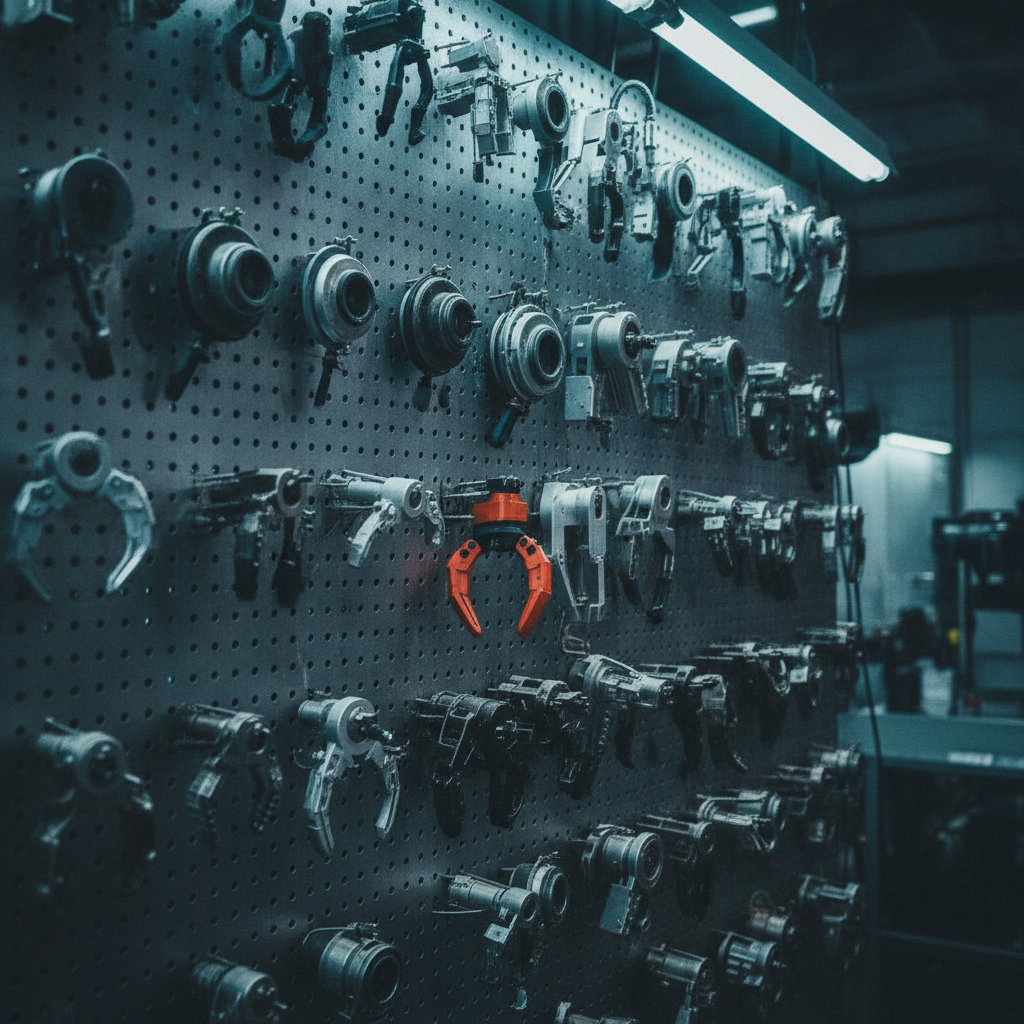
The company says the same base model learns sensorimotor policies that transfer across radically different ways of interacting with the physical world. [1]
GEN-1 is pretrained on Generalist's in-house robotics dataset, which now spans more than half a million hours of real interaction data across approximately 9,000 end-effector variations — off-the-shelf tools, printed parts, and custom gripper modifications. [1] Each new end effector is treated as a distinct sensorimotor interface: a way to learn about geometry, contact, friction, forces, and dynamics. [1]
The analogy Generalist reaches for is multilingual training: just as concepts learned in one language improve understanding in another, learning across many hands stands to benefit physical intelligence. [1] But not every tool contributes equally — whisks shift the sensor-processing weights far more than peelers do, likely because the model has to perceive the whisk's thin wire geometry. [1] That asymmetry points to a deliberate data strategy: identify where novelty lands in the architecture, then collect more of it.
[2] Internet-trained models cannot acquire it: internet data has no proprioception, no intervention, no consequence. [2]
What makes this moment interesting is the shift in how robot capability is being framed — not as a fixed body mastering a fixed task, but as a single intelligence adapting its grip on the world depending on what it is holding.
[2]
Physical commonsense is the dark matter of robotics: unseen, everywhere, and responsible for most of what actually works.Andy Zeng