PCSEL Lasers Head to Space in UK Photonics Push
A Glasgow-led consortium will stress-test Photonic-Crystal Surface-Emitting Lasers for orbital use, aiming to reshape how satellites talk to each other and to Earth.
By The space-quantum Desk
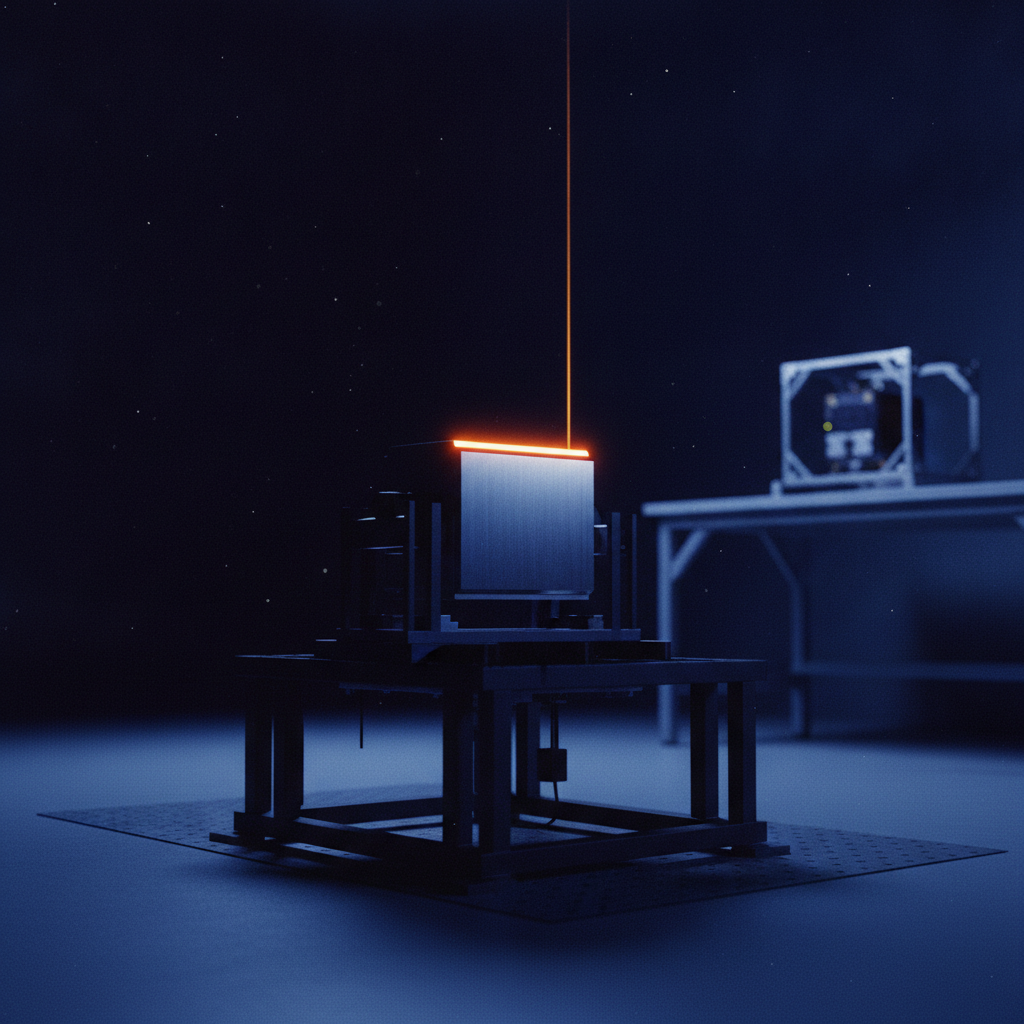
Three UK organisations are betting that a relatively obscure class of laser could become the backbone of next-generation satellite communications. Craft Prospect, Fraunhofer Centre for Applied Photonics (Fraunhofer CAP), and Vector Photonics have launched PERSEUS — short for PCSEL Environmental and Radiation Sensitivity: Evaluation for Use in Space — a programme designed to find out whether Photonic-Crystal Surface-Emitting Lasers can survive, and perform, in orbit. [1]
PCSELs are a distinct family of semiconductor lasers that promise higher beam quality and efficiency than conventional alternatives. The PERSEUS project will put that promise through a rigorous filter: radiation campaigns, vibration tests, and thermal-vacuum cycles — the standard gauntlet any technology must clear before it can be trusted on a spacecraft. [1]
Beyond surviving launch, the consortium wants to show the lasers can work end-to-end. PCSEL devices will be integrated with flight-representative hardware for data transmission demonstrations, and the team will run long-range, high-bandwidth free-space link tests to establish early performance baselines. [1]
The interest here runs deeper than one laser type. Optical communications in space have long been constrained by component-level immaturity — technologies that perform well in a lab often fail under the cumulative stress of radiation exposure, extreme thermal cycling, and the mechanical shock of launch. Closing that gap demands exactly this kind of methodical, unglamorous engineering.
The programme targets both space-to-space and space-to-ground applications, positioning PCSELs as candidates for longer-range, higher-capacity, and more secure free-space optical links between ground stations, satellites, and potentially deeper-space assets. [1]
Funding comes from the Advanced Connectivity Technologies (ACT) programme, delivered by Innovate UK and funded by the Department for Culture, Media and Sport (DCMS). The ACT R&D Programme was announced by Minister Ian Murray during his speech at Connected Britain on 9 September 2026. [1]
At Craft Prospect, Head of Engineering Kevin Quillien serves as Project Lead, supported by Chief Engineer Paul Yarr and Systems Engineers Lauryn Atkinson and Kairavi Pandit. At Fraunhofer CAP, Dr Gerald Bonner is subcontract lead, while Vector Photonics is represented by subcontract lead Dr Richard Taylor and Project Manager Dr Graham Goldberg. [1]
PERSEUS also builds on Craft Prospect's growing quantum-optical communications capability. The company is already developing and testing space-to-ground free-space quantum and optical communications technologies through its OPS-SAT VOLT programme — experience that gives the team a practical read on what free-space optical links actually require from a component. [1]
Fraunhofer CAP brings institutional depth to the hardware side. [2]
What PERSEUS ultimately represents is a shift in how the sector approaches photonics readiness — moving the conversation from component datasheets to actual spacecraft environments. The findings will feed an engineering roadmap, not just a research paper.
The results of the PERSEUS test campaigns will feed into a future communications system design concept and help define the engineering roadmap required to progress PCSEL technology towards a differentiated space communications solution. [1] Whether PCSELs become a standard fixture in satellite optical terminals will depend on what the radiation chambers reveal — but the fact that a funded, multi-partner programme is now asking that question marks a meaningful step toward finding out.
By carrying out all the necessary early-stage work to test and characterise PCSELs for space, we will build a strong understanding of the potential that the technology offers in building the next generation of communication solutions.Kevin Quillien