Permafrost Is Melting Faster Than Our Models Know
Arctic soil holds 1.5 trillion tons of carbon. The UN's climate models barely account for it — and wildfire is making the gap worse.
By The energy-climate Desk
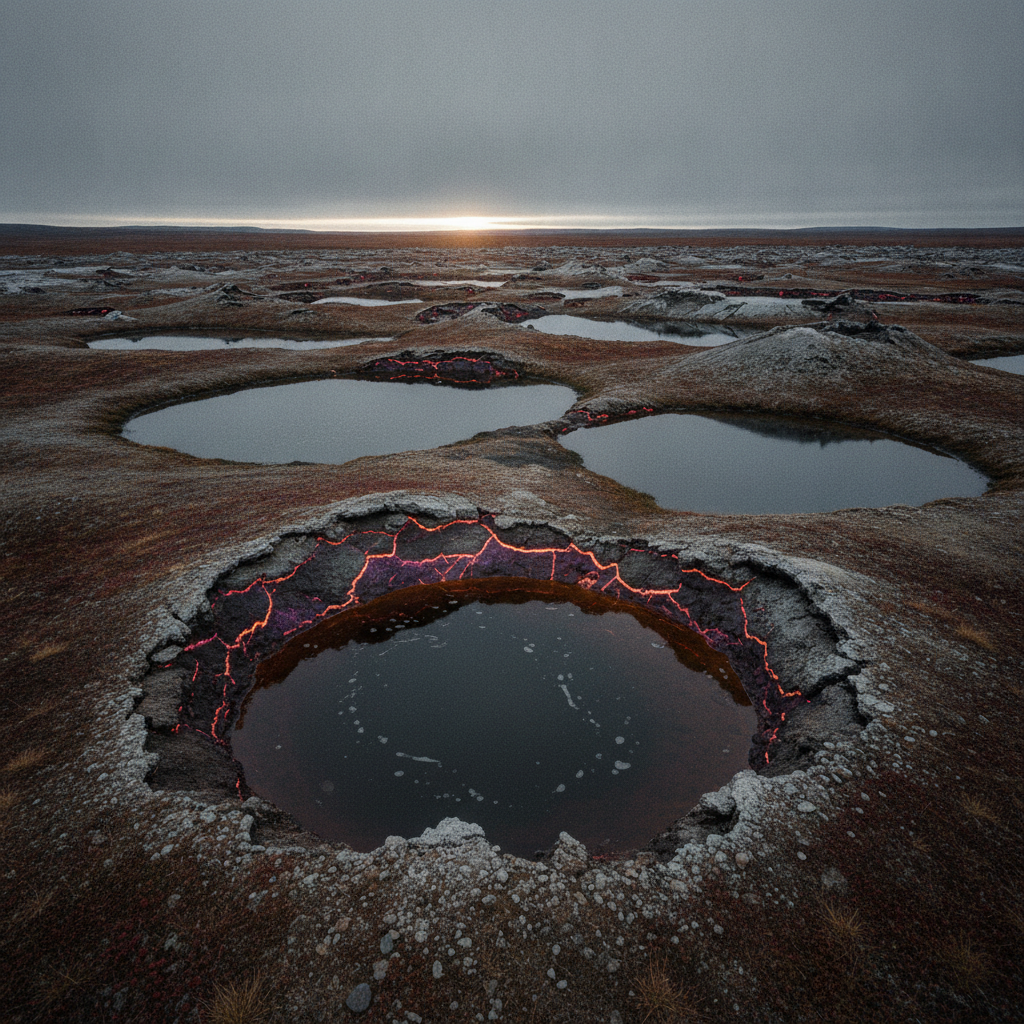
Beneath about 15% of land in the Northern Hemisphere lies a frozen layer of soil that has been locking away organic material since the last ice age [1]. As temperatures rise, microbes break down that matter, releasing carbon dioxide and methane — and triggering a feedback loop that accelerates warming further [1].
The scale is staggering: permafrost holds roughly 1.5 trillion tons of carbon, about twice the amount currently in the atmosphere [1]. Yet only a minority of the models used in UN climate reports account for gradual permafrost loss — and none include the abrupt thaw and collapse that can follow heat waves or fires [1]. Arctic permafrost has already shrunk by about 12% since 1850, with the pace accelerating over the last 50 years [1].
Wildfires sharpen the problem. By the end of the century, fire-driven thaw could release the equivalent of 80 billion metric tons of carbon dioxide [1]. Researchers at the Woodwell Climate Research Center are building a burn-risk and carbon-vulnerability map across Alaska to identify where intervention would matter most [1]. Options on the table include prescribed burns — a practice Indigenous groups have used for thousands of years — as well as early detection and rapid suppression [1].
The honest answer is that the picture keeps getting messier the closer scientists look. Carbon lost to thaw and fire might be partly offset by northward-migrating plants, but the net balance depends on local conditions too varied for any single model to capture.
Until climate models reflect both gradual and abrupt permafrost loss, every warming projection carries a hidden asterisk — and that asterisk is buried under the tundra [1].