Poland's Warmate 30 Is Already a Finished Product
WB Group's jet-powered loitering munition enters series production as Poland builds a networked drone-strike architecture no ally can fully replicate.
By The Defense Desk
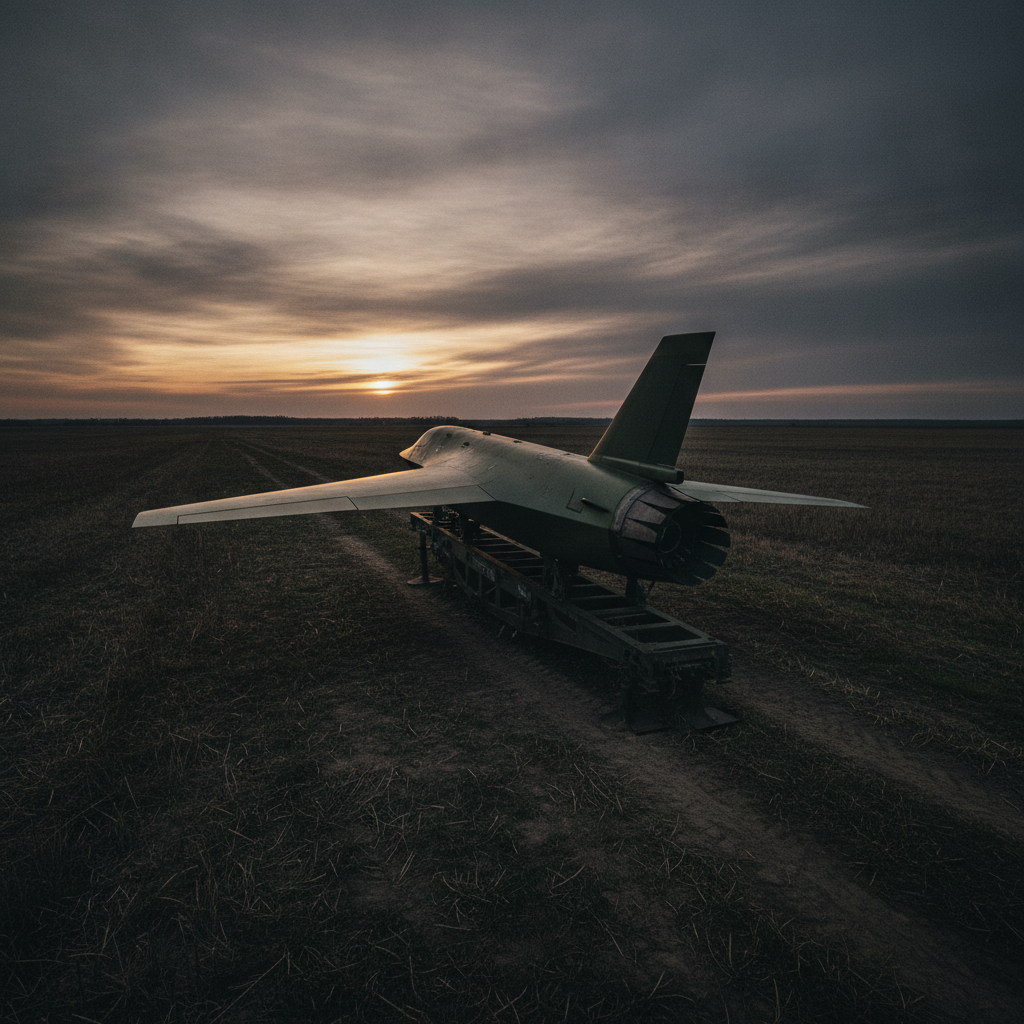
[1] The reveal was deliberately late: since last year the first few prototypes have been produced and are being tested, and at a press meeting a few days before the show, the company's CEO declared "It is currently a finished product." [1]
That phrase — finished product — carries weight in a defense market still flooded with concepts and demonstrators. [1] In other words, the Polish Army, not the marketing calendar, set the schedule.
There is a certain discipline in that posture. The most consequential weapons programs of recent years have not been the loudest ones — they have been the ones that showed up quietly, in numbers, when they were needed.
Warmate 30 sits inside a broader WB Group architecture called Gladius — a battery-formation system designed to combine various types of UAVs launched from ground vehicles fitted with a universal launcher, or from a towed launcher. [1] The Warmate 30 is built to integrate fully with the Gladius reconnaissance-strike system and the Topaz command system, enabling what the company describes as "continuous data exchange between platforms during real-time combat operations." [1] The drone is also referred to internally as Gladius 2, though that designation can apply to an upgraded version of the wider recon-strike system as well. [1]
Physically, the airframe is a flying-wing configuration with flaperons. [1] Its composite structure ensures a reduced radar and thermal signature — a design choice that reflects lessons absorbed from watching drone warfare play out in Ukraine, where detectability is often the difference between a strike and a shootdown. [1] WB Group says the system can fly pre-programmed waypoints in attack mode and loiter over a target before engaging. [1]
What is notable here is not any single specification but the combination: range, speed, low observability, and deep integration into a command network. Each attribute is achievable in isolation. Achieving all four in a domestically produced system, at production scale, is a different kind of achievement.
Poland is not merely buying drones — it is assembling a domestic strike stack. According to data released this June by Lt. Gen. Sławomir Owczarek, First Deputy General Commander of the Armed Forces, four Gladius battery-level fire modules have already been delivered to the Polish Army. [1] That is a deliberate, phased procurement — not a single headline purchase but a structural expansion of capability over three years.
The NATO dimension adds another layer. Wojciechowski confirmed that Gladius is attracting interest from other alliance members, but was direct about the limits of what allies can expect: "certain solutions implemented in the system will only be available in the version for the Polish Armed Forces." [1] He also stressed that the "Gladius offered to export customers differs from the one offered to the Polish Army, if only due to the specific requirements of other potential users." [1] It is a familiar posture for sovereign defense programs — share the platform, retain the edge.
That asymmetry between what an ally gets and what the originating nation keeps is one of the quieter arguments for indigenous defense production. Off-the-shelf procurement closes capability gaps; domestic development lets a country define where those gaps are for everyone else.
Warmate 30 is not the end of this roadmap. WB Group is already conducting research and development on two follow-on systems designated Gladius 3 and Gladius 4. [1] Wojciechowski said "it is too early to reveal further details at this time," but confirmed that Gladius 3 is scheduled for launch in 2027, and that its functionalities and features have been agreed upon with the Polish customer. [1] The pipeline suggests a company that is not waiting for the next conflict to begin thinking about the one after it.
Warmate 30 also joins an existing family of systems. WB Group's Warmate line already includes the smaller Warmate 5 loitering munition and the Warmate TL-R recon drone — a tiered offering that lets operators match the platform to the target rather than defaulting to a single solution for every engagement. [1] Warmate 30 occupies the high end of that family: longer legs, heavier payload, jet propulsion. It is designed for high-value, time-sensitive targets at long range — the category of mission where speed and standoff matter most. [1]
The evolution from a single product to a scalable family is how defense programs mature — and how industrial bases develop depth. A country with one strike drone has a weapon. A country with a tiered, networked, domestically produced family of them has a doctrine.
What WB Group is building — methodically, on a schedule set by soldiers rather than trade shows — is a networked strike architecture in which the individual drone is less the point than the system it connects to. Warmate 30 is powerful on its own; integrated with Gladius and Topaz, it becomes a node in something considerably more difficult to replicate or counter. [1] That is what "finished product" actually means here: not just that the airframe is ready, but that the infrastructure around it is too.
Gladius 3 arrives in 2027. Gladius 4 is somewhere behind it. [1] Poland is not building toward a capability — it is already inside one, and moving deeper.