Qatar's Drone Maker Goes Public
Barzan Holdings debuted more than a dozen platforms at Milipol 2026—a signal that Doha is building a defense industry, not just buying one.
By The Defense Desk
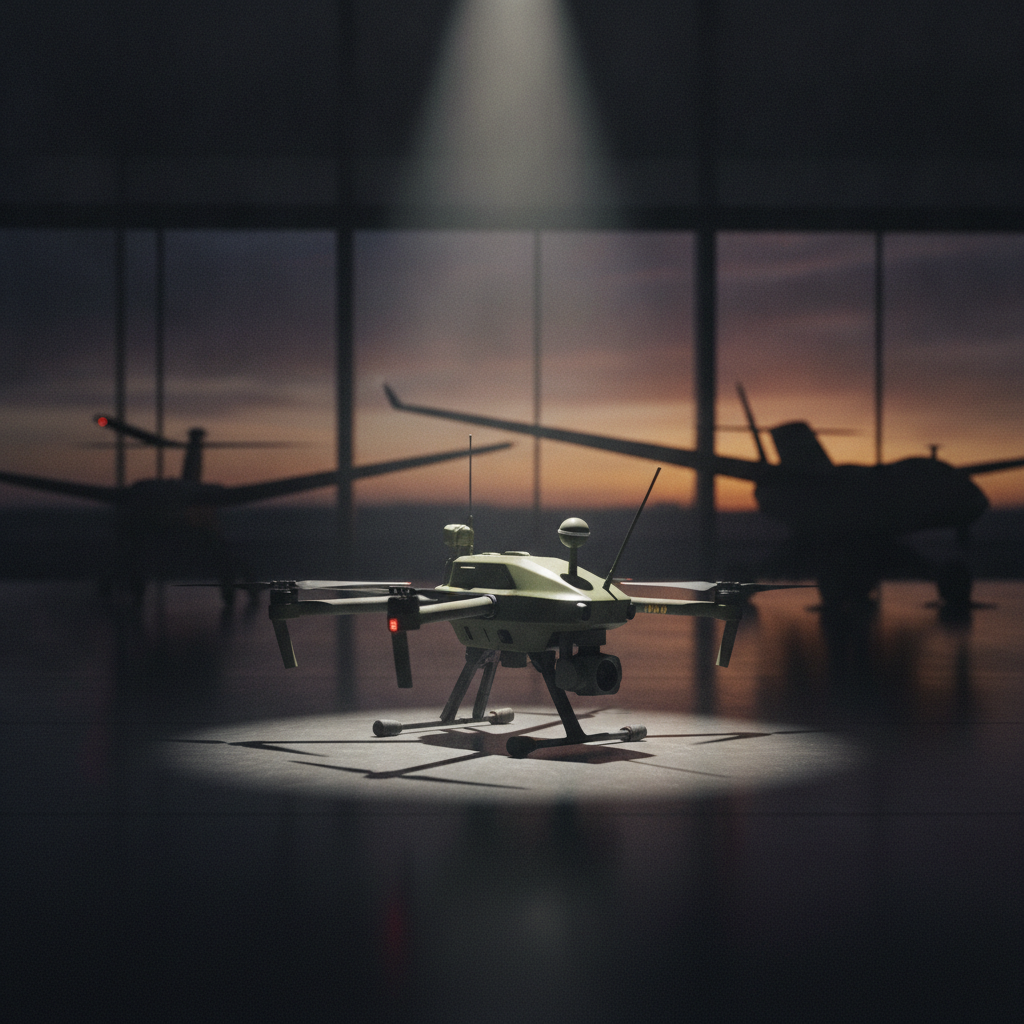
At the Milipol 2026 exhibition in Doha, Barzan Holdings, Qatar's state-owned defense company, put more than a dozen new platforms on the floor for the first time—FPV drones, VTOL aircraft, unmanned surface vessels, and electronic warfare systems, all bearing the flag of a country that, until very recently, preferred to buy its security rather than manufacture it. [1]
The timing was not incidental. Like other Gulf states, Qatar was targeted by Iranian missiles and drones, and it was the only Gulf state struck by an Israeli raid in September 2025. [1] Those strikes made the strategic vulnerability of depending on imported hardware and foreign guarantees feel less like an abstract policy debate and more like a live problem.
For decades, small but wealthy states in volatile neighborhoods solved the security problem through alliances and arms purchases. What Milipol 2026 suggests is that the calculus is shifting—that sovereign manufacturing capacity is becoming as important as the treaty relationships wrapped around it.
Barzan's new drone lineup spans a deliberately wide range of form factors. The FPV Drone-15 inch is a tactical reconnaissance quadcopter with a payload capacity of up to 4 kilograms, a range of 20 kilometers, and an endurance of up to 20 minutes. [1] The FPV Drone-10 inch carries up to 2.5 kilograms across 15 kilometers with 12 minutes of endurance at full payload, while the smaller FPV Drone-7 inch—designed for rapid deployment—lifts 1.5 kilograms over the same 15-kilometer range and stays airborne for up to 15 minutes. [1]
Those three sit at the tactical end of the portfolio. Further up the capability ladder, Barzan debuted the H Silent ISR Quadcopter, a multirotor equipped with an electro-optical and infrared gimbal that can remain aloft for up to 40 minutes with a datalink range of 40 kilometers—designed for surveillance, border security, and critical infrastructure protection. [1] The ISR VTOL-400 pushes the envelope further: a fixed-wing-hybrid UAV with a 4-kilogram payload, a 40-kilometer datalink range, a maximum operating altitude of 10,000 feet, and a speed of 110 kilometers per hour. [1]
Read together, the drone family tells a coherent story—short-duration quadcopters for close-contact reconnaissance at one end, longer-endurance ISR platforms for perimeter and maritime surveillance at the other. The architecture is modular in intent even if the hardware is still new.
The surface domain got equal attention. Barzan unveiled the Rasid USV, an unmanned jet ski-style watercraft built for surveillance missions, alongside the Barzan Conversion Solution, a coast guard vessel engineered to operate either manned or unmanned. [1] The dual-mode design is notable: it allows existing vessels to transition toward autonomy without a full fleet replacement, which matters for a small navy managing both budget constraints and institutional familiarity with crewed operations.
Completing the display, Barzan introduced two communications products—Secure Comms VPN and Secure Comms CHAT—designed to support secure communications and protect user privacy. [1] The additions round out what is beginning to look less like a product portfolio and more like a doctrine: detect, communicate, surveil, and respond, across air and sea, with systems built and controlled at home.
The most strategically consequential announcement came not from the hardware floor but from a partnership deal. During the exhibition, Barzan announced a joint venture with Ukrainian company Carmine Sky to develop a layered "Full-Cycle Air Defence" capability aimed at meeting sovereign and national security requirements and protecting critical assets. [1] The system is expected to counter a range of unmanned aerial vehicles—from FPV drones to jet-powered UAVs—and incorporate radar, radio-frequency sensors, electronic warfare systems, and hard-kill platforms. [1]
Carmine Sky is not a household name in Western defense circles, but the joint venture is designed to allow Doha to leverage Ukraine's expertise in drone and counter-drone systems. [1] For Barzan, the partnership is a shortcut—not in the pejorative sense, but in the practical one. The joint venture is designed to deliver an integrated, layered air defense architecture that combines detection, identification, and neutralization capabilities. [1]
There is something instructive in who Qatar chose as its co-developer. The partnership reflects a broader reordering of defense technology transfer: combat experience, accumulated fast and at scale, is becoming a form of intellectual property that traditional arms exporters cannot easily replicate from the outside.
All of this sits under the banner of the "Made in Qatar" initiative, Doha's broader push to grow domestic industrial capacity across sectors. [1] In defense, the initiative now has a concrete expression: a state company showcasing indigenous platforms at a domestic exhibition, signing international joint ventures, and framing the entire effort around hard-won strategic lessons rather than prestige procurement.
"This is a significant achievement, particularly as we continue to expand Qatar's domestic defence and security capabilities in a year where we have had to rise to a number of regional challenges," Barzan said in a statement released during the exhibition. [1] The language is careful—"rise to challenges" is a phrase that could mean many things—but the hardware on display gives it specificity. Each platform category maps directly onto a threat Qatar has already faced: aerial incursions, maritime intrusion, communications intercept.
Defense exhibitions are, by nature, a form of signaling. What states choose to display, and to whom, says as much as what they choose to keep classified. Milipol 2026 was Doha's most explicit statement yet that it intends to be a producer in this market, not only a customer.
Whether Barzan's platforms reach operational maturity fast enough to matter—and whether the Carmine Sky joint venture delivers an air defense layer that actually works at scale—will determine whether Milipol 2026 is remembered as a turning point or a very expensive trade show. But the intent is now on the record, in hardware and in contracts. Qatar is building something. [1]