Roman's Mirror Is Ready. The Universe Is Next.
After a final inspection at Goddard, NASA's Nancy Grace Roman Space Telescope is cleared for launch — and a view of the cosmos unlike any before it.
By The space-quantum Desk
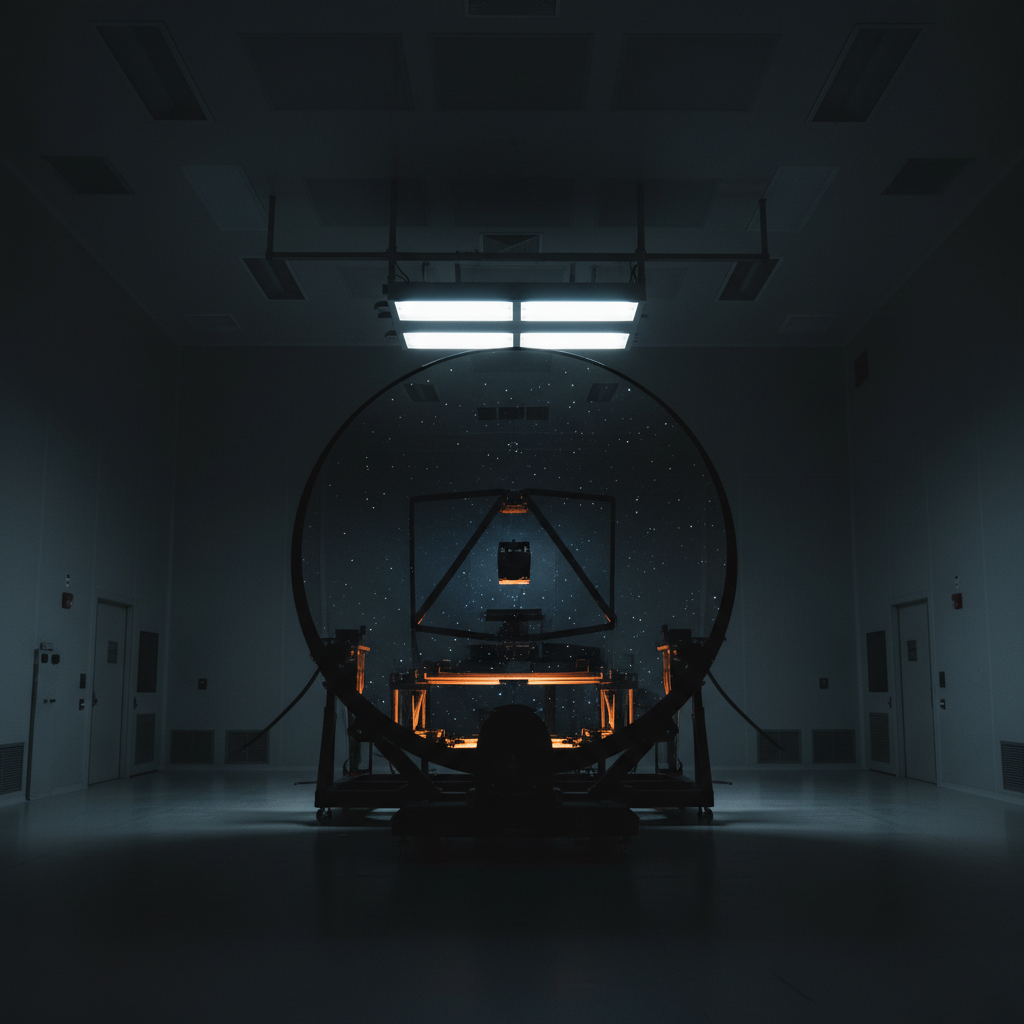
The next set of eyes to examine that surface will belong to the cosmos itself.
The 7.9-foot (2.4-meter) mirror at the heart of NASA's Nancy Grace Roman Space Telescope has cleared its final pre-launch inspection [1]. Engineers conducted a meticulous visual check — deploying a high-resolution camera equipped with a very powerful zoom lens — to confirm no debris had settled on the optics and that the coating and alignment remained intact [1]. The verdict: the mirror passed with flying colors, keeping the mission on track for an early September launch [1].
That coating is worth pausing on. Roman's mirror carries a layer of silver less than 400 nanometers thick — about 200 times thinner than a human hair [1]. The choice of silver is deliberate: it reflects near-infrared light more efficiently than the alternatives [1]. Hubble's mirror is coated with aluminum and magnesium fluoride, optimized for visible and ultraviolet wavelengths [1]. The James Webb Space Telescope's mirrors are gold-coated to suit longer infrared observations [1]. Each telescope is, in effect, tuned to a different frequency of the universe.
The surface precision is harder to picture than to measure. The average bump on Roman's primary mirror stands just 1.2 nanometers tall — more than twice as smooth as the mission requires [1]. Scale that mirror up to the size of Earth, and those bumps would be a quarter of an inch high [1]. This is not engineering as craft; it is engineering as geometry, carried to an almost philosophical extreme.
What makes a telescope more than its glass and metal is the question it is built to answer. Every design decision — material, coating, surface finish — is ultimately a commitment to a set of problems the builders believe matter most.
Roman's primary instrument, the Wide Field Instrument (WFI), is a 300-megapixel infrared camera [2]. Each image it captures will cover a patch of sky larger than the apparent size of a full Moon [2]. Hubble's infrared images, taken with its Wide Field Camera 3, are about 200 times smaller; even Hubble's widest exposures with the Advanced Camera for Surveys are nearly 100 times smaller [2].
The scale implications compound quickly. Over its first five years of observations, Roman will image over 50 times as much sky as Hubble covered in its first 30 years, surveying the sky up to 1,000 times faster than Hubble can while maintaining similar sensitivity and infrared resolution [2]. Scientists will be able to quickly conduct research that could take hundreds of years using other telescopes [2].
The WFI's 18 detectors convert starlight into electrical signals, which are then decoded into high-resolution images of large sky patches [2]. The instrument is designed to detect faint infrared light from across the observable universe — from the outskirts of our solar system to the edge of the observable universe [2]. That range matters because the expansion of the universe stretches light emitted by distant galaxies, shifting visible and ultraviolet wavelengths into infrared by the time the light reaches us [2]. Earth's atmosphere compounds the challenge, blocking some of those infrared wavelengths and glowing brightly enough in the upper layers to overwhelm signals from distant galaxies [2]. Roman, observing from space, sidesteps both problems.
There is something quiet and counterintuitive about the work of seeing farther: the instruments grow larger, the coatings thinner, the tolerances tighter — and the objects being sought become dimmer, older, and more diffuse. Precision and ambition move in opposite directions.
Roman's science targets span the known universe's most stubborn puzzles. A clearer picture of dark energy, the mission team argues, will give scientists a better sense of the universe's past and future evolution [2]. Roman will also use multiple methods to find and study exoplanets both near and far, finding many worlds that other existing telescopes cannot detect, including analogs to nearly every planet in our solar system [2].
The mirror's material is as considered as its coating. It is made from a specialty ultralow-expansion glass that resists flexing when temperatures shift — a critical property for a telescope that must transition from Earth's ambient conditions to the deep freeze of space [1]. If the primary mirror changed shape even slightly after launch, it would distort every image Roman returns [1]. The glass eliminates that variable.
After the inspection, engineers confirmed the optics along the light path to the WFI detector array remained in proper alignment following the observatory's shake test — a simulated launch environment designed to surface any structural vulnerabilities before the real thing [1]. Roman survived it intact. The team is now preparing to ship the observatory to NASA's Kennedy Space Center in Florida in the coming weeks [1].
NASA expects the mission to begin returning data within several months after launch [1]. The WFI will look deep into dusty regions of space, including the star-studded heart of the Milky Way galaxy, unveiling celestial bodies and phenomena that would otherwise be difficult or impossible to find [2]. The Coronagraph Instrument — described by the mission team as a system of masks, prisms, detectors, and even self-flexing mirrors built to block out the glare from distant stars and reveal the planets in orbit around them — has been integrated onto the instrument carrier alongside the WFI [2].
A telescope is, at its core, a promise about what it is still possible to find. The mirror is polished, the coating is set, the alignment holds. The observatory is ready to be shipped. What comes after is not engineering — it is waiting, and then it is knowing.
Roman's mirror spent its final moments on Earth under a protective hood, held in a clean room, inspected by engineers who will not see it again [1]. Whatever it sees next will belong to everyone else.