Saab's Fighter Drone Is Gunning for the High End
Sweden's ACP program puts a stealthy, supersonic loyal wingman on the runway—and positions Saab as a first-mover in a crowded field.
By The Defense Desk
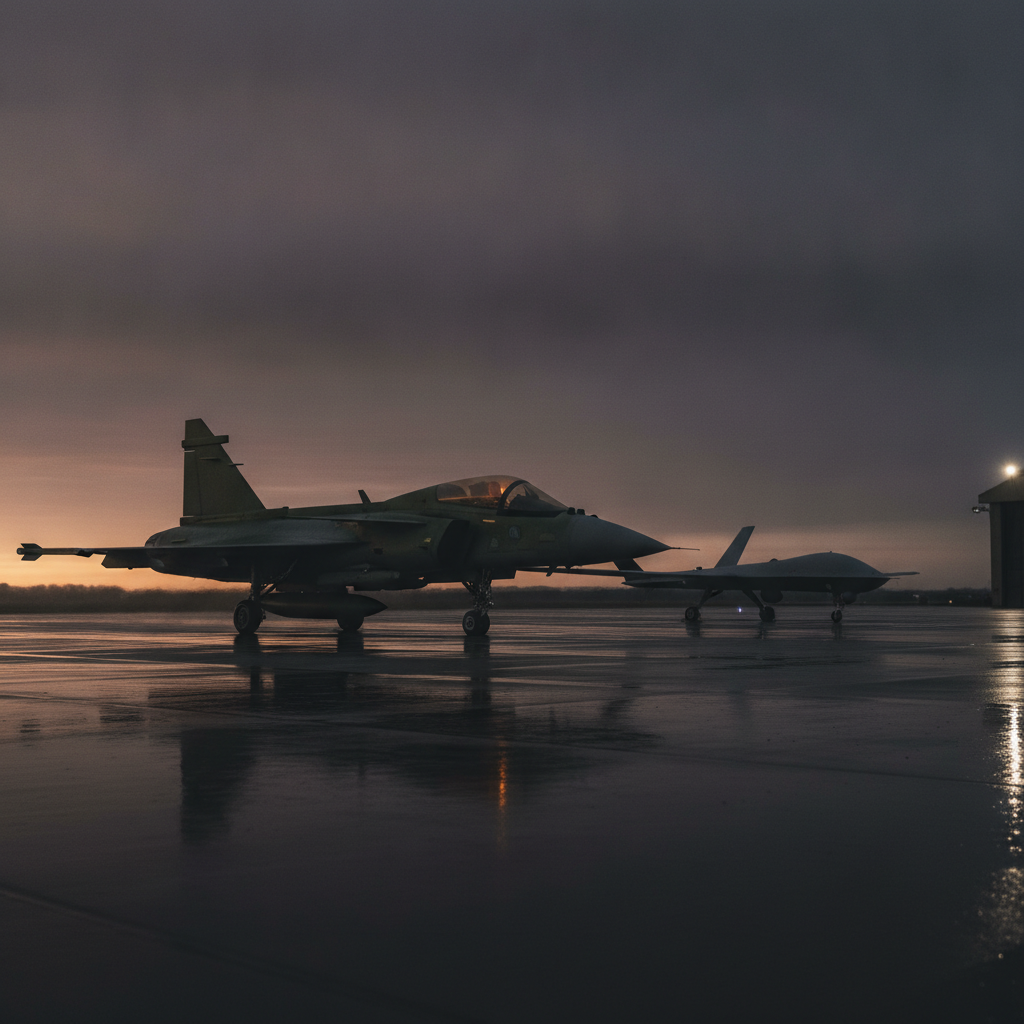
At Malmen Air Base in Sweden, during a ceremony marking the Swedish Air Force's 100th anniversary, Saab unveiled a full-scale mock-up of aircraft A3—a tailless, stealthy, supersonic drone the company says could enter service in the mid-2030s. [1] The program, called the Autonomous Collaborative Platform, or ACP, sits inside Sweden's broader KFS project: Koncept för Framtida Stridsflygplan, or Concept for Future Combat Aircraft. [1]
The A3 mock-up is the showpiece, but the real work is already flying—or nearly so. Saab is developing two uncrewed technology demonstrators, A1 and A2, funded by the Swedish Ministry of Defense. Aircraft A1 is expected to fly within the next 15 months, according to Peter Nilsson, head of Saab's Advanced Programs business unit. [1] The defense ministry asked Saab to 'go from concept to first flight within 36 months,' a timeline Nilsson described as 'quite challenging.' [1]
A1 is powered by the GE Aerospace F414 turbofan—the same engine that powers the Saab Gripen E/F crewed fighter—producing around 22,000 pounds of thrust and ensuring A1 has supersonic performance. [1] Its primary mission is proof of concept: demonstrate that Saab can build and fly a low-observable drone. [1] A1 will have capacity for an internal weapons bay, although it will not be used for stores release tests; A2 will also have an internal weapons bay and will be used to test ordnance, plus evaluation of new materials and sensors. Saab is contracted until 2030 to develop both demonstrators. [1]
[1] Gone from earlier renders is the bulge above the engine nozzle. What remains is a platform designed for 'high-risk missions in heavily defended airspace,' including air-to-air combat, electronic warfare, suppression of enemy air defenses, and deep precision strike. [1]
Compared with the U.S. Air Force's Collaborative Combat Aircraft program, Saab pitches the ACP as a higher-end proposition—more advanced, larger, and with superior performance than the drones currently being test flown in the United States. [1] Saab envisions the Gripen E acting as a tactical mission commander for one or more ACPs, coordinating alongside its GlobalEye airborne early warning and control aircraft. [1] Outside Sweden, the platform could pair with a wide variety of crewed aircraft from other operators.
Cost is a deliberate part of the pitch. [1] Still, Nilsson was candid about the program's dependency on Stockholm: 'if a customer does not come along I don't know when my CEO will stop me spending — you need a customer to buy into this.' [1]
The timeline hinges on Swedish government decisions that have not yet been made. A development contract for the A3 could come around 2030; the aircraft could fly in the early 2030s, leading to initial operational capability from the mid-2030s. [1] The Swedish Air Force is meanwhile weighing whether to pursue a crewed Gripen successor, abandon crewed fighters altogether, or join a foreign sixth-generation program—a decision expected between 2028 and 2030. [1] Brigadier-General Niclas Magnusson, the deputy commander of the Swedish Air Force, said he expected the future force to field both crewed and uncrewed platforms. [1]
What Saab is threading here is a needle familiar to any advanced-programs shop: spend enough on demonstrators to stay credible, while keeping the flagship concept close enough to production reality that a customer can picture signing a check. The ACP is both an insurance policy and an audition.
The ACP architecture also doubles as the conceptual seed for a future crewed Gripen successor, which the Swedish Air Force would require sometime after 2055. Saab says it could begin development of such an aircraft in the mid-2030s if demand materializes. [1]
With the ACP program, Saab hopes to stake its claim as the 'first-mover in the segment' for high-end loyal wingman aircraft. [1] Whether Stockholm funds the next step or not, the A1 and A2 demonstrators give Sweden a way to pressure-test its future air combat options without locking into any one of them. For Saab, the flying is the argument.
We are currently in an intensive development phase where, together with Sweden, we are exploring technologies that will lay the foundation for the next generation of combat air systems.Peter Nilsson