Saildrone and Blue Water Autonomy Sue the Navy Over MUSV Cuts
Two maritime drone makers allege the Navy broke its own rules when it ejected them from a $2.1 billion autonomous-vessel competition.
By The Defense Desk
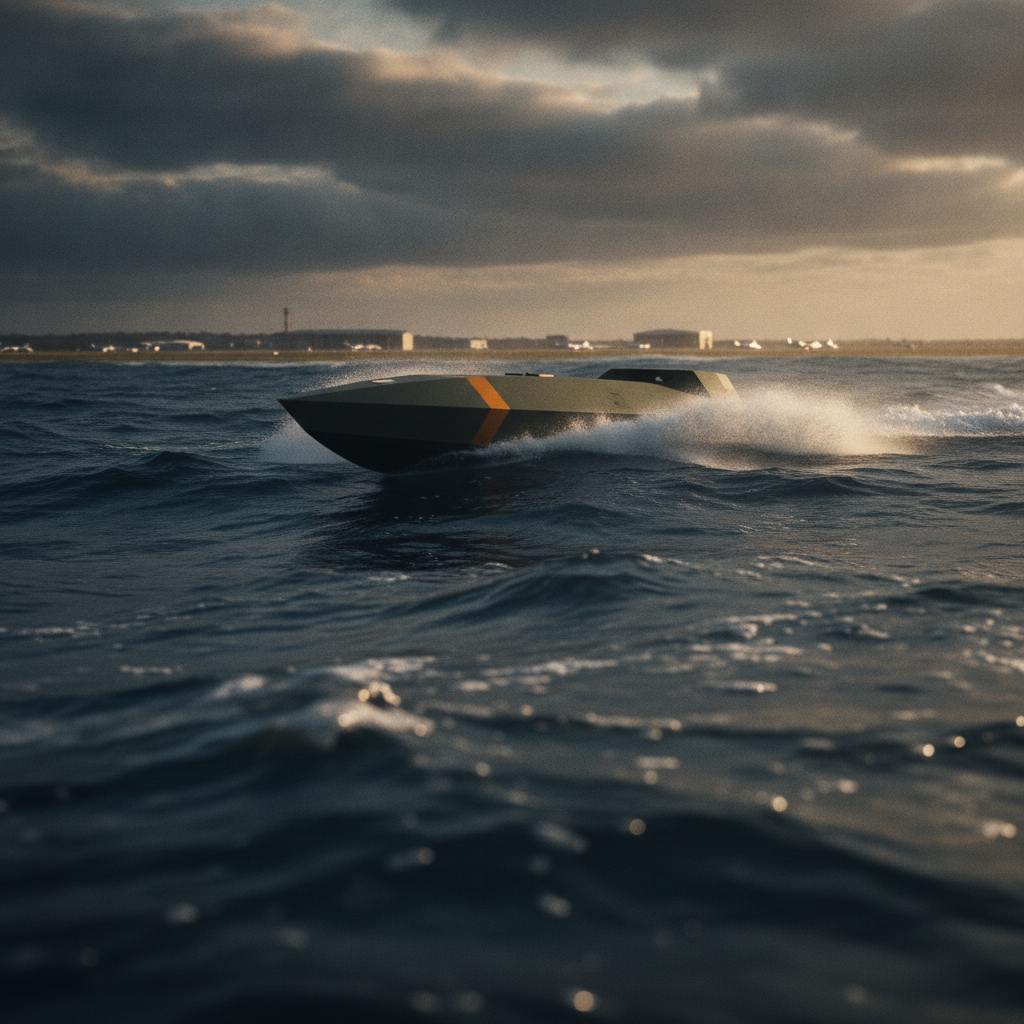
Two maritime drone companies are taking the US Navy to court. Blue Water Autonomy and Saildrone filed separate lawsuits after the Navy rejected their bids for the Medium Unmanned Surface Vessel (MUSV) marketplace — a competition backed by roughly $2.1 billion in federal funding. [1]
The MUSV marketplace launched in March as a replacement for the canceled Modular Attack Surface Craft (MASC) program. According to Navy officials, the service nixed the MASC program because it was more of a "prototyping effort," and the service determined there were enough mature platforms to move into production. [1] Seven firms — including Leidos, Huntington Ingalls Industries, and Saronic — were selected in June to advance to at-sea prototype testing; once testing wraps up, those eligible will receive $15 million and qualify for follow-on production contracts. [1]
Neither Saildrone's Spectre MUSV nor Blue Water Autonomy's Liberty MUSV made the cut. Both companies allege in unsealed complaints that their proposals met every requirement in the Navy's request for proposals issued in March, and that the Navy eliminated them based on conclusions that don't align with the RFP. [1] The funding behind those contracts flows from President Donald Trump's "One Big Beautiful Bill," which passed in July 2025 and earmarked roughly $2.1 billion for MUSVs. [1]
Blue Water's situation carries a particular sting. The Navy had previously "evaluated Blue Water's vessel solution through a multi-stage process and selected Blue Water's solution" under the now-canceled MASC program. [1] Relying on that track record, the company — backed by investors including Google Ventures — made significant financial investments in its design before the Navy switched programs and ultimately excluded it from the replacement competition. [1]
Blue Water is seeking an injunction that would halt the Navy from completing at-sea testing and awarding follow-on production contracts until it reassesses the Liberty MUSV proposal in accordance with the RFP and existing law. [1] The complaint argues the Navy "arbitrarily and prematurely excluded Blue Water from further consideration in the competition" without allowing it to run a surrogate vessel through testing. [1]
Saildrone is asking for something narrower. The company says its Spectre vessel received American Bureau of Shipping certification in December 2025, and that it ordered all long-lead-time components in late 2025 to support fielding in fiscal year 2027. [1] It learned it had been cut not through an official notification but through a public news story — the Navy only confirmed the rejection after Saildrone pressed for details. [1] Saildrone shared a draft complaint with the Department of Justice in June in an attempt to resolve the dispute without litigation; the Navy declined to reevaluate the proposal. [1]
Critically, Saildrone is not asking courts to pause the broader test schedule for other participants — only that the Navy conduct a lawful reevaluation of its own submission and, if found acceptable, permit Saildrone to join the test event without disruption. [1] The at-sea testing phase is expected to wrap up in October. [1]
The suits expose a tension that haunts defense procurement: the faster an acquisition office moves to narrow the field, the more it risks excluding contenders who built real capability in good faith. When the rules of engagement shift mid-competition, private capital that followed those rules has nowhere to go but the courts.
Chief of Naval Operations Adm. Daryl Caudle acknowledged the underlying dysfunction at a CSIS event in March. He said he could "sense the frustration" with the situation, adding: "I get equally frustrated with the number of times we've tried to start doing modules in the Navy." [1] The Navy's standard response to the lawsuits has been silence: a spokesperson told Breaking Defense the service does not comment on pending litigation. [1]
The lawsuits were originally filed at the end of June and unsealed in mid-July, with The New York Times first reporting that Blue Water Autonomy and Saildrone had filed lawsuits against the Navy. [1] With $2.1 billion and the Navy's unmanned surface fleet strategy on the line, the outcome will shape how — and whether — startups bet on Pentagon procurement cycles in the future.